TwinBed.app practical guide
Low Loft vs. High Loft Bed for a Child’s Room
Loft beds are often compared by what fits underneath: bins under a low loft, a desk under a high one. For a child’s room, the more important comparison begins above. How far is the mattress from the floor? How much guardrail remains with the approved mattress? Can the child use the ladder predictably at night? Is there comfortable sitting room below and above? Because “low” and “high” are not standardized categories, two products carrying the same label may differ by many inches. The purchase should be driven by measured geometry and the exact manual. This guide separates the practical advantages of each type from the marketing shorthand and explains when a conventional twin bed may be the better use of space.
Quick answer
A low loft keeps the sleep surface closer to the floor and usually offers limited play or storage space below. A high loft creates more usable vertical room for a desk or seating but demands greater ceiling clearance, more climbing, and stricter planning around fans and fixtures. Choose by exact measurements, manufacturer age rules, the child’s ability, and the room—not by the low or high label.
Define Low and High With Product Measurements
Ignore category labels initially and record the frame’s overall height, mattress-support height, under-bed clearance, footprint, ladder projection, and approved mattress dimensions. A low loft may still place the mattress substantially above a conventional platform. A high loft may use some of its elevation in thick rails and frame members rather than usable desk space.
Compare dimensions using the same reference points. Under-bed height may be measured to the bottom of slats or a lower brace; deck height may mean the support surface or side rail. Consult diagrams or the manufacturer when definitions are unclear. Do not estimate from a staged photograph, where mattress thickness and room scale can be misleading.
- Record support-deck height.
- Record clear height under braces.
- Check ladder projection.
- Use maximum approved mattress thickness.
What a Low Loft Does Well
A low loft can expose floor area for shallow drawers, toy bins, a reading nook, or limited play space while keeping the upper level closer to the floor than a high loft. The shorter climb may be easier for an eligible child, and caregivers may find bedding and nighttime reassurance more manageable. Ceiling clearance is generally less demanding, though it still must be measured.
The space below is not automatically a safe play cave. Guard against hard frame edges, low braces, cords, and objects a child can stack for climbing. Use only curtains, tents, or panels approved for the exact model. Keep structural components visible for inspection and preserve airflow and an easy exit.
What a High Loft Adds
A high loft can create enough vertical space for a desk, chair, shelving, or sitting zone, depending on exact clearance. This can be valuable in a genuinely small room where a separate desk would otherwise block circulation. The elevated mattress also makes the lower area feel more like a distinct zone rather than underbed storage.
The tradeoffs are significant: a longer or steeper climb, harder sheet changes, more distance from the floor, and less room to the ceiling. Fans, lights, windows, and shelves become more reachable. A high loft should solve a present space problem, not be chosen merely because the child may want a desk in several years.
Apply Age and Ability Requirements
CPSC guidance keeps children under six off upper bunk surfaces, and loft makers may specify a higher minimum age or other restrictions. A low loft is still elevated and should not be assumed appropriate for a preschooler because the word low sounds reassuring. Follow the exact product’s age, weight, and use statements.
For an eligible child, observe controlled ladder use, including descent when the next rung is not visible. Consider sleepwalking, coordination, vision, nighttime bathroom trips, and willingness to follow no-play rules. Medical or developmental considerations should be discussed with the child’s clinician. A lower elevation does not convert a loft into an enclosure or therapeutic bed.
Compare Ceiling and Sitting Clearance
Add the approved mattress thickness to the support-deck height and subtract that sum from the lowest ceiling or obstruction above the bed. Compare the remaining space with the sleeper’s seated height and natural movement. Low lofts usually leave more overhead room; high lofts can become cramped under common ceilings.
Measure at the pillow, center, foot, and ladder opening, especially under a slope. Keep the entire elevated bed away from a ceiling fan’s reachable zone. Do not remove guardrails or lower the deck to gain headroom. When the high loft is too tall, a low loft is the direct alternative—not a modified high frame.
Compare the Lower Zone Honestly
Under a low loft, measure whether the child can sit comfortably without striking braces. A floor cushion, bins, or short shelving may work, but tall furniture can block inspection or create climbing access. Avoid placing an ordinary mattress underneath unless the manufacturer designs and approves that configuration.
Under a high loft, test desk height, chair travel, knee room, monitor placement, and lighting. Keep electrical cords out of the ladder route and away from the upper mattress. Do not attach a generic desktop to structural posts. An integrated desk should be assembled with every support and fastener shown in its instructions.
- Map headroom below the lowest brace.
- Preserve access to bolts and supports.
- Keep furniture from becoming a step.
- Manage lighting without hanging cords.
Evaluate Nighttime Access
A low loft’s shorter ladder can reduce the duration of a climb but still requires a clear landing and approved entry opening. A high loft may place the sleeper closer to the ceiling exactly when transferring from ladder to mattress. Measure that movement path, not just the flat sleeping position.
Use lighting that makes rungs visible without exposed cords or glare. Teach facing the ladder and keeping hands free. Do not allow jumping from either height. If the child becomes ill, dizzy, injured, or temporarily unable to climb reliably, use an approved lower sleeping surface until the situation changes.
Consider Adult Work and Emergency Access
Caregivers must make the bed, retrieve dropped objects, check hardware, and reach a child during illness. Low lofts typically simplify these tasks. A high loft may require awkward reaching; never stand on an unapproved chair, desk, or lower brace. Follow the maker’s method for mattress installation and service.
Include the loft in the household fire plan. Maintain alarms as required and ensure the bed does not obstruct devices or escape routes. The child should know the plan without practicing unsafe jumps. An arrangement that blocks quick adult access or pushes the ladder behind a door deserves reconsideration.
Think Beyond the Novelty Period
Children may initially view either loft as play equipment. Establish from the beginning that the mattress, rails, and ladder are for sleeping and access—not jumping, hanging, or fort construction. Do not attach ropes, belts, bags, swings, or unapproved fabric. A simpler frame is easier to inspect and less inviting to modify.
Consider how interests and furniture needs may change. A low loft can later be replaced with a desk without leaving a huge structure in the room. Some high lofts convert, but only documented configurations should be used. Store conversion parts and instructions. Resale claims should never substitute for current fit.
When a Regular Twin Bed Wins
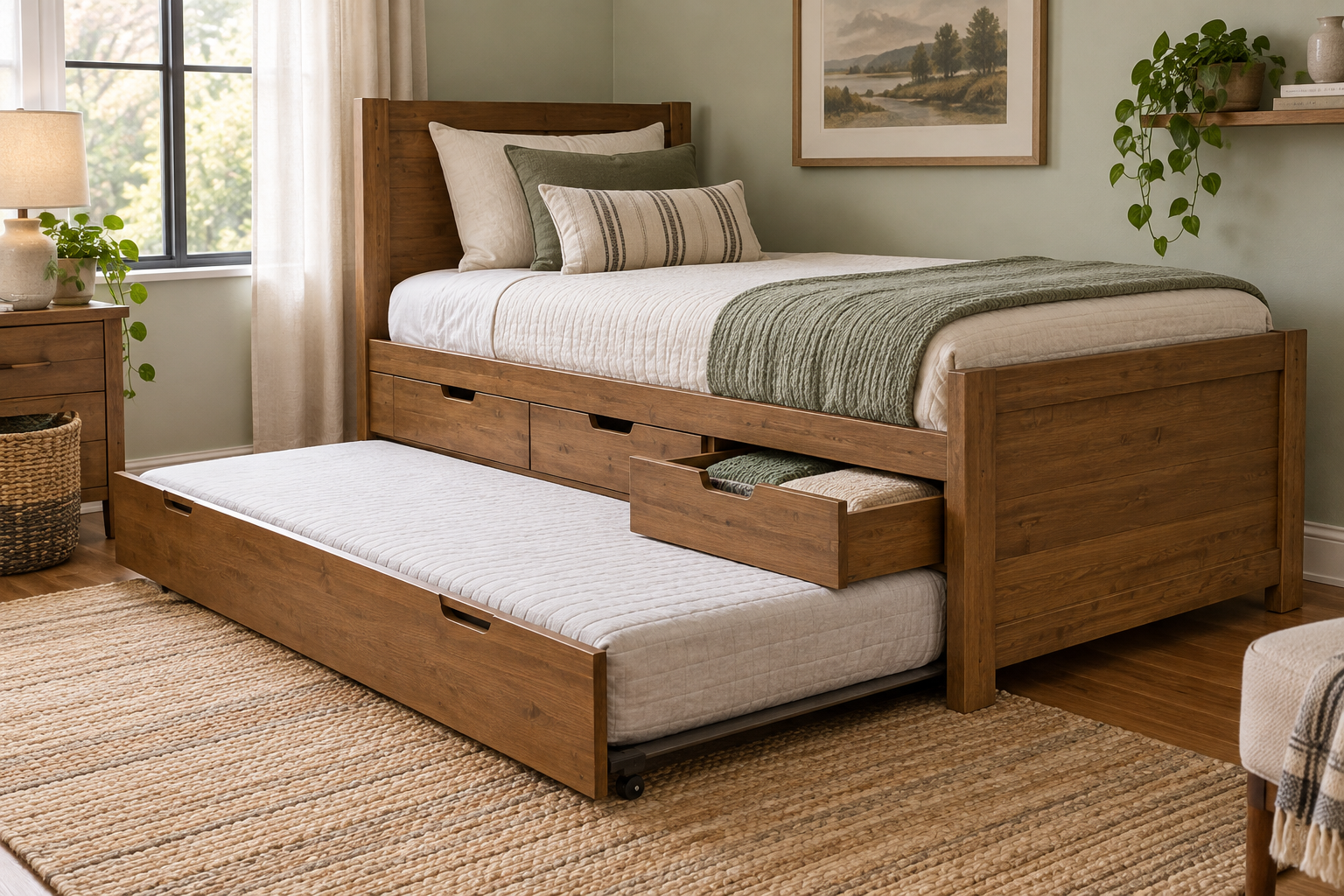
A conventional low platform may offer underbed drawers, easier bedding, simpler nighttime access, and fewer ceiling concerns. In a room with adequate floor space, the vertical complexity of a loft may not deliver enough benefit. Storage furniture can be rearranged as the child grows, while a loft commits the room to a fixed height and ladder.
Choose a loft when its reclaimed floor area has a specific, measured purpose. If the lower space will merely accumulate bins or the desk does not fit comfortably, the elevation is not earning its tradeoffs. A standard twin can be the more efficient choice when daily use and care are included in the calculation. Review that purpose each year as the child grows and room needs change.
Frequently asked questions
Is a low loft bed safe for a five-year-old?
Do not assume so. CPSC upper-bunk guidance excludes children under six, and the loft manufacturer may set stricter limits. Follow the exact age and ability instructions.
How high is a low loft bed?
There is no standardized height. Compare the support-deck, overall, and under-bed dimensions for the exact product instead of relying on the category name.
Can a desk fit under a low loft?
Sometimes, but measure clear height under all braces, desk height, seated headroom, and chair travel. A high loft more commonly provides adult-like desk clearance.
Does a high loft require a special ceiling height?
It requires enough measured space from the approved mattress top to the lowest overhead obstruction for the sleeper’s seated movement. No single room-height rule fits all frames.
Can a high loft be shortened later?
Only if the manufacturer documents an approved lower configuration and supplies the required parts. Do not cut posts, relocate the deck, or omit structural components.
Which loft is easier to make?
A low loft is usually easier for an adult to reach, but frame and rail design matter. Use the manufacturer’s recommended bedding and service method without climbing on unapproved furniture.
Final verdict
A low loft prioritizes easier access and overhead room while reclaiming modest space below. A high loft can support a true desk or seating zone but asks more from the room, sleeper, ladder, and caregiver. Compare exact deck height, under-bed clearance, approved mattress, seated headroom, and access path instead of the product label. If the high option creates tight ceiling clearance or the low option lacks a useful lower purpose, a conventional twin bed may be the more practical answer. Let the measured daily use—not the novelty—make the final choice.
Product examples