TwinBed.app practical guide
How to Buy a Twin Bed Frame and Mattress That Actually Fit Together
A frame and mattress can share the word Twin and still make a poor system. One listing may group Twin and Twin XL variations under the same photos. A platform may have slat gaps that a foam mattress does not permit. A tall hybrid may physically enter a bunk frame while leaving too little guardrail above it. Even a correct standard combination can look wrong when the mattress hides most of the headboard or sits far below a deep rail. Compatibility is therefore a sequence of checks, not a label match. The safest order is size, support, height, load, and room operation—followed by confirmation of the exact variations in the cart.
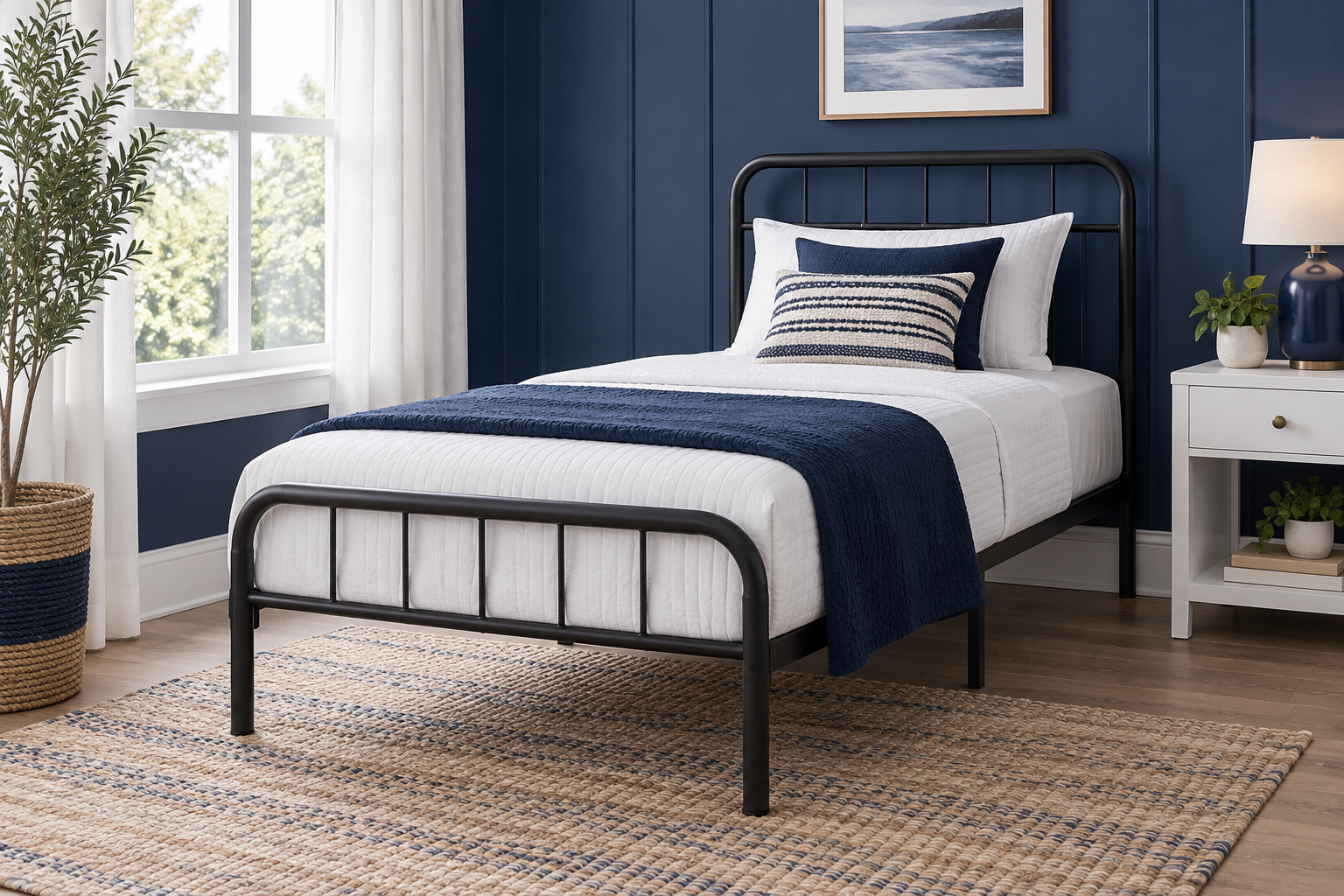
Quick answer
Match the exact size first: standard Twin with Twin and Twin XL with Twin XL. Then verify the frame's interior mattress dimensions, support-deck design, slat-spacing limit, mattress thickness range, and combined load capacity. Special beds add constraints: bunks need guardrail exposure, trundles need closing clearance, and adjustable bases need a flexible compatible mattress.
Lock the size name and dimensions
Standard Twin mattresses are commonly about thirty-eight by seventy-five inches; Twin XL is roughly the same nominal width and eighty inches long. Manufacturing tolerances and rounded listings mean actual dimensions can vary. Use the frame's stated interior mattress area and the mattress's finished dimensions. The opening should hold the mattress without a dangerous gap or forced compression. Decorative outside dimensions are useful for room planning but do not establish mattress fit.
Do not mix Twin and Twin XL. A standard mattress on an XL frame leaves lengthwise space and can shift. An XL mattress will generally overhang or fail to seat in standard rails. Also distinguish products described as twin-over-full, adjustable from Twin to larger sizes, or offered as a Twin option. Grouped marketplaces can retain a family title while the selected variation changes. Read the selected size near the purchase controls and again in the cart.
- Match named size
- Compare interior and finished dimensions
- Separate room footprint from mattress cavity
- Reconfirm the selected variation
Make the support deck satisfy the mattress
A mattress needs continuous or regularly spaced support. Foam can bow into gaps that are wider than its maker permits. Hybrids distribute weight through coils but still rely on a stable deck. Check slat width, spacing, attachment, center rails, and leg requirements. A frame marketed as no box spring needed usually supplies direct support, but that phrase does not prove compatibility with every mattress. The mattress instructions define acceptable support for that product.
If the frame expects a box spring or foundation, verify its size and resulting height as another component. Do not add plywood or a bunkie board automatically. A board can change ventilation, flex, height, and warranty conditions. If one is allowed, it must sit securely without creating sharp edges or reducing rail engagement. Assemble the frame squarely and ensure all legs meet the floor before installing the mattress; an uneven deck can imitate mattress sag.
Calculate mattress thickness as part of the furniture
Measure from the support deck to the top of side rails, headboard panels, footboard, bunk guardrail, or daybed back. Mattress thickness determines how much of each feature remains exposed. A tall mattress can cover upholstery and reduce footboard clearance. A thin one can sit deep inside rails and make sheet changes awkward. Add any topper to the sleep-surface height, because the body and guardrail interact with the top layer, not the mattress label.
Upper bunks impose a true maximum: enough guardrail must remain above the sleep surface according to the bed's instructions. Trundles impose a moving maximum under the main bed, including protector and stored bedding. Daybeds need a deliberate relationship between mattress and side rails. Platforms focus more on finished sitting height. These constraints can eliminate a mattress even when length and width are perfect.
Verify load, edge, and movement compatibility
Frame capacity should be interpreted using the manufacturer's definition and should account for the mattress, sleeper, bedding, and expected use. A heavy hybrid consumes more capacity than a light foam model. Dynamic force from sitting or dropping onto the bed differs from static weight. The frame's center supports and joints must be installed as directed. Do not infer adult occupancy merely from robust-looking metal or a high marketing number.
Adjustable bases require a mattress identified as compatible with articulation. Many foam and pocket-coil hybrids flex, while some traditional coil systems or rigid designs do not. The base's retainer and dimensions must also fit the mattress. Storage-lift beds introduce hinges and moving decks; mattress weight can affect operation. For a conventional frame, check that the mattress edge rests over support rather than bridging beyond the last slat.
- Include every component in load planning
- Respect intended occupancy
- Use articulation-compatible mattresses
- Keep moving mechanisms unobstructed
Fit the assembled pair into the room
Add headboard thickness, rail projections, drawer extension, trundle travel, and ladder angle to the room plan. A mattress measurement alone can understate frame length and width by several inches. Maintain a useful path and access to outlets, closets, and exits. If the bed sits against a wall, allow room to make it without dragging the mattress across sharp hardware. Measure stairs, doors, and turns for rigid frame pieces and plan safe handling of the expanded mattress.
Finished height affects entry and appearance. Add floor-to-deck height, foundation if used, mattress, pad, and topper. Compare that number with a chair the sleeper finds comfortable. Headboard photos may show a different mattress depth than the one selected, so calculate visible headboard rather than copying the styling. If underbed bins are planned, measure clear space between legs and braces, not just vertical clearance.
Use a compatibility worksheet before checkout
Create two columns. For the frame, record selected size, interior area, outside footprint, support type, slat spacing, capacity, deck height, and special limits. For the mattress, record selected size, actual dimensions, weight, thickness, required base, permitted slat spacing, and adjustable compatibility. Compare line by line. Any missing critical specification should prompt a question to the maker or a different product, not an optimistic assumption.
Then add room and accessory data: doorway route, desired surface height, topper, protector, sheet depth, headboard visibility, drawer clearance, and planned sleeper. Save screenshots or documents that identify the selected variations because listings can change. On arrival, inspect pieces before assembly, follow both manuals, and do not force a mattress into rails. A few minutes of documented matching prevents the expensive discovery that two individually appealing products do not operate together.
Frequently asked questions
Will any twin mattress fit any twin frame?
No. Standard sizes are nominal, and frame cavities, slat spacing, mattress dimensions, thickness limits, and support requirements vary. Verify both exact products. Compare the frame's interior opening with the mattress's finished length and width, then check the deck against the mattress maker's base rules. A mattress can fit between the rails yet remain unsupported because gaps are too wide. It can also be structurally compatible but too tall for a guardrail, daybed back, or footboard. Grouped listings make this harder because size and thickness can change while photos remain similar. Save the exact selected variations and ask for missing critical measurements before ordering rather than assuming every product follows one universal Twin template.
Can a Twin mattress fit a Twin XL frame?
It is too short for a proper match and can leave a shifting gap. Pair standard Twin with Twin and Twin XL with Twin XL.
How much gap should be around a twin mattress?
Use the frame maker's intended interior dimensions and safety guidance. The mattress should seat without forced compression and without an unsafe opening. Do not rely on a homemade universal gap allowance.
Does a platform frame need a box spring?
Usually not when it provides direct mattress support, but follow the exact frame and mattress instructions. Adding a foundation changes height and may conflict with the rail design.
Can a thick mattress go on a daybed or bunk?
Only within the stated limits. Bunks need guardrail exposure; daybeds need functional rail height; trundles need closing clearance. Count toppers in the total.
Final verdict
A matching frame and mattress share more than a size word. Their actual dimensions, support rules, height, load, and movement must agree. Build the pairing on paper before buying, then verify selected variations and assemble according to both sets of instructions. Compatibility is what turns two products into one stable bed—and it is much easier to establish before either box is opened. Review tolerances instead of expecting perfect edge-to-edge contact: rounded mattress corners and upholstered rails can create small visual variations, but a large gap, persistent overhang, or mattress that must be bowed into place needs investigation. Photograph the empty support deck, labels, and assembled frame before adding bedding. If support is needed, exact model identifiers and measured gaps produce a clearer answer than saying only that the Twin pieces do not fit. Recheck the pairing after several weeks because foam can finish expanding and hardware or slats can settle. Make sure every slat remains seated, each leg still contacts the floor, and the mattress stays centered during normal entry. If a topper is added later, recalculate surface height, sheet depth, headboard exposure, and any bunk or trundle limit rather than treating it as an unrelated accessory. Keep the frame and mattress manuals together so later owners or guests do not substitute an incompatible foundation. A successful match remains a system through its life, not just on assembly day. Before any future move, label orientation and hardware, then inspect the new floor for level support before assuming the original combination will behave identically in a different room.
Product examples