TwinBed.app practical guide
Twin Bed Buying Checklist: Size, Support, Storage, and Delivery
Twin-bed mistakes rarely come from forgetting the color. They come from measuring the mattress but not the headboard, choosing a trundle without rollout space, assuming no box spring means every foam mattress is supported, or ordering Twin sheets for a Twin XL. A checklist puts dependencies in the right order. It begins with the sleeper and the room, moves through the frame-and-mattress system, and ends with delivery and maintenance. Use it as a worksheet rather than a shopping wish list: if a critical answer is missing, pause the purchase until the specification is clear.
Quick answer
Before buying a twin bed, verify who will sleep there, choose standard Twin or Twin XL, measure the assembled frame and moving features, match the mattress to the support deck, calculate finished height, confirm load and safety limits, map delivery access, and recheck every selected variation. Storage and style come after fit and support.
1. Define the sleeper and the job
Record whether the bed is for a child, teen, adult, guest, or rotating group. Note height, primary sleep position, likely years of use, mobility, heat preference, and whether a pet shares the surface. Decide nightly versus occasional use. A guest daybed, upper bunk, and adult primary bed can all take a Twin mattress but require different comfort depth, edge behavior, and access.
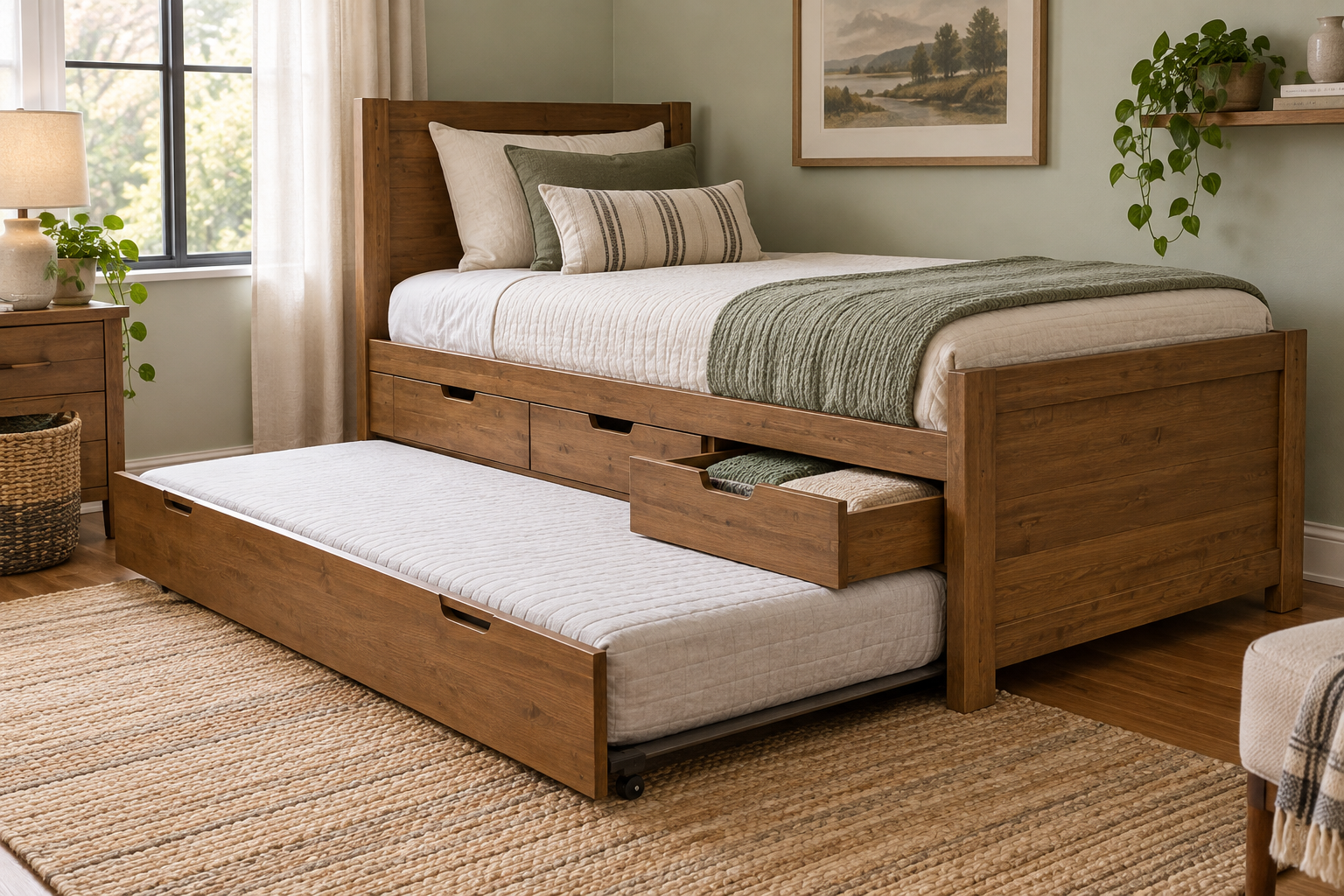
State the room's second function. Does the bed need drawers, a trundle, daytime seating, a desk below, or simply the smallest calm footprint? Rank these needs. A storage headboard plus four drawers plus trundle may sound efficient but can make access and assembly difficult. Select the feature that solves the largest constraint.
- Sleeper height and habits
- Nightly or occasional use
- Expected years
- One primary room function
2. Choose and measure the size
Select standard Twin or Twin XL deliberately. Twin is commonly about thirty-eight by seventy-five inches; Twin XL adds around five inches of length. XL does not add width. Record the exact mattress and frame dimensions rather than treating nominal figures as guarantees. Mark the outside frame footprint on the floor, including headboard and footboard projections.
Measure clear walking routes, door swing, closet access, windows, heaters, outlets, and ceiling height for bunks or lofts. Extend drawers and trundles in the plan. Leave room for a ladder and for changing sheets. If two beds are involved, measure between them as well as around them. Photograph the tape layout for reference while comparing listings.
3. Match support and mattress construction
Record whether the frame uses a solid deck, slats, mesh, or a separate foundation. Compare slat spacing and center support with the mattress instructions. Confirm whether direct platform use, box spring, bunkie board, or adjustable base is allowed. No box spring needed is not a universal compatibility certificate. A foam mattress can sag through excessive gaps; a heavy hybrid can expose weak support.
Choose mattress feel after compatibility. Consider contour versus bounce, firmness, thickness, edge use, airflow, and handling weight. Count any topper in height and comfort planning. For a bunk, obey maximum thickness. For a trundle, measure the smallest closing clearance with bedding. For a daybed, decide how much rail should remain visible. Record the selected mattress weight for capacity and lifting plans.
4. Check structure, capacity, and safety
Verify intended occupancy and the stated capacity definition. Include mattress and bedding, not only body weight. Review center legs, anti-tip anchoring, guardrails, ladder angle, and required wall clearance. Children's bunks and lofts have age and mattress rules that should be followed exactly. Do not improvise rails or modify structural parts merely to fit a preferred mattress.
Read recent instructions if available; marketplace photos may not show every support. Confirm hardware and tools included, assembly space, and whether two people are recommended. In rental housing, understand wall-anchor requirements and floor protection. If the bed has LEDs, outlets, or powered adjustment, plan a safe electrical route without cords crossing walkways or being pinched by moving parts.
- Intended occupant count
- Complete load calculation
- Guardrail and ladder requirements
- Anchoring and electrical route
5. Calculate the finished bed
Add floor-to-deck height, foundation, mattress, pad, and topper. Compare the result with desired sitting height and the sleeper's ability to get in and out. Calculate visible headboard and footboard. Check fitted-sheet pocket depth against the final stack. A tall mattress may make a low frame comfortable for an adult but conceal daybed rails or violate a bunk limit.
Plan bedding and protection as part of the purchase. Match Twin versus Twin XL for protector, sheets, topper, and comforter. Decide between fitted and encasement protection according to exposure. Hot sleepers should consider membrane and fabric breathability. Keep at least one complete spare set for guest or child use when rapid laundering matters.
6. Map delivery and assembly
Measure the narrowest door, stair turn, elevator, hallway, and room entry. Compare those with rigid package dimensions and weights. Boxed mattresses enter compactly but expand and are difficult to recompress. Choose an opening area away from sharp frame hardware and follow expansion instructions. Arrange help for heavy cartons instead of assuming Twin means one-person handling.
Inspect packages and parts before discarding materials. Assemble on a protected floor, sort hardware, and follow the sequence. Tighten progressively so the frame remains square. After placing the mattress, confirm even gaps, stable legs, centered slats, and unobstructed drawers or mechanisms. Retain manuals, model details, spare hardware, and order records.
7. Perform the final cart audit
Read every selected variation beside the buy control: size, color, frame configuration, mattress thickness, and quantity. Grouped listings can show a Twin title while another option is active. Confirm what is included; a styled photo may show a mattress, drawers, bedding, or accessories sold separately. Avoid relying on price as proof of a bundle. Review current delivery, return, trial, and warranty information from the responsible seller or maker.
Complete a one-page record with room measurements, product names, dimensions, support requirements, load, finished height, accessory sizes, delivery plan, and unresolved questions. If an essential number conflicts, stop. If everything aligns, the purchase is based on evidence rather than momentum. After installation, schedule fastener checks and mattress rotation only as the respective instructions allow.
Frequently asked questions
What should I measure before buying a twin bed?
Measure the assembled outside frame, mattress cavity, walking space, doors and stairs, drawer or trundle extension, floor-to-deck height, and any bunk ceiling clearance. Add headboard and footboard projections, ladder angle, center-leg locations, rug thickness, and the narrowest delivery turn. Record the open position of drawers or a trundle, not only their closed footprint. For the sleep stack, total the deck, foundation, mattress, pad, and topper. Compare that height with sitting comfort, visible rails, and guardrail requirements. Measure the intended bins between braces rather than using the advertised underbed height alone. Finally, mark the layout on the floor and operate nearby doors, closets, and chairs inside the outline; static dimensions often miss the conflict created by actual daily movement.
Should I buy the frame or mattress first?
Choose them as a system. Lock the size and room format, then compare frame support requirements with mattress base rules before ordering either. Document both selected variations before checkout.
Do twin platform beds need box springs?
Many do not, but the exact frame and mattress instructions control. Verify deck or slat support and do not add a foundation if rails or height make it unsuitable.
What is the biggest Twin versus Twin XL mistake?
Assuming they are interchangeable. Twin XL is longer, so its frame, mattress, protector, and fitted sheet must match the XL size.
How do I know whether storage drawers will open?
Use the stated extension dimensions or the drawer depth as a planning estimate, then include handles, rugs, nightstands, and walking clearance. Confirm on the exact listing.
Final verdict
A reliable twin-bed purchase follows a strict order: sleeper, size, room, support, height, safety, access, and only then style. Record the specifications and make the frame, mattress, accessories, and space agree. The checklist may slow checkout by a few minutes, but it prevents returns, unsafe workarounds, blocked drawers, and mismatched Twin XL pieces after the boxes arrive. Add a cancellation threshold before shopping. Missing interior dimensions, an unknown bunk thickness limit, unclear adult capacity, or a package that cannot clear the stairs should stop the purchase regardless of a sale timer. Compare at least two candidates on the same worksheet so impressive features do not distract from a critical omission. Include the seller shown for the selected variation, expected package count, carton weights, and where delivery will be left. Plan disposal or reuse of the previous mattress according to local rules before the new box blocks the hallway. On delivery day, photograph damaged packaging before opening, inventory parts against the manual, and avoid discarding materials until the frame is stable and the selected mattress is confirmed. After one week, check bolts, drawer travel, noises, mattress centering, and whether the calculated sitting height works in practice. After the first month, note temperature, edge use, bedding fit, and any support movement. These observations create a maintenance baseline and make a return or service conversation specific. The checklist should remain with the bed rather than disappear after checkout. Record allowed rotation, protector care, fastener intervals, model numbers, and unique spare hardware. When the sleeper grows, a topper is considered, or the frame moves to another room, reopen the document and repeat the affected measurements. Buying carefully is valuable, but maintaining compatibility as the setup changes is what protects the decision over time. Style can be updated with bedding; a mistaken size, unsafe guardrail relationship, or unsupported mattress is far harder to correct.
Product examples