TwinBed.app practical guide
Is a Twin XL Bed Long Enough for a Tall Adult?
Bed-length advice is often reduced to a shopper's height plus a few inches, but real sleep positions are not ruler-straight. A pillow occupies part of the surface, toes extend beyond standing height for some positions, and a tall footboard changes how the edge feels. Twin XL provides an adult-standard 80-inch length within a narrow footprint. To decide whether that is enough, evaluate the sleeper's actual space use rather than treating height as the only measurement.
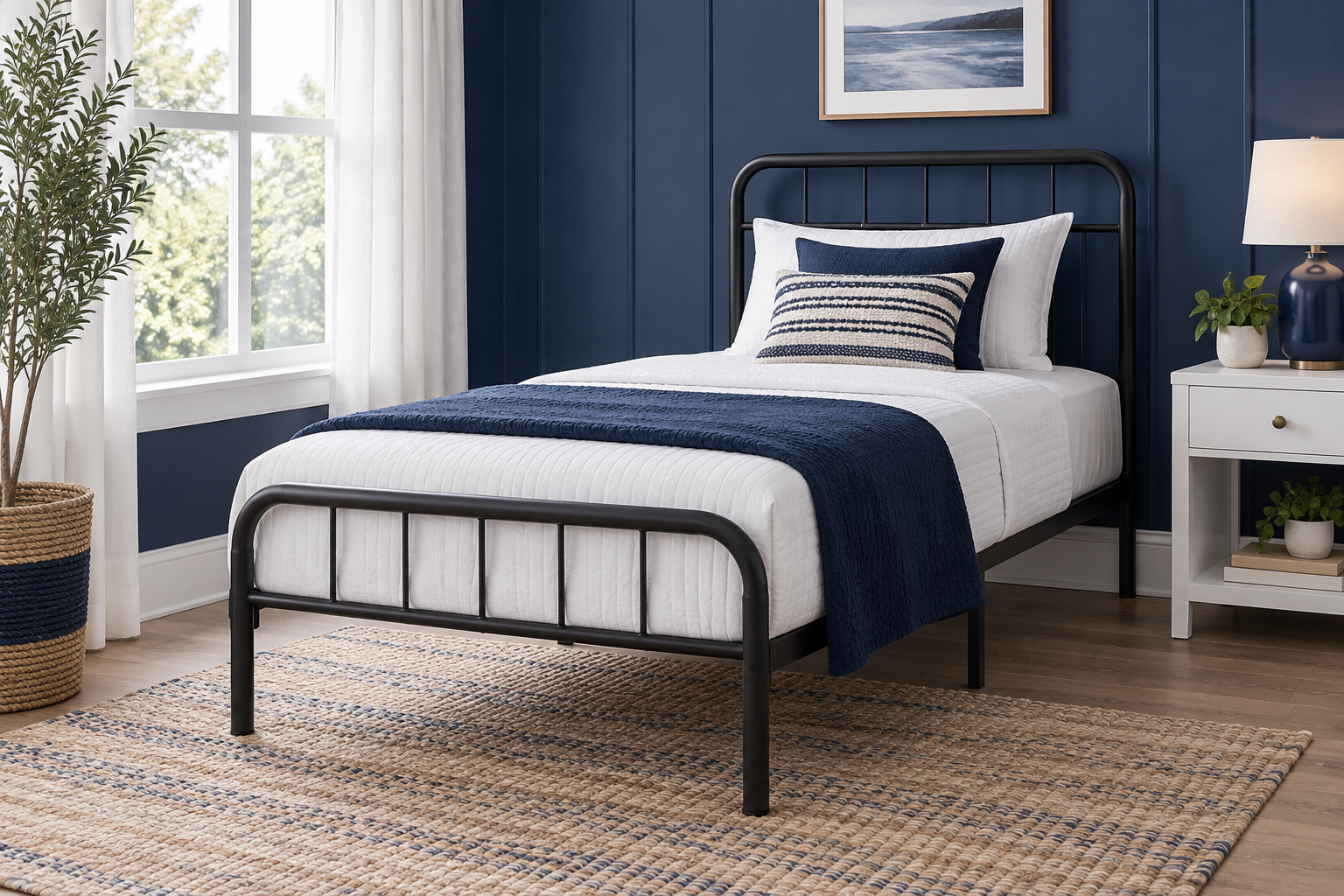
Quick answer
A Twin XL mattress is about 80 inches long, five inches longer than a standard Twin and the same nominal length as most Queen and King mattresses. It can be long enough for many tall adults, but comfort also depends on pillow placement, sleeping posture, body proportions, and whether a footboard reduces usable space. Its 38-inch width is often the more important limitation for an adult.
Eighty inches is adult length, not unlimited length
Twin XL shares its nominal 80-inch length with Queen and standard King mattresses. For many adults, that is a meaningful improvement over the 75 inches offered by a standard Twin. The extra five inches can keep heels on the mattress and provide breathing room between feet and a footboard.
A person's standing height does not translate perfectly into required mattress length. The head is normally placed below the top edge, often on a pillow that shifts the body downward. Back sleepers may point or relax their feet past their stated height, while side sleepers bend at the hips and knees. The useful test is the sleeper's occupied length in a normal sleep posture.
As a practical exercise, lie on an existing mattress with the usual pillow and measure from the head-end edge to the farthest comfortable foot position. Add a small comfort margin. If that total approaches or exceeds 80 inches, Twin XL may still feel constrained even though broad height charts say it should work.
Very tall sleepers who already feel cramped on a Queen will not gain length by switching to Twin XL. They would only lose width. In that situation, California King or another extra-long specialty size may deserve consideration if the room and budget permit.
Width determines whether the bed feels adult-sized
Twin XL is roughly 38 inches wide, exactly the same nominal width as standard Twin. That can work well for a person who sleeps in one position and wants to preserve floor area. It can feel restrictive to a broad-shouldered sleeper or anyone who changes positions often.
Compare occupied shoulder and elbow width while lying down, not standing body width. Back sleepers sometimes rest with elbows angled outward. Side sleepers may bring knees forward. A wall on one side can make the surface feel narrower because only one edge is freely accessible.
Pets, children visiting in the morning, medical equipment, and large pillows all consume usable width. Those habits are easy to overlook when comparing mattress specifications. If they are part of daily life, a Full or Queen may offer a larger comfort improvement than Twin XL.
The narrow format remains valuable in studios, dorms, and multipurpose rooms because it can preserve 16 inches or more of floor width compared with a Full. The decision is a trade between movement on the mattress and movement around it.
Footboards, pillows, and frames can shorten the experience
An open-ended platform lets feet extend slightly beyond the mattress without striking furniture. A high footboard creates a hard boundary at 80 inches. Tall shoppers who are close to the limit should pay particular attention to this design difference.
Thick pillows can shift the shoulders and torso farther down the bed. That does not make the pillow unsuitable, but it changes the usable layout. Testing with the actual pillow stack gives a more accurate answer than lying flat without one.
Some frames recess the mattress inside rails. The mattress remains 80 inches long, yet bulky headboard padding or bedding tucked tightly at both ends can make the surface feel less forgiving. Check interior frame dimensions and product photos for raised borders.
Wall placement matters too. A headboard-free frame pushed against a wall may let pillows disappear into a gap, encouraging the sleeper to move lower. A stable headboard can preserve the top boundary, provided it does not project excessively into the mattress area.
Match the frame and mattress to the adult using them
A tall adult also needs a suitable finished bed height. Very low platforms can be visually clean but may be less convenient for some people to enter and leave. High storage frames create room underneath but can produce a tall surface when paired with a deep mattress. Add the measurements before ordering.
Support requirements deserve equal attention. Verify slat spacing, center support, weight capacity, and whether a foundation is required. These are product-specific questions; size alone says nothing about structural suitability. Follow both the frame and mattress instructions when requirements differ.
For adjustable use, choose a compatible mattress and base. Twin XL is common in adjustable systems, but not every foam or hybrid mattress is designed to articulate and not every decorative frame accepts a moving base. Exact model documentation should guide the pairing.
A quiet, stable frame can matter more to adult satisfaction than an elaborate headboard. Compare construction, support layout, floor protectors, and assembly requirements. Product pages should be read for the exact Twin XL variation because specifications can change between sizes.
Use a real-space trial before committing
If possible, mark a 38-by-80-inch rectangle on an existing bed or floor and place the usual pillow where it would sit. Lie within the boundaries in several normal positions. The exercise is imperfect without a mattress edge, but it makes width and length constraints tangible.
Next, tape the selected frame's overall footprint in the room. Confirm that saving width actually improves something useful: a clear closet path, workable desk chair, storage access, or safer aisle. Space saved has value only when it supports a real room function.
Compare the same sleeper on Full and Queen dimensions if those sizes fit. Full adds substantial width but usually remains 75 inches long, while Queen offers both greater width and an 80-inch length. A tall person choosing Full may trade one problem for another unless an extra-long Full is available.
Finally, check return and trial terms at the retailer and manufacturer level. Mattress comfort cannot be established from dimensions alone. Keep packaging and documentation as directed, and do not assume the bed frame and mattress share the same return policy.
Account for bedding and everyday habits
A tucked top sheet or tightly secured blanket can reduce how free the foot area feels. Tall sleepers who dislike pressure on their toes may prefer looser bedding and an open foot end. The comforter should have sufficient length to cover the sleeper without requiring an aggressive tuck.
Reading in bed changes the occupied length because sitting against stacked pillows moves the hips toward the foot. If the bed will double as a sofa or study spot, test that posture as well as a flat sleeping position. A headboard that supports upright use can be useful, but thick padding consumes a little room.
Morning routines matter too. One long side against a wall saves space, yet it makes sheet changes more difficult and can feel confining. A narrow bed accessible from both sides may feel more usable than a wider bed wedged into a corner.
Treat measurements as a shortlist tool, then evaluate firmness, support, surface feel, and edge behavior separately. Twin XL can provide enough length without providing the sleep experience a particular adult prefers. Size is foundational, not the whole decision.
Couples considering a future split King should test how the two sides meet. Separate Twin XL mattresses can differ in firmness, but their heights should align if the center is meant to feel continuous. Compatible bases, connectors, sheets, and head positioning all influence whether the combined arrangement serves its purpose.
An adult furnishing a rental should also measure stairs and doors. Twin XL is narrow, yet an assembled headboard, rigid foundation, or adjustable base may be hard to turn through a tight landing. Package dimensions and component weights reveal delivery challenges that the mattress footprint alone cannot show.
Frequently asked questions
Is Twin XL longer than a Queen?
No. Both are normally about 80 inches long; Queen is substantially wider.
Can a six-foot adult sleep on Twin XL?
Many can, because 80 inches provides about eight inches beyond standing height, but pillows and sleep position affect the usable margin.
What is the main downside for a tall adult?
The 38-inch width may feel restrictive even when the length is adequate.
Should tall sleepers avoid footboards?
A low or open foot end can feel more forgiving when the sleeper is near the mattress-length limit.
Is a Full longer than Twin XL?
A standard Full is usually 75 inches long, so Twin XL is typically five inches longer but much narrower.
Final verdict
Twin XL gives tall adults a legitimate 80-inch sleep length in a space-efficient format. It works best when the sleeper values length and room circulation more than sprawling width. Test normal posture with the usual pillow, inspect the foot-end design, and compare the room benefit against Full and Queen. That personal fit check is more reliable than a height chart by itself. Include the frame, mattress depth, bedding habits, and delivery route in the decision so the selected sleep system works beyond its length specification and continues to suit ordinary daily routines.
Product examples
Continue comparing on TwinBed.app