TwinBed.app practical guide
Can a Twin Mattress Fit a Twin XL Frame?
This mismatch sounds minor because the mattress is smaller rather than larger. Nothing hangs over the edge, and both sizes share the word Twin. The problem appears at the head or foot: five inches of frame remain uncovered. Depending on the design, that space may expose slats, create a place for bedding to catch, let the mattress slide, or disrupt a headboard and footboard fit. Compatibility therefore depends on more than whether the mattress can be placed on top.
Quick answer
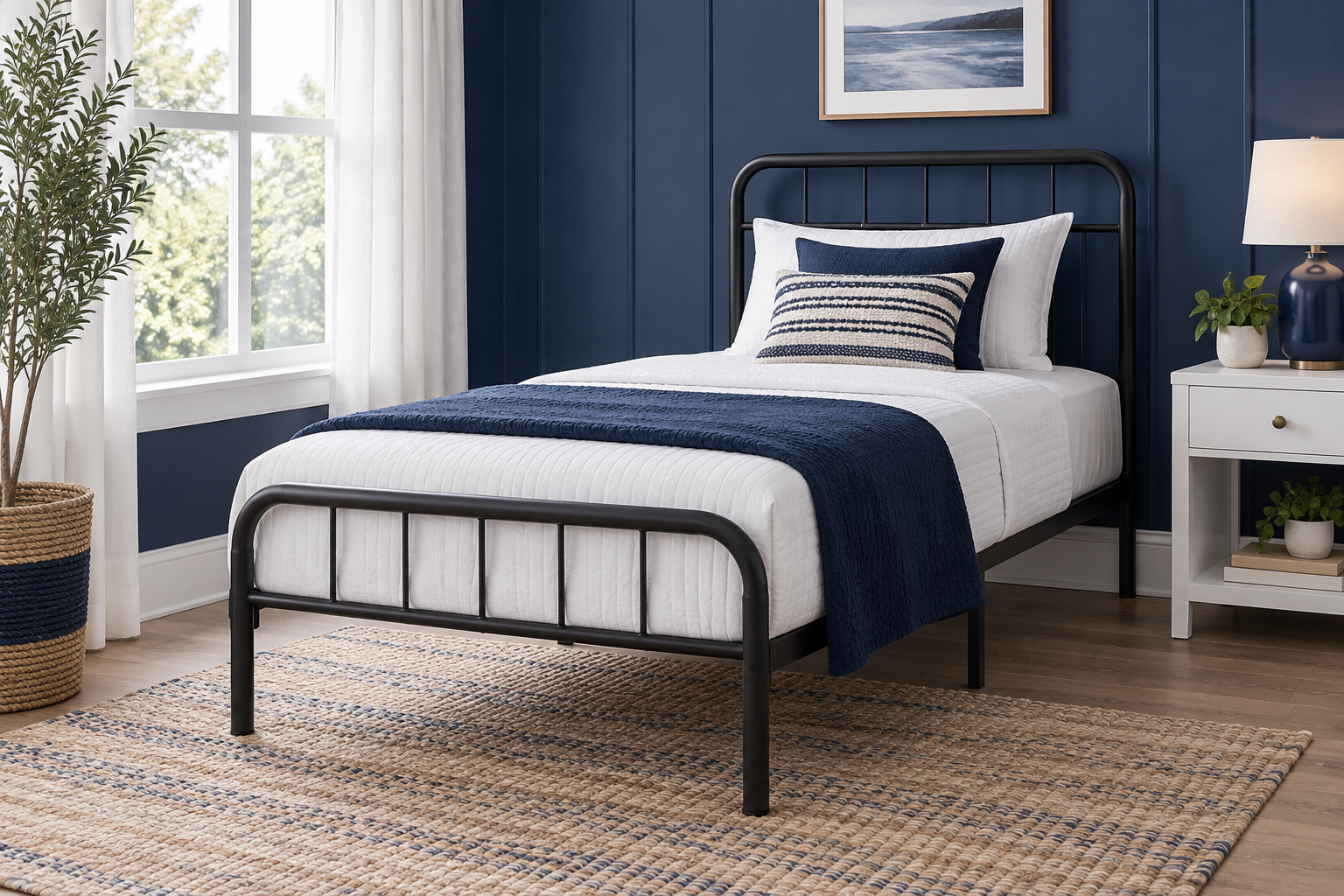
A standard Twin mattress is usually about 38 by 75 inches, while a Twin XL frame is designed for roughly 38 by 80 inches. The widths align, but the mattress leaves about five inches of unused support length. It may rest on some open platforms temporarily, yet the gap can allow movement or expose slats and is not automatically safe. Use the frame maker's approved mattress size whenever possible.
The width matches, but the length does not
Standard Twin and Twin XL mattresses are both nominally about 38 inches wide. Their lengths are approximately 75 and 80 inches, respectively. Placing the shorter mattress on the longer support creates a five-inch difference that must appear somewhere along the length.
If the mattress is pushed against the headboard, the open area collects near the foot. Centering it creates smaller gaps at both ends. Pushing it to the foot shifts the space behind the pillows. None of these positions turns the support into a standard Twin frame; they only relocate the mismatch.
Actual products vary slightly, and a frame's listed outside dimensions do not reveal the interior support length. Use the support deck or inner rail measurement when available. Decorative headboards and posts make the overall frame longer still, but they do not change the mattress target.
Do not assume a thick fitted sheet or comforter can fill the space. Bedding is compressible and not a structural spacer. It can hide the visual gap while leaving the mattress free to move or exposing an edge underneath.
Platform design determines what the gap exposes
On a continuous solid deck, the smaller mattress may have full support under its entire surface, but it can still slide along the extra length. The deck edge or uncovered platform may be visible. Confirm that the manufacturer allows the smaller size before treating full surface support as compatibility.
With spaced slats, the location of the final slat matters. A shorter mattress might end in a position where its edge lacks the support pattern intended by the designer. Slat spacing, center rails, and end stops are part of a complete system and should not be rearranged casually.
Recessed frames can create a five-inch channel that is awkward to clean and easy for small items to enter. Raised rails or footboards also create harder boundaries around the gap. For children or anyone who may sit or step in that area, exposed support components deserve particular caution.
Adjustable bases are not candidates for improvised sizing. Mattress retainers and articulating sections are designed around a specific length. A standard Twin mattress on a Twin XL adjustable base may not bend at intended points or stay located during motion. Follow the base and mattress compatibility documents.
Temporary use should still meet support instructions
A household may want to use an existing Twin mattress while waiting for a Twin XL delivery. Before doing so, ask the frame manufacturer whether standard Twin is an approved size. Review the mattress support requirements as well, including slat spacing and the need for a foundation.
Inspect the exposed area in the planned position. There should be no sharp hardware, unstable slat end, pinch point, or opening that a person could mistake for a supported surface. Keep loose blankets from becoming trapped around mechanical parts or between rails.
Monitor movement each day. If the mattress shifts, corners lift, supports move, or the frame makes new sounds, stop using the pairing until the correct components are installed. A makeshift spacer should not be introduced unless both manufacturers explicitly approve the method.
Warranty and trial terms can depend on using an approved base. Even if the short mattress feels stable, an unapproved support configuration may affect coverage. Written product guidance is more dependable than a visual fit test.
Do not fill the five inches with household objects
Pillows, rolled towels, pool noodles, loose foam, and wood offcuts are sometimes suggested as gap fillers. These items are not engineered mattress restraints. They can compress, migrate, block ventilation, or create an uneven edge, and hard additions can damage covers or contact the sleeper.
Modifying a metal or wood frame by drilling, moving brackets, or shortening rails can weaken it and invalidate instructions. The resulting geometry may look simple but change load paths and fastener engagement. Use a purpose-built standard Twin frame rather than converting furniture without documented approval.
Adding a foundation does not correct length. A Twin foundation remains short on a Twin XL frame, while a Twin XL foundation creates the same five-inch relationship beneath a Twin mattress. Every fitted structural layer should match the intended footprint.
Headboard pillows can visually disguise space at the top but should remain bedding, not safety components. If the mattress slides away from them, the original gap reappears. The cleanest solution is size-matched equipment.
Room planning can explain why the mismatch arose
Sometimes a shopper orders Twin XL furniture for future growth while retaining a child's standard Twin mattress. That plan preserves the option of a longer mattress later, but it creates an interim fit question now. The correct answer depends on explicit frame approval, not the future intention.
In a guest room, spare components are often combined because use is occasional. Frequency does not remove the need for stable support. Guests are less familiar with the furniture and may sit at the exposed foot, making an obvious, properly fitted surface especially important.
A dorm assignment can also create confusion. Most residence halls supply both mattress and frame as a matched set; students generally should not replace or alter the furniture. If a personal mattress is permitted, housing staff should confirm exact dimensions and placement rules.
When floor space is the concern, the Twin XL frame remains roughly five inches longer than a Twin frame regardless of mattress. Using the shorter mattress does not recover that aisle space. Measure the furniture footprint before selecting the longer frame.
A compatibility checklist before assembly
Verify the exact product variation on the listing and carton. Multi-size pages can show Twin dimensions while Twin XL is selected or vice versa. Record the recommended mattress size, interior support dimensions, slat spacing, weight capacity, and foundation requirements.
Compare those specifications with the mattress label and its support instructions. Check whether the frame uses a foot-end retainer, recessed cavity, or moving mechanism. Any one of those features can make a five-inch mismatch more consequential.
If the products are already in the room, do not infer approval from the fact that assembly is possible. Contact the maker with model numbers and ask whether the smaller mattress is supported. Keep the response with purchase records.
When there is no clear approval, choose one matched pair: standard Twin mattress with a standard Twin frame, or Twin XL mattress with a Twin XL frame. That decision protects support geometry, appearance, bedding fit, and future product coverage in one step.
Distinguish a convertible frame from a merely long frame
Some metal frames are intentionally adjustable across several mattress sizes. Their rails lock into documented positions, and their instructions may include both Twin and Twin XL. A product with that feature is different from a fixed Twin XL platform that simply has spare space under a shorter mattress.
If the frame is convertible, use only the labeled position and all hardware required for standard Twin. Confirm that cross arms, glides, and foundation supports move together as instructed. An incomplete conversion can leave supports misaligned even when the outside length looks right.
A decorative platform commonly has fixed slats and side rails, so it should not be called convertible without explicit documentation. Search the manual for approved sizes and model-specific assembly diagrams. Marketing terms such as universal or adjustable can refer to headboard brackets or leg height rather than mattress length.
After conversion, remeasure the support and make sure there is no unused rail projecting into the aisle. Install the correct fitted bedding and inspect stability. Purpose-built adjustability can solve the size issue; visual improvisation cannot.
If the existing Twin mattress will eventually move to another room, compare the cost and usefulness of buying its proper frame now against using a convertible model. A standard frame can remain paired with the mattress, while the Twin XL frame stays ready for its intended longer mattress. That approach avoids repeated disassembly and reduces the chance that hardware disappears between configurations.
When children use the bed, the uncovered frame area deserves additional scrutiny because it can look like a step or seat. Follow age, guard, and mattress requirements for the exact furniture. A gap that an adult considers merely awkward may be approached differently by a child, which strengthens the case for a size-matched setup rather than a temporary-looking compromise.
Photograph the size label on both components before discarding cartons. If a guest later changes the bed or a replacement mattress is ordered years from now, the record prevents the same ambiguity from returning. Include the interior support length, not only the broad Twin XL name, because model revisions and convertible positions can alter the correct setup.
Frequently asked questions
How much space does a Twin mattress leave on a Twin XL frame?
Nominally about five inches of length, because both are approximately 38 inches wide but 75 versus 80 inches long.
Can I center the Twin mattress on the longer frame?
Centering divides the gap between head and foot but does not resolve support, sliding, or manufacturer-approval concerns.
Can a gap filler make the sizes compatible?
Household fillers are not structural restraints and should not replace a manufacturer-approved mattress size.
Is the mismatch acceptable on a solid platform?
A solid deck may support the mattress surface, but movement, exposed deck, and warranty issues remain. Check the frame instructions.
Will Twin XL sheets help a Twin mattress fit?
No. Bedding does not change mattress dimensions or make an unmatched frame mechanically compatible.
Final verdict
A Twin mattress can physically rest on some Twin XL frames, but the shared width hides a five-inch length mismatch. The exposed support area, sliding risk, rail design, and product instructions decide whether temporary use is acceptable. For a durable setup, use a standard Twin mattress on a standard Twin frame or complete the Twin XL frame with the mattress size it was built to hold.
Product examples
Continue comparing on TwinBed.app