TwinBed.app practical guide
Can a Twin XL Mattress Fit a Standard Twin Frame?
Putting a longer mattress on a shorter frame creates a more serious mismatch than leaving a little empty platform. The final five inches of a Twin XL may have no intended support, and an end rail can press into the mattress at the wrong point. Foam is flexible enough to make the setup look possible for a moment, but flexibility is not approval. Proper support protects the mattress shape, the sleeper, and the frame's load design.
Quick answer
A Twin XL mattress is normally about five inches longer than a standard Twin frame is designed to support. Although the widths are similar, the mattress can overhang, lose edge support, shift, or conflict with a footboard. Do not force it into a recessed frame or let it bend over the end. Use a frame or approved support explicitly sized for Twin XL.
Five inches of extra mattress must go somewhere
A standard Twin mattress is nominally about 38 by 75 inches; Twin XL is about 38 by 80 inches. Because the widths align, the mismatch appears entirely along the length. On an open-ended frame, the mattress may project past the support. Inside a headboard-and-footboard design, it may not fit between the rails at all.
Compressing the mattress into a short cavity is not a solution. It can bow foam, stress coils, distort the cover, and push continuously against the frame. A mattress should lie flat on the support system specified by its maker.
Letting all five inches hang beyond the foot is also problematic. The unsupported edge can flex when someone sits there, and repeated loading may affect materials. Even if no one sits at the foot, the design no longer distributes weight as intended.
Splitting the overhang between head and foot does not create more support. It can add two unstable edges and allow the mattress to migrate. The correct comparison is the mattress footprint against the usable support footprint, not the decorative outer dimensions.
Support rules protect more than immediate comfort
Mattress warranties commonly specify acceptable foundations, slat spacing, and center support. A frame that is five inches too short may fail those conditions even if its slats are otherwise strong. Read the mattress documentation for the exact model and keep it with the frame specifications.
Foam mattresses need consistent support so the base does not dip between wide slats or beyond the frame. Hybrid and innerspring designs have their own requirements. Broad material labels do not replace the maker's instructions.
An unsupported end can make fitted sheets harder to install because the mattress flexes as the corner is pulled. It can also let bedding catch around the frame edge. These inconveniences are signals that the surfaces were not designed as a pair.
Weight capacity does not cure dimensional mismatch. A standard Twin frame might be rated for a high load while still being the wrong length. Capacity, size, spacing, and hardware condition are separate compatibility checks.
Footboards and recessed rails can make fitting impossible
A recessed platform surrounds the mattress with raised rails. If its interior cavity is 75 inches long, an 80-inch mattress cannot sit flat without compression or lifting. Do not remove an end rail or leave required hardware out to gain length.
A footboard introduces a fixed vertical barrier. Forcing the Twin XL mattress between headboard and footboard can squeeze the cover and distort corners. Resting it on top of the footboard is unstable and concentrates pressure where the mattress was not designed to bend.
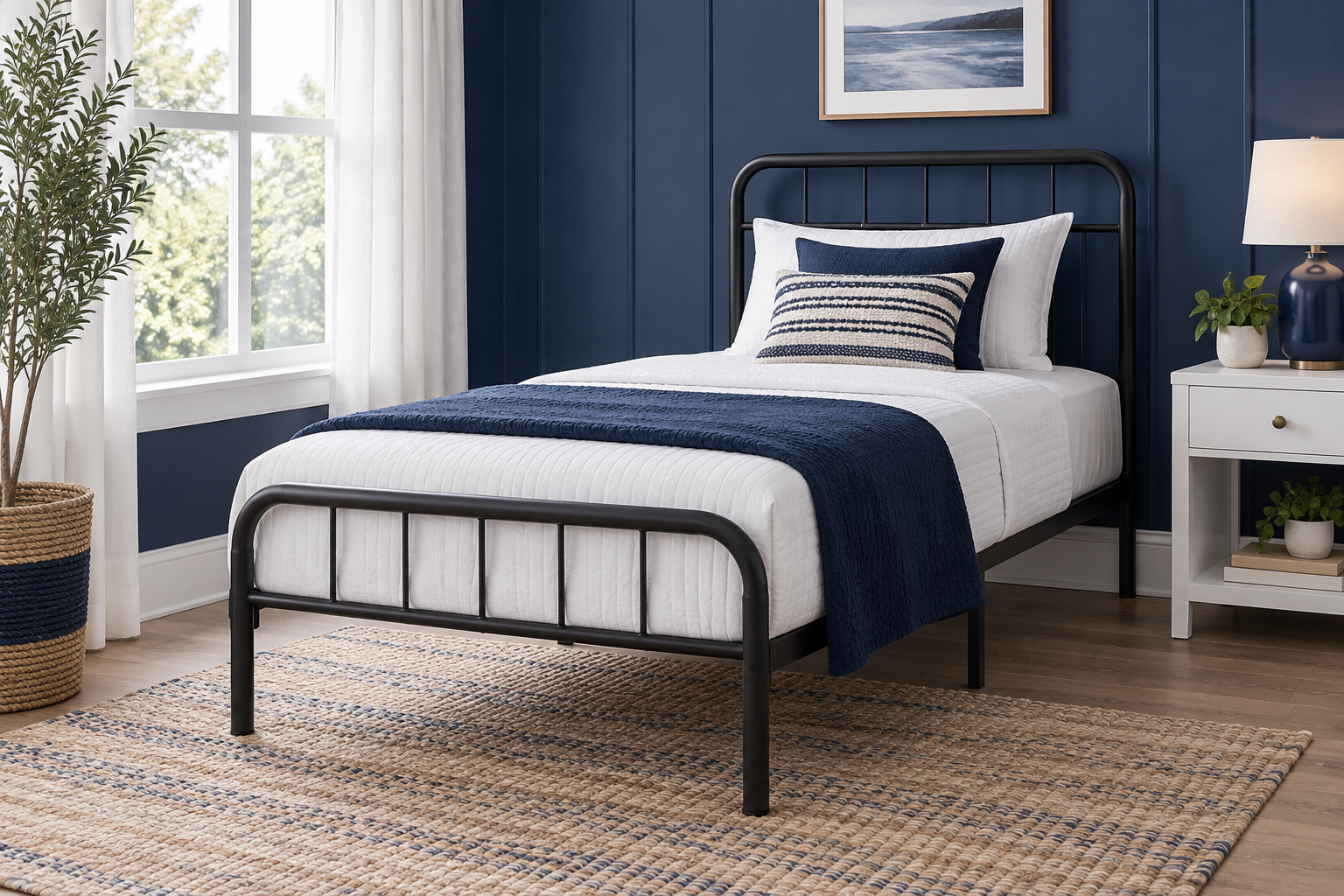
Minimal metal frames may look more permissive because they have no decorative end. Yet the final crossbar or slat still defines the supported area. Measure from the head-end support to the foot-end support and check the size marking.
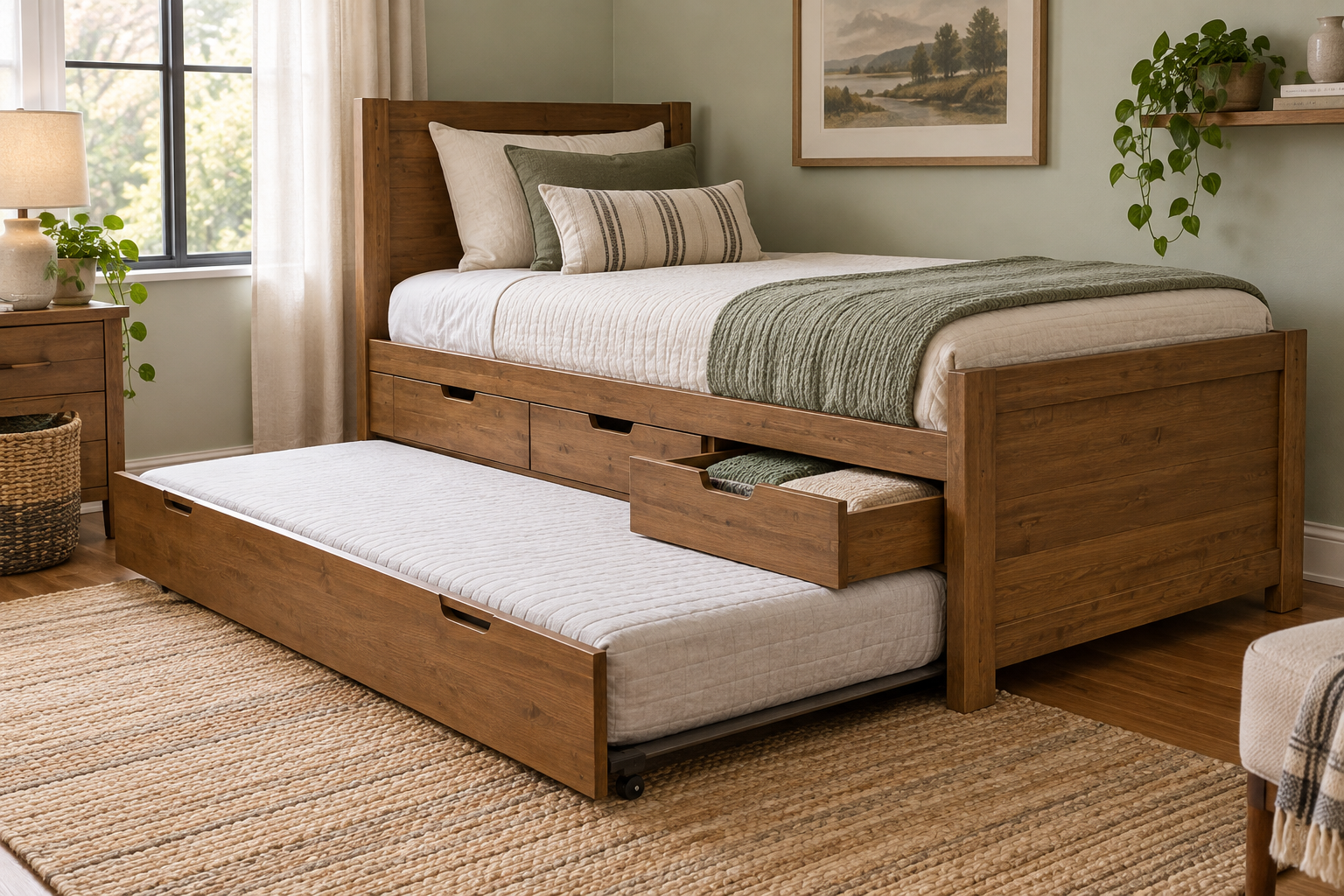
Storage frames add drawer and rail geometry underneath. Moving end components to extend the deck can interfere with drawer operation or structural bracing. Modifications should not be improvised merely because the frame appears simple.
Foundations and boards should not be improvised as extensions
Placing a Twin XL foundation on a shorter Twin frame transfers the overhang problem to the foundation. A bunkie board extending five inches beyond its frame also lacks intended support at that end. Each structural layer should be supported across the footprint defined by its manufacturer.
A loose piece of plywood is not automatically a safe extension. Thickness, attachment, ventilation, edge finish, and the underlying load path all matter. It may tip or flex when weight reaches the overhang. Follow documented conversion hardware if a manufacturer offers it; otherwise use the correct frame.
Bed extenders marketed for certain products are model-specific. A generic reference to extending a bed does not mean it fits every Twin frame or preserves capacity. Verify exact model compatibility and installation instructions.
Do not rely on a nearby bench or storage box to catch the foot of the mattress. Furniture can move independently and create a gap or pinch point. The mattress support should function as one approved system.
What to do when the wrong sizes arrive
Keep the mattress flat on an appropriate temporary surface only if its manufacturer permits that surface and ventilation is adequate. Do not bend or fold it unless the product directions explicitly allow the handling method. Preserve packaging and labels while contacting the seller.
Check order confirmations carefully. Retail pages often group Twin and Twin XL variations, and a single click can change the selected size while photographs remain the same. Compare carton labels, model numbers, and the dimensions in the manual before assembly.
If the frame is already assembled, avoid drilling new holes or discarding components while a return is possible. Photograph the size markings and measure the support deck. Clear evidence helps customer service distinguish a wrong shipment from an assembly issue.
Decide which component better serves the room and sleeper. A tall adult may benefit from keeping Twin XL and exchanging the frame. A child with plenty of length may use standard Twin efficiently, in which case exchanging the mattress can be sensible.
A matched setup still needs a final inspection
Once the Twin XL frame is installed, verify that all slats, fasteners, center legs, and retainers are present. Measure the deck if the size label is unclear. The mattress should rest evenly without being squeezed or hanging over support edges.
Leave any wall or mechanical clearance specified by the frame maker. A longer mattress and frame can bring the foot five inches closer to a door, desk, or walking path than the former Twin. Recheck room operation after the exchange.
Choose Twin XL fitted protectors and sheets. Standard Twin corners will be short even though the width matches. Top blankets may be reusable if their printed length gives adequate coverage.
Observe the bed during the first nights for movement or noise, then retighten hardware only according to the assembly instructions. Correct dimensions create the foundation for a good setup, but proper assembly completes it.
Why a temporary floor setup also needs thought
When the correct frame is delayed, some mattress makers permit short-term use on a clean floor while others specify a foundation and ventilation. A floor is not automatically approved. Moisture can collect beneath a mattress, and lifting a long, flexible mattress for airflow or cleaning can require more than one person.
If floor use is allowed, keep the mattress flat and away from conditions prohibited in the care instructions. Do not place the unsupported end on stacked boxes or books to imitate a frame. Unequal surfaces can create a bend more severe than the original overhang.
Protect the mattress from traffic during the temporary period and preserve a clear exit route. A Twin XL extends five inches farther into the room than a Twin, which can surprise someone accustomed to the old footprint at night.
Arrange the exchange promptly rather than letting a temporary setup become permanent by inertia. Once the matching Twin XL support arrives, inspect the mattress for distortion and allow it to settle flat according to its instructions before completing the bed.
A mattress that has already overhung for some time should be examined along the unsupported end for a persistent bend, cover strain, or internal irregularity. Do not attempt to flatten damage by placing heavy objects on it. Contact the mattress maker for care guidance, especially if the surface does not return to its intended shape on a correct flat support.
The replacement frame also changes the room footprint. Mark the extra five inches before delivery and open nearby doors and drawers. A correct Twin XL frame solves the support problem, but it can reveal a circulation problem if the prior standard Twin ended close to a desk, closet, radiator, or bedroom entrance.
Once the room is reconfigured, verify that the longer bed does not cover a floor vent or force bedding against a heat source. Preserve the walking path at the foot and confirm that storage bins can still be removed. Correct support and practical placement belong to the same final inspection.
Frequently asked questions
How far will Twin XL overhang a Twin frame?
Nominally five inches in total length because Twin XL is about 80 inches long and standard Twin about 75.
Can memory foam bend over the foot temporarily?
It should remain on a support approved by its manufacturer; repeated or prolonged bending can distort the mattress and is not a compatibility solution.
Can plywood extend the Twin frame?
A loose board is not automatically safe or approved. Use the proper Twin XL frame or a documented model-specific conversion.
Are Twin and Twin XL frames the same width?
They target the same nominal mattress width, but their support lengths differ by about five inches.
Should I exchange the mattress or the frame?
Keep the size that best suits the sleeper and room, then match the other component to it exactly.
Final verdict
A Twin XL mattress should not be treated as a flexible extension of a standard Twin setup. Its extra five inches need stable, approved support, not overhang, compression, furniture, or a loose board. Choose which mattress length the sleeper needs, then use the frame designed for that size and verify the entire support system before sleeping on it. If an order mismatch has already occurred, preserve packaging, document both model numbers, and pursue the correct exchange before altering either product. A short delay is preferable to months of unsupported mattress material or a frame modified beyond its instructions. Once matched, check slats, center supports, retainers, and room clearance so the corrected length is supported in practice as well as on the label. Keep the assembly manual with the purchase record.
Product examples
Continue comparing on TwinBed.app