TwinBed.app practical guide
Does a Twin Bed Need Center Support?
Because a twin is narrower than larger beds, shoppers often hear that center support is unnecessary. That statement confuses common design with universal design. A steel grid platform may distribute load through perimeter rails; a wood frame may use a longitudinal beam; an adjustable base contains an entirely different structure. Mattress requirements add another layer: close slat spacing can matter even when the frame itself is strong. The right question is not whether all twins need a middle leg, but how this frame is designed to carry this mattress and sleeper into the floor.
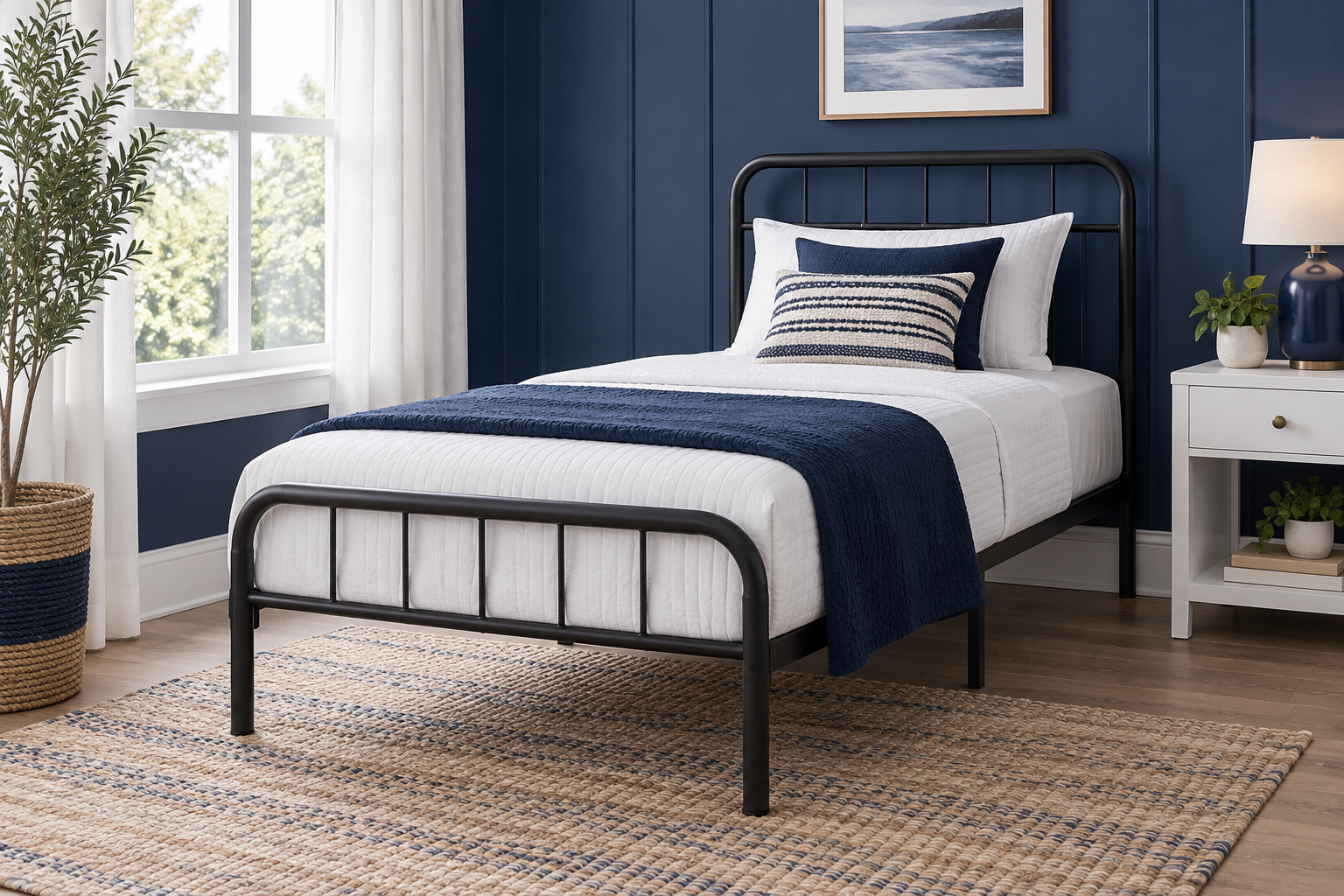
Quick answer
Some twin frames are engineered to span their narrow width without a center rail, while others require a center beam, legs, or additional supports. The frame instructions and mattress base requirements decide. Do not remove specified center parts or add improvised legs that change load paths; verify slat span, spacing, capacity, and floor contact for the exact setup.
Understand the load path
Weight moves from the sleeper through the mattress into slats, mesh, or a deck, then into side rails, beams, legs, and floor. A center rail shortens the unsupported span of slats and can reduce flex. Center legs transfer some load directly to the floor. A rigid welded platform may achieve the same goal with cross-members rather than one visible middle beam. Appearance does not reveal engineering; the parts list and assembled diagram do.
Dynamic loading matters. Sitting on the edge, turning, or a child jumping creates forces different from quiet lying. Capacity statements depend on correct assembly and often include the mattress. A frame that feels firm when empty can flex substantially under combined load. Do not test capacity by overloading it. Inspect specified connections and use the intended mattress support.
Read the frame instructions before applying rules of thumb
Look for a center rail, crossbar, support legs, adjustable feet, and slat straps in the parts diagram. If included, install them even if the bed appears stable without them. A center leg that does not reach the floor may require adjustment, not removal. If the floor is uneven, follow approved leveling guidance. Missing pieces should be replaced with model-specific parts.
Some frames explicitly support Twin without a center leg but require one in Full, Queen, or King variations. Grouped listings can show photographs of a larger size with parts the Twin does not use, or the reverse. Confirm the selected Twin manual and package. Never infer missing hardware from a family photo. Ask the manufacturer when instructions and delivered parts conflict.
- Use the selected-size diagram
- Install every supplied structural part
- Level adjustable supports
- Resolve missing parts before use
Separate frame strength from mattress support spacing
A frame can carry the load yet fail the mattress's slat-spacing requirement. Flexible foam may dip between broad gaps, while a hybrid needs a stable surface beneath its coil unit. Compare maximum permitted gaps, slat width, deck type, and foundation instructions. A center beam does not correct widely spaced slats; it supports their middle while gaps remain between them.
Conversely, a solid foundation can distribute mattress load across a frame that expects that component. Adding a board or foundation changes height, ventilation, and rail engagement and must be permitted. A mattress warranty may specify support independently of the frame warranty. Both sets of rules must be satisfied. When they conflict, the pairing is unsuitable without written product-specific guidance.
Evaluate adult, child, guest, and special-bed use
A nightly adult setup deserves close attention to total load, repeated edge sitting, and long-term slat flex. A child's bed still needs every structural component and must withstand normal approved use; smaller body weight does not authorize incomplete assembly. Guest beds receive fewer cycles but can host a heavier visitor than anticipated. Choose capacity and support for the likely range rather than the lightest regular sleeper.
Bunks and lofts use integrated support systems and must not receive homemade center legs that interfere with lower clearance or structural movement. Trundles need rolling clearance. Storage beds may route load around drawers with engineered rails. Adjustable bases often replace the conventional slat system entirely. In each case, adding a generic beam can obstruct mechanisms or create concentrated stress.
Inspect center components and floor contact
With the mattress removed, examine the beam for cracks, bends, loose brackets, or incomplete seating. Check each support leg vertically and confirm its foot contacts the floor without lifting the frame. A leg adjusted too long can crown the bed and unload perimeter legs; too short allows the beam to flex before engaging. Use a level and the manufacturer's adjustment method.
Floor coverings affect contact. A narrow foot may sink into carpet or catch a rug edge. Use approved cups or load-spreading components rather than scrap wood. Recheck after moving the bed, changing rugs, or placing it on a different floor. New squeaks, a central dip, slats leaving their ledges, or hardware repeatedly loosening can signal support movement and should trigger inspection.
- Inspect beam condition
- Set leg height correctly
- Use approved floor interfaces
- Recheck after relocation
Do not engineer a repair by guesswork
Adding a center beam sounds conservative, but an incorrectly sized member can press against the mattress, force rails outward, block storage, or shift loads into joints not designed for them. Drilling side rails weakens material and can void instructions. A freestanding leg beneath a flexible slat may tip. Structural modifications deserve written maker guidance or evaluation by a qualified furniture professional.
If a frame lacks adequate support for the desired mattress, choose a compatible foundation or frame rather than layering improvised components. Document dimensions, selected size, mattress weight, sleeper needs, slat layout, and photographs when asking for help. The correct solution may be a replacement part, a permitted bunkie board, or a different frame. Safety and durability matter more than preserving a mismatched purchase.
Compare common twin support layouts
A basic metal rail frame may be intended to carry a separate foundation, with cross arms locating that foundation rather than supporting a mattress directly. A platform frame usually supplies slats, mesh, or panels for direct mattress support. A wood bed may use side ledges plus roll-out slats, sometimes with a central longitudinal member. These layouts are not interchangeable. Placing a mattress directly on a rail frame designed for a box foundation leaves large unsupported areas even if a center bar is visible.
Closely spaced side-to-side slats can span a Twin without a longitudinal beam when the frame has been engineered for that span and load. Wider or thinner slats may require a central ledge. Steel platforms may use several small crossbars that collectively distribute force. A buyer should count and measure the supplied components rather than searching only for one obvious center rail. The relevant question is whether the complete deck matches the instructions.
A foundation adds its own internal grid and spreads load into the frame rails. A bunkie board is a thinner support panel or slatted unit, but its construction and permitted uses vary. Neither product automatically increases the frame's structural capacity. If the frame is missing a required leg, placing a board above it does not restore the intended path into the floor. Support layers and structural members solve related but distinct problems.
Storage platforms route forces around drawers, cubbies, or lift mechanisms. Their internal dividers may function as structural supports and must be assembled in the specified locations. Removing a divider to create a larger compartment can weaken the deck. Likewise, a decorative center panel does not prove structural support. Use the parts diagram to distinguish load-bearing pieces from trim.
Monitor deflection without creating a dangerous test
With the mattress removed, sight along slats and rails for existing bowing. Place a straight reference across the unloaded deck without standing or kneeling on unsupported components. After normal use, inspect whether slats have left their pockets, connectors have opened, or the center leg has marked the floor unevenly. These observations reveal movement without deliberately overloading the bed.
A small amount of designed flex can be normal, particularly with sprung slats. The goal is not to make every deck rigid. Concern increases when flex grows over time, becomes asymmetric, allows the mattress to dip between supports, or accompanies cracking and loose hardware. Compare with the manufacturer's description and photographs rather than assuming any visible movement is failure.
If the sleeper notices a central sag, rotate the mattress only when permitted and observe whether the sensation follows the mattress or stays with the frame position. Inspect both systems before drawing a conclusion. Do not sleep on the floor as a long-term diagnostic unless the mattress maker permits that base, because moisture and support conditions change. A short approved comparison can be useful, but product guidance controls.
Keep load information current when the setup changes. A thicker replacement mattress, storage placed on the deck during moving, or a second person sitting regularly can alter demand. Capacity is not a reserve for unplanned occupancy. The center system should be evaluated for the actual mattress and approved sleeper use each time a major component changes.
Frequently asked questions
Do all twin platform beds need a middle leg?
No. Designs vary. Some use rigid cross-members or side-to-side slats without a center leg; others require a beam and legs. Follow the exact Twin assembly manual.
Can I remove the center support to create storage space?
Not when it is a specified structural part. Removal changes the load path and can cause flex or failure. Choose storage containers that fit around supports or a frame engineered for open clearance.
Does a foam twin mattress need center support?
It needs the support surface specified by its maker, including allowable slat gaps and foundation type. Whether a visible center beam is required depends on the frame design.
Why is my center leg not touching the floor?
It may be misadjusted, installed incorrectly, or sitting over an uneven area. Keep the frame unloaded while following the leveling instructions. Do not simply remove the leg.
Can plywood replace center support?
Not automatically. Plywood changes the deck but may not replace structural beams or legs, and it affects ventilation and height. Use it only when both frame and mattress instructions permit it.
Final verdict
A twin's narrow span can simplify support, but it does not erase engineering. Install the exact structure shown for the selected frame, then make sure the deck also meets the mattress requirements. Center beams, cross-members, and foundations solve different parts of the load path. When support is missing or damaged, replace the intended component or choose a compatible system rather than improvising beneath the bed.
Product examples