TwinBed.app practical guide
Pop-Up Trundle vs. Pull-Out Trundle: Which Setup Works Better?
The names describe movement, not quality. A pull-out trundle travels horizontally from under the bed. A pop-up trundle first travels out and then rises on a folding linkage. That second motion changes the user experience: getting in and out, making the bed, aligning two surfaces, and operating the hardware. It does not make the guest bed disappear while occupied. The useful comparison begins with who sleeps there, who opens it, and what the bedroom must continue to do after the lower deck is deployed.
Quick answer
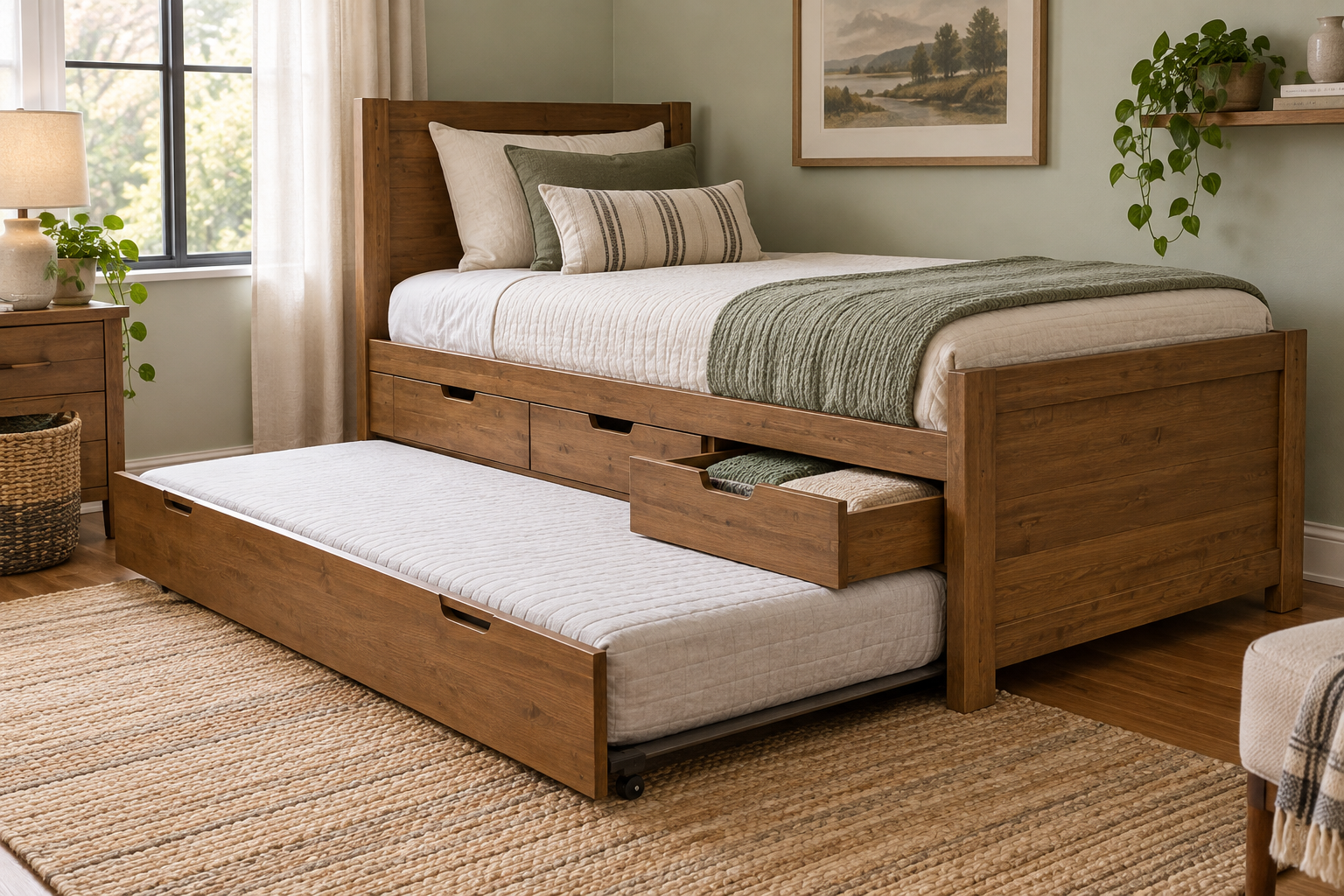
A pull-out trundle is usually simpler: it rolls out and remains close to the floor. A pop-up trundle adds a lifting mechanism that raises the lower mattress nearer the main bed’s height, which may help adult guests or create adjacent surfaces when the frame permits. Both consume similar floor area when open, and both require model-specific mattress, capacity, and operating checks.
Final Sleeping Height Is the Biggest Difference
A standard pull-out remains near floor level. Children may find that easy to use, and the low position creates less visual bulk. Adults with knee, hip, balance, or mobility limitations may find the rise from a low mattress uncomfortable. The user also feels closer to floor drafts, pets, and dust, so cleaning and bedding care deserve attention.
A pop-up brings the lower deck closer to conventional bed height. That can make entry and bed-making easier, but final height depends on the frame, mattress, and locking position. Do not assume it aligns exactly with the main mattress. If the intent is to place both surfaces together, verify that the manufacturer supports that setup and compare finished heights after approved mattresses are installed.
Two standard twin mattresses side by side approximate a king’s width but remain about five inches shorter than a standard king. A gap, differing firmness, and independent movement still remain. A connector or topper should be used only if compatible with the beds and never allowed to interfere with pop-up locks or stated mattress limits.
Mechanical Simplicity Favors the Pull-Out
A basic pull-out uses casters, glides, or wheels and a fixed support deck. There are fewer steps between closed and ready. Maintenance generally focuses on wheel attachment, frame alignment, fasteners, and a clear floor. It can still bind on thick carpet, rug edges, or uneven flooring, and a loaded deck may be difficult to pull if the operator has limited grip.
A pop-up adds hinges, linkage, springs or other assisted hardware, and locks. The exact design matters. Users must know where to place hands, how to raise both ends evenly, and how to confirm the deck is secure. Fingers and bedding must stay clear of moving joints. Never raise or lower it by jumping, sitting, or forcing one corner.
More hardware is not automatically unreliable, but it demands more disciplined operation. Review the manual before purchase if available. If the person expected to open the bed cannot confidently perform the prescribed motion, the height benefit may not be worth the mechanism.
Open Floor Space Is Nearly the Same Problem
Both types need a mattress-sized zone beside or beyond the main bed. The pop-up also needs room for the lifting action and a person positioned safely around it. Measure the exterior of the lower deck, not only the mattress, and preserve space to step backward while pulling. The bedroom door, closet, desk chair, nightstand, and luggage must all work around the expanded layout.
Vertical conflicts are more relevant to a pop-up. A window sill, floating shelf, low table, or projecting main-bed rail can interfere as the deck rises. A pull-out’s low profile may slide beneath some furniture projections, but furniture must never hang above the sleeper in an unsafe way. Map the final occupied zone as well as the travel path.
Flooring affects both. Small wheels may sink in carpet; transitions can skew the frame; grit can mark hard floors. Use the surface conditions permitted by the instructions. If the room requires a loose rug, place it completely outside the wheel route rather than expecting the loaded deck to cross a raised edge.
Mattress Limits Can Change the Decision
Closed clearance usually imposes a maximum lower-mattress thickness regardless of trundle type. Pop-up hardware may also reduce usable space beneath the main bed. Verify supported length, width, thickness, foundation requirements, and combined mattress-plus-sleeper capacity. Include fitted bedding in the closed-height check.
If the raised goal is a level adjacent surface, compare the permitted lower mattress with the upper mattress rather than buying two thick models by instinct. A lower deck may need a shallower mattress to close, leaving a height difference when raised. Some designs account for that; others do not promise perfect alignment. Current diagrams and instructions are the authority.
A pull-out used independently does not need to match the upper mattress feel or height. That freedom can simplify shopping, provided the low platform supports the chosen construction. Ventilate and inspect either mattress regularly because it spends storage time in a confined, low position.
Guest Type and Frequency Point to the Better Setup
For children’s occasional sleepovers, a fixed low pull-out often provides the straightforward routine families expect. It has no lift step and clearly remains a separate sleep surface. Supervision and product age guidance still apply, and the rolling platform should never be used as a toy.
For recurring adult guests, a pop-up may be easier to enter and may simplify sitting at the edge, assuming the guest weight, mattress, and frame limits are suitable. The household must be comfortable operating and inspecting it. A conventional guest bed may be better than either if visitors stay for long periods or have substantial mobility needs.
Frequency changes the maintenance calculation. Hardware that opens weekly should be easy to inspect and operate; a trundle opened twice a year still needs a practice run before guests arrive. Bedding storage, floor cleaning, and a destination for displaced furniture are necessary for both.
Consider how the arrangement affects privacy and sound. A raised guest lies closer to the main sleeper’s level, which may make conversation easier but can make two bedtimes feel less separate. A low pull-out visually distinguishes the guest zone yet places that person closer to footsteps and floor noise. Neither outcome is inherently better; it should match the ages, relationship, and habits of the people sharing the room.
Room temperature may differ near the floor, especially beside an exterior wall or vent. Test the lower position at night before assigning it routinely, but do not block heating or cooling equipment with bedding. A pop-up changes height, not the room’s ventilation plan. Appropriate sleepwear and removable bedding layers are safer tools than relocating portable heaters into a crowded expanded layout.
Read Product Names as Starting Points, Not Proof
Catalog entries such as the ZINUS Suzanne Bamboo and Metal Daybed with Trundle and Harper & Bright Designs Twin Captain’s Bed with Trundle confirm that a lower guest deck is part of the configuration, but the word trundle alone does not establish whether a mechanism pops up. Inspect current images, dimensional drawings, and manuals for the exact lower-deck action. Retail listings can change by size or variation.
A complex configuration such as the Shintenchi Twin-over-Full Bunk Bed with Trundle requires additional checks beyond mechanism type: ceiling clearance, bunk safety, guardrail and mattress guidance, multiple sleeper capacity, and an unobstructed expanded path. A pop-up feature would not erase those constraints; a low pull-out would not make them irrelevant.
Create a comparison sheet for the exact finalists. Record closed height, open exterior dimensions, lower mattress limit, support type, total capacity, wheel surface guidance, operating steps, and whether the platform locks. The setup that works better is the one the household can deploy correctly in the available room.
- Choose low pull-out simplicity when floor-level sleeping suits the guest.
- Consider pop-up height when entry and sitting height matter.
- Do not assume adjacent mattresses will align or form a standard king.
- Verify mechanism type and limits for the exact size variation.
- Rehearse the full open, raise, lock, lower, and close sequence.
Frequently asked questions
Does every trundle bed pop up?
No. Many simply roll out and remain near the floor. Confirm the mechanism in the exact product documentation.
Can a pop-up trundle make a king bed?
Two standard twins approximate king width but are shorter than a standard king. Alignment, locking, and manufacturer-approved use must also be verified.
Are pop-up trundles harder to open?
They require an additional lifting and locking step. Whether that is difficult depends on the design and operator, so review the specified procedure rather than generalizing.
Which trundle is safer for children?
Safety depends on the exact frame, age guidance, correct mattress, assembly, supervision, and operation. A simpler mechanism reduces steps but is not automatically child-safe.
Do both types use thin mattresses?
They often have thickness limits because the lower deck must close beneath the main bed. The permitted measurement is model-specific for either type.
Final verdict
Choose by the final bed height and the household’s ability to operate the mechanism. A pull-out offers a direct, low sleeping surface; a pop-up exchanges mechanical simplicity for a raised position. Neither reduces the open footprint, and neither should be selected without exact mattress and capacity limits. The better setup is the one that can be opened safely, occupied comfortably, and closed without forcing hardware or rearranging the entire room.
Product examples