TwinBed.app practical guide
What Mattress Size Fits Under a Twin Trundle Bed?
The top bed’s size does not settle the lower mattress choice. A twin frame can hide a twin trundle, a shorter proprietary platform, or a drawer-like deck with a strict low-profile mattress limit. The mattress must fit in three dimensions: length and width on the deck, plus thickness beneath the upper rails when the trundle is closed and made up. Bedding, handles, casters, and pop-up hardware can steal additional space. Verify the exact model before selecting comfort layers.
Quick answer
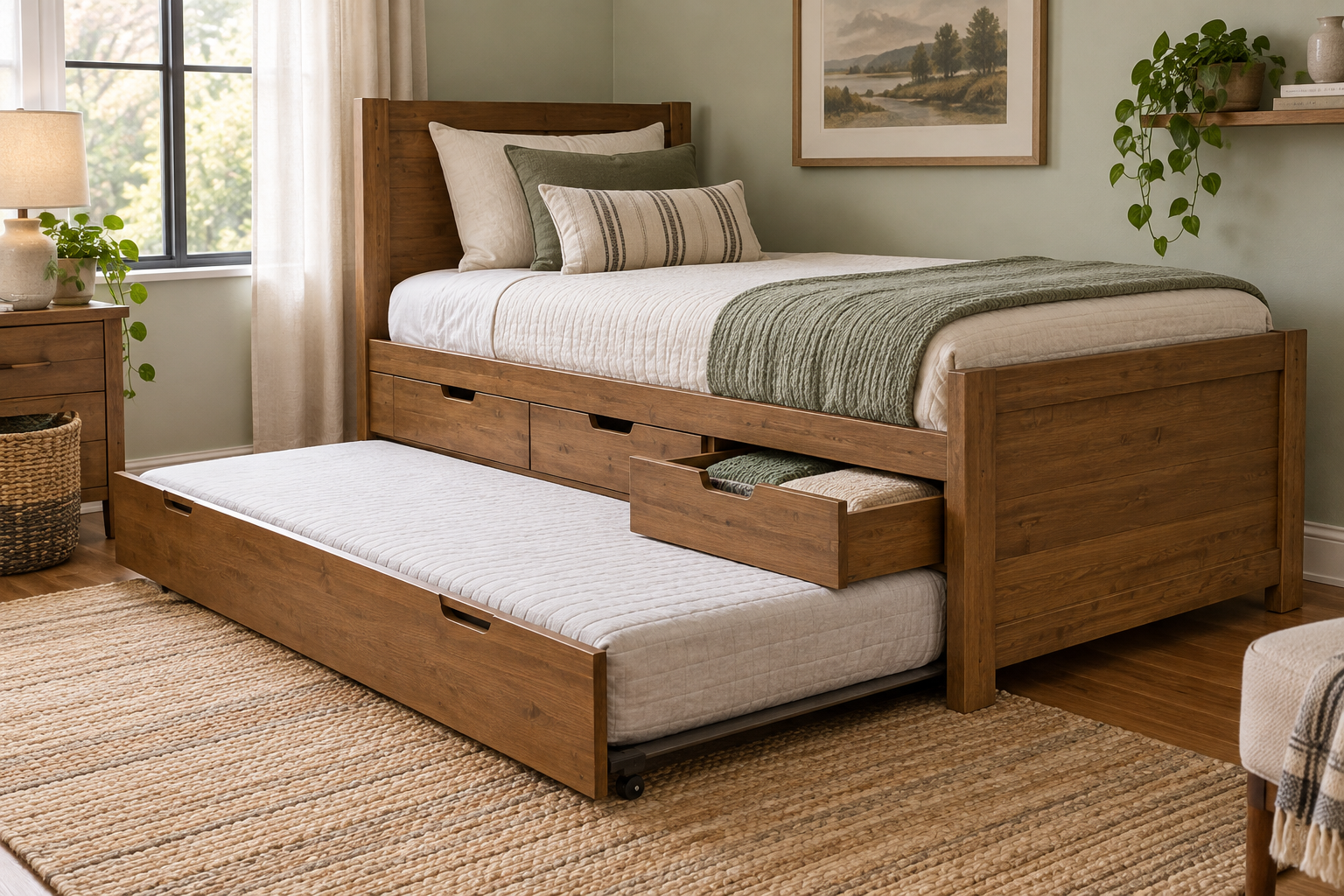
Most trundles beneath a twin daybed or twin bed are designed for a standard twin mattress, approximately 38 by 75 inches, but the required dimensions and maximum thickness are model-specific. Measure the trundle deck and closed vertical cavity, then follow the manufacturer’s mattress-size and thickness limits. Twin XL usually will not fit a standard twin trundle.
Standard Twin Is Common, Not Guaranteed
A standard U.S. twin mattress is generally about 38 inches wide and 75 inches long. Many twin trundles are built around that footprint. Twin XL is typically the same width but five inches longer, so it normally cannot close beneath a standard twin bed. Some imported, antique, or compact frames use nonstandard decks. A product title saying ‘twin trundle’ may describe the main bed, the lower deck, or both.
Read the dimension drawing and assembly manual for the lower sleep surface. Look for the supported mattress length and width, not just the trundle’s exterior. Rails or corner brackets can make the usable deck smaller than the overall rolling unit. If the listing is unclear, obtain written confirmation before buying a mattress that may be difficult to return after expansion.
Thickness Is Usually the Limiting Dimension
The lower mattress must pass beneath the main bed’s lowest obstruction. Measure from the trundle support surface to the underside of the upper frame, then subtract room for sheets, a protector, slight mattress expansion, and easy rolling. Follow the stated maximum thickness even if a thicker mattress appears to squeeze in. Compression against rails can damage bedding, prevent closure, or create unsafe friction.
Low-profile mattresses are common for trundles. A six-inch model, such as the LIFERECORD 6-Inch Twin Gel Memory Foam Mattress, may be worth comparing when a frame allows that exact size, but its name alone does not establish compatibility. Foam and hybrid mattresses can measure differently after expansion, and bedding adds height. Verify current specifications for both mattress and frame.
Pull-Out and Pop-Up Trundles Need Different Checks
A pull-out trundle stays near floor height. Its mattress choice is dominated by closed clearance and support spacing. A pop-up trundle lifts to the main bed’s height, adding hinge and linkage considerations. When raised, the two surfaces may be intended as separate twins or positioned together. Matching mattress thicknesses can improve surface alignment, but the frame maker’s limits still take priority.
Do not assume two adjacent twins form a conventional king unless the lengths and final positions correspond. Two standard twins together match a king’s approximate width but remain five inches shorter than a standard king. If the goal is a combined sleep surface, confirm whether the pop-up frame locks level and whether the manufacturer supports that arrangement.
Support Compatibility Matters
Inspect the lower deck: slats, metal grid, link springs, or solid panel. The mattress maker may specify maximum slat gaps or require a particular foundation. A thin foam mattress can sag between widely spaced supports; a heavy hybrid may exceed a lightweight trundle’s limit or become hard to roll. Use the lower deck’s stated capacity for the mattress plus sleeper, not the sleeper alone.
Ventilation matters because the lower mattress spends time close to the floor and beneath another bed. Pull it out periodically, allow bedding to dry, and clean below it. Never add an unapproved board merely to change support; it can affect airflow, height, and frame behavior. Use components permitted by both manufacturers.
Plan for Bedding and Real Use
A fitted sheet and slim protector may stay on the trundle if clearance allows. A comforter usually needs separate storage because it adds bulk and can catch in casters. Keep a dedicated bedding bundle in a nearby drawer or closet so setup remains quick. Before guests arrive, pull out the trundle and let a compressed mattress recover according to its instructions.
For children, follow all age, guardrail, mattress-thickness, and safety guidance for the complete bed. A trundle is not a bunk, but gaps, rolling components, and low height still require supervision and an uncluttered path. For adults, confirm both dimensions and weight support; ‘twin’ describes area, not structural capacity or comfort.
Evaluate Comfort Within a Low-Profile Limit
Once dimensions are fixed, compare mattress construction rather than chasing height. Foam feel depends on density, layer design, firmness, and the support below it; a hybrid adds coils but may be too tall or heavy for some trundles. A six-inch mattress is not automatically firm, soft, durable, or child-specific. Use the manufacturer’s stated construction, sleeper guidance, trial terms, and foundation requirements. Avoid claims inferred only from thickness.
The guest’s age, sleep position, and frequency of use matter. A lightweight child using the bed occasionally has different needs from an adult staying for a month. If the frame accepts only a very shallow mattress, decide whether that limitation suits the intended guest before buying the furniture. A conventional second bed, daybed without a trundle, or air mattress may sometimes support the use case better than forcing comfort into a restrictive cavity.
Edge behavior matters on a low surface because the sleeper may push against the border while rising. The trundle should be fully extended and stable before anyone sits or lies down. Do not allow a person to sleep on a partially deployed platform, and never use boxes or improvised blocks to raise it. For pop-up designs, confirm every lock is engaged according to instructions before evaluating alignment or comfort.
New compressed mattresses often need time to expand and release packaging odor in a ventilated area. Follow the maker’s timing and handling directions before placing one under the main bed. Measure its final height rather than the rolled package. If the mattress expands beyond the trundle’s stated maximum, do not force the unit closed; resolve compatibility with the sellers while applicable return options remain.
Temperature can influence the initial feel of some foam products, but the practical decision still belongs to the published care and expansion instructions. Do not trim, fold, or permanently compress a mattress to make it fit a trundle. Those alterations can damage the product and do not solve an incompatible deck or thickness limit.
For an occasional guest bed, add comfort through suitable sheets, a breathable protector, and a pillow chosen for the sleeper rather than an unauthorized topper that prevents closure. If a topper is used only while the bed is open, it needs a clean storage location afterward. Include that extra setup step when judging whether the arrangement remains convenient.
Revisit comfort after a full night, not just a brief sit. Ask guests about support, temperature, ease of getting up from the low height, and noise from the deck. Their feedback can guide bedding adjustments within the permitted limits. It should not justify replacing the mattress with a thicker one that the frame cannot safely store.
A Compatibility Checklist for Specific Frames
The ZINUS Suzanne Bamboo and Metal Daybed with Trundle, Harper & Bright Designs Twin Captain’s Bed with Trundle, and Shintenchi Twin-over-Full Bunk Bed with Trundle represent different upper structures. Their lower platforms should never be assumed interchangeable. For each, record lower mattress width, length, maximum thickness, deck type, weight limit, and closed height from its current documentation.
Measure the delivered frame after assembly before unboxing a nonreturnable mattress where possible. Manufacturing tolerances, floor unevenness, and bedding can affect practical closure. Roll the empty trundle through its full path first, then test with the mattress and permitted bedding. It should move without lifting the upper bed or rubbing forcefully.
- Verify lower deck length and width.
- Follow maximum mattress thickness.
- Include protector and fitted-sheet height.
- Match mattress type to support spacing and capacity.
- Store bulky top bedding elsewhere.
Frequently asked questions
Will a regular twin mattress fit a trundle?
Often, but only when the lower deck is designed for a standard twin and the mattress meets its thickness limit. Verify the exact frame.
Can a Twin XL mattress fit under a twin bed?
Usually not because Twin XL is about five inches longer. Use it only if the trundle documentation explicitly specifies Twin XL.
Can bedding remain on a trundle mattress?
A fitted sheet and thin protector may fit if included in the clearance calculation. Thick blankets and pillows generally need separate storage.
Is a thicker trundle mattress more comfortable?
Thickness alone does not determine comfort, and exceeding the frame limit can prevent closure. Compare construction and support while staying within the permitted dimensions.
Can adults sleep on a twin trundle?
Only if its dimensions, mattress, and complete trundle weight limit suit the adult. Check current specifications rather than inferring capacity from size.
Final verdict
Begin with the lower deck, not the upper bed label. Standard twin is common, but thickness, support, and closed clearance decide whether a particular mattress truly fits. Collect the frame’s exact limits, include bedding in the height calculation, and test movement after assembly. A modest low-profile mattress that rolls cleanly is a better match than a plush model that turns the trundle into a jammed drawer.
Product examples