TwinBed.app practical guide
Twin Bed Dimensions: Mattress, Frame, and Room Space Explained
The phrase “twin bed dimensions” sounds as though it should produce one tidy pair of numbers. It does not, because shoppers use “bed” to mean the mattress, the frame, or the entire zone occupied once the bed is usable. That distinction matters in a narrow bedroom where three added inches can obstruct a door or make a storage drawer impossible to open. This guide separates the fixed mattress standard from the variable furniture footprint and the larger planning area a comfortable room needs.
Quick answer
A standard twin mattress measures 38 inches wide by 75 inches long. The assembled bed is usually larger: a simple metal platform may add only an inch or two, while a substantial headboard, footboard, drawers, or upholstery can create a footprint around 40–45 inches wide and 78–85 inches long. Plan from the listed frame dimensions, not the mattress label, and preserve usable walking and drawer clearance.
The standard twin mattress measurement
In the United States, the nominal twin mattress size is 38 by 75 inches, or roughly 3 feet 2 inches by 6 feet 3 inches. Manufacturers may use the word single for the same size. Minor manufacturing tolerances and compression can produce small differences, so measure the actual mattress when replacing a very tight frame or fitting custom bedding.
A twin supplies 2,850 square inches of sleeping surface. That compact footprint is why it remains common in children’s rooms, guest rooms, bunk beds, daybeds, dorm-style layouts, and bedrooms that need to reserve space for a desk. It is designed primarily for one sleeper; the narrow width does not provide two adults with practical everyday sleeping room.
- Nominal width: 38 inches
- Nominal length: 75 inches
- Sleeping area: about 19.8 square feet
- Typical sleeper count: one
Why the frame is larger than the mattress
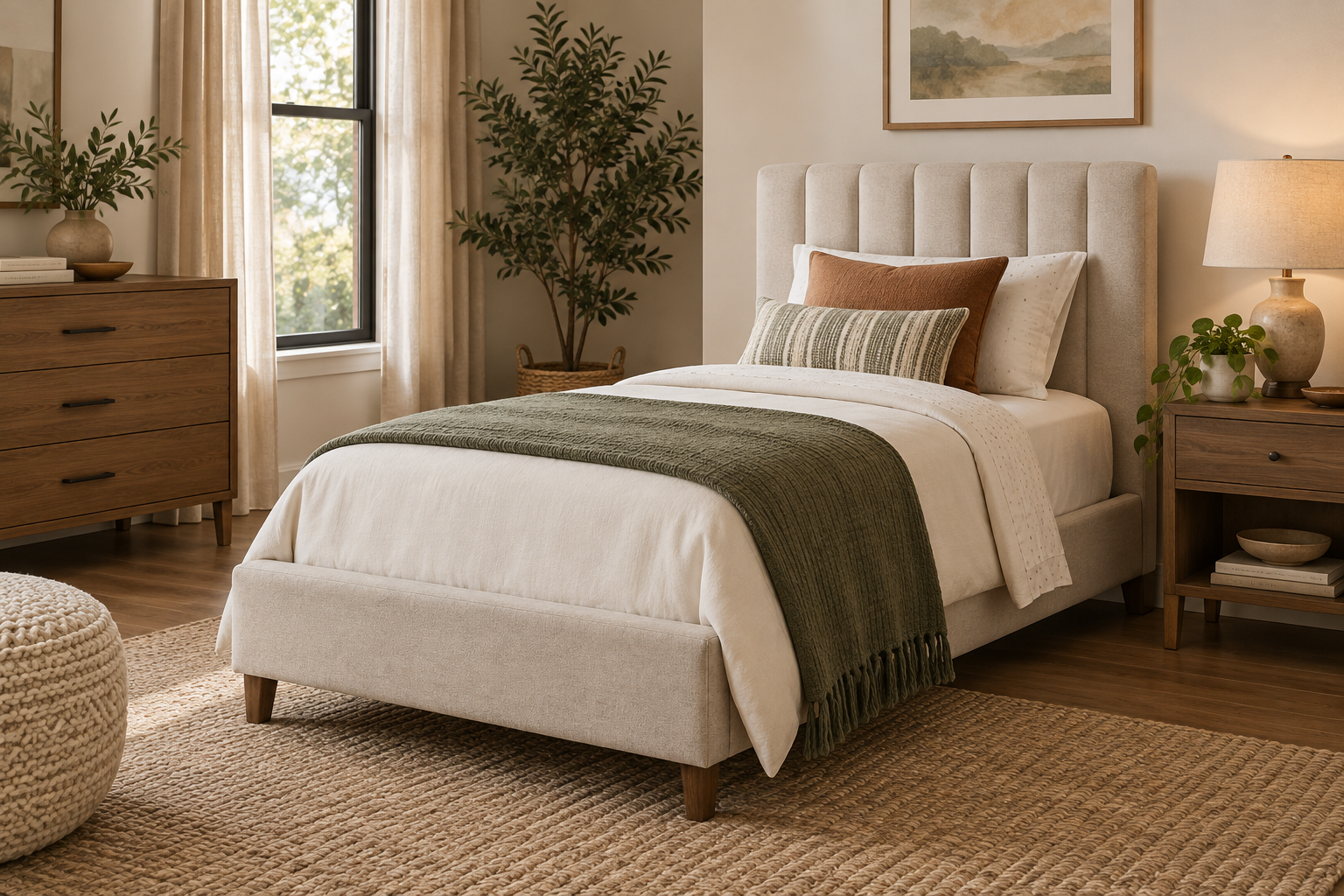
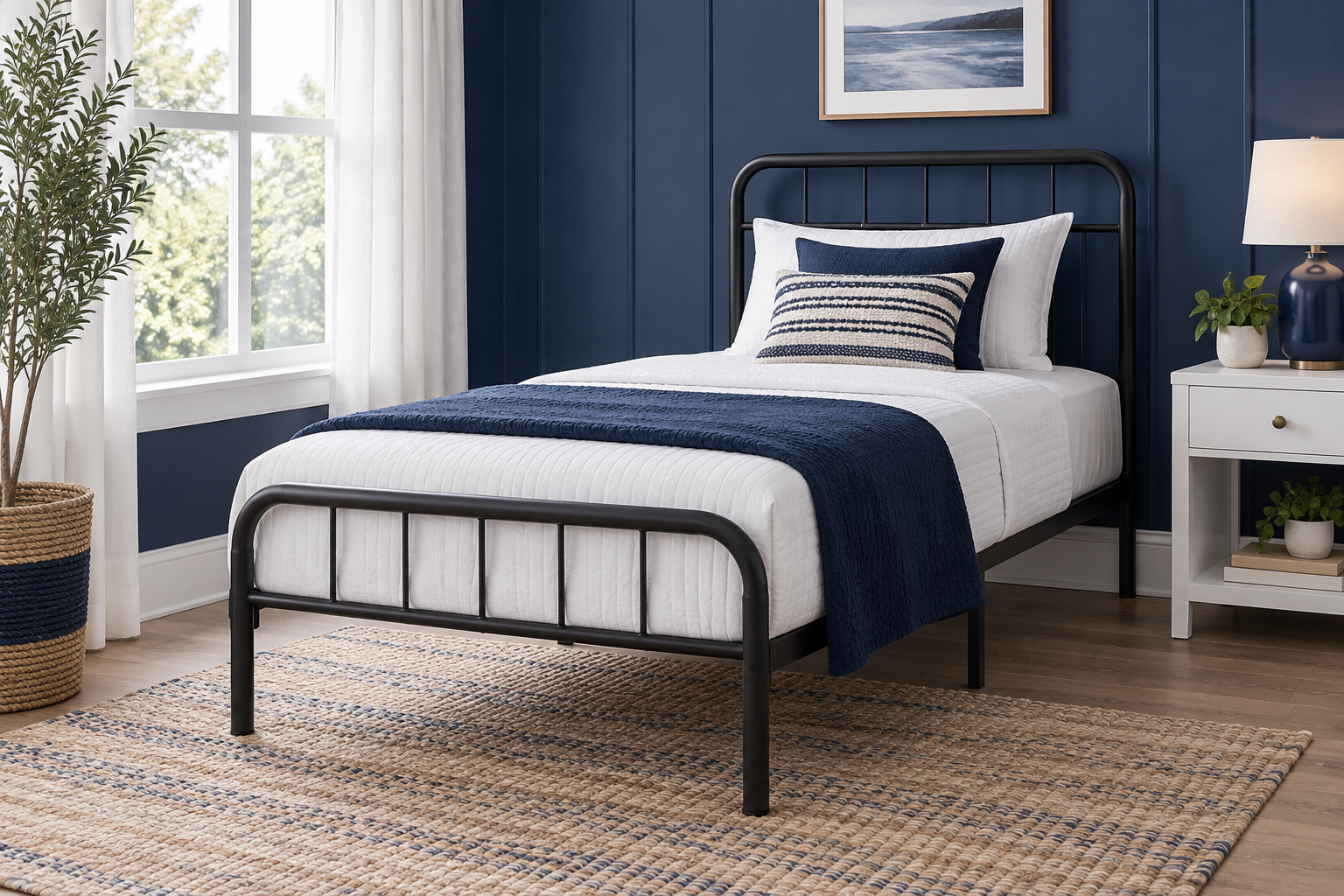
A frame must surround or support the mattress, and its rails, posts, brackets, and decorative pieces occupy additional space. A spare metal platform can stay close to 39–40 inches wide and 76–77 inches long. Upholstered frames commonly add several inches on both sides, while sleigh beds and beds with thick headboards and footboards can add considerably more length.
Never substitute mattress dimensions for the product’s assembled dimensions. Product photography can also hide depth: a headboard with shelving or a footboard with curved posts may project farther than the side rails. For a precise layout, record overall width, overall length, headboard height, frame height, and any feature that moves beyond the static footprint.
The room space a bed actually consumes
The usable bed zone includes circulation. Thirty inches of open space on an exposed side is a comfortable planning target, although a constrained child’s or guest room may function with about 24 inches in selected locations. The foot of the bed should not pinch the main path from the door to the closet. A bed against one wall needs less circulation but becomes harder to make from both sides.
Moving parts require their own allowance. Measure an underbed drawer fully extended, not merely closed. A trundle needs approximately another mattress width on its pullout side, plus a place to stand. Storage bins need enough clearance to tilt and lift. A lift-up platform may demand overhead clearance and room for the user to operate it safely.
Ceiling height and vertical dimensions
Floor plans do not reveal vertical conflicts. Mattress thickness changes the sitting height and how much of a headboard remains visible. On a bunk or loft, it changes guardrail effectiveness and headroom. Follow the frame maker’s maximum mattress-thickness instruction instead of assuming a plush mattress is automatically better.
Measure windowsills, outlets, wall vents, thermostats, sloped ceilings, and ceiling fans. A tall headboard can cover a window or switch; a high platform can meet a low sill; a loft can place a sleeper too close to a fan. Vertical checks are especially important in attic rooms and converted spaces.
A reliable pre-purchase measuring method
First measure the room wall to wall at floor level, because baseboards can reduce the usable span. Mark the prospective frame’s exact assembled width and length with painter’s tape. Then add tape for opened drawers, a trundle, or the swing of a nearby door. Walk the intended route while carrying something about the size of a laundry basket; this exposes bottlenecks that an empty diagram can miss.
Finally, verify delivery. A frame shipped in pieces is easier to maneuver than a rigid foundation, but long side rails and broad headboards still must pass stairs and landings. Record the narrowest doorway, stair turn, and elevator opening. The best-fitting bed is one that can reach the room as well as fit inside it.
Choosing a frame by footprint rather than style alone
Compact rooms reward simple profiles such as the ZINUS Abel Metal Platform Bed Frame – Twin Option or DUMOS Wood Twin Platform Bed Frame. A padded model such as the DHP Braylon Twin Bed can soften the look and supply a headboard, but the buyer should compare its completed outer dimensions with the bare mattress standard.
Storage can justify a larger footprint only when it replaces other furniture. A frame with drawers may eliminate a dresser, yet drawers on the wall side are wasted. Judge each design as part of the entire room system: sleeping surface, access, storage, sightlines, and the furniture it allows you to remove.
Account for bedding beyond the nominal mattress edge
The dimensions of a bare mattress do not show how a made bed occupies space. A comforter can drape several inches past both sides, and a thick duvet may brush a wall or bunch between the mattress and a nightstand. That does not normally change whether the furniture fits, but it affects appearance, airflow, cleaning, and how easily a sleeper can pull the covers into place. A bed jammed tightly into an alcove may need a coverlet with a shorter drop rather than a bulky comforter.
Pillows also influence useful length. A deep stack of decorative pillows consumes more of the 75-inch sleeping surface until it is removed. If the bed has a hard footboard, a tall sleeper cannot extend feet beyond the mattress edge. Treat the mattress dimensions as the maximum platform for sleep, then notice how the chosen headboard, pillow arrangement, and footboard reduce or preserve the portion a body can use.
Mattress thickness affects the visual proportions of the complete bed. A very tall mattress can cover much of a low headboard or leave a footboard looking undersized. A thin mattress can sit too far below deep side rails. Check the frame maker’s recommended thickness range and any mattress warranty support requirements rather than selecting height by appearance alone.
Translate measurements into a final buying brief
Before comparing models, write down the nonnegotiable limits: maximum assembled width, maximum assembled length, desired top-of-mattress height, minimum clear underbed height, and the side on which storage must open. Add the required mattress size and support type. This short brief makes it easier to reject a beautiful frame whose dimensions fail the room instead of trying to rationalize the conflict after purchase.
Separate hard limits from preferences. A door that must open is a hard limit; wanting a taller headboard is a preference. Required guardrail height on a bunk is a safety constraint; a particular upholstery color is a style choice. Ranking needs in this way is particularly helpful when several people share the decision, because it keeps size and function ahead of photographs.
Recheck the selected listing immediately before ordering because variants can have different measurements and sellers can revise specifications. Save the dimension diagram and confirm that the chosen dropdown still says Twin rather than Twin XL or Full. A final five-minute review connects the room survey to the exact variant that will arrive.
Frequently asked questions
Is every twin mattress exactly 38 by 75 inches?
That is the U.S. nominal standard, but small manufacturing tolerances are normal. Measure an existing mattress and check the frame maker’s interior opening when the fit will be tight.
How wide is a twin bed with a frame?
Many finished frames are about 39–45 inches wide, though oversized upholstery or posts can make one wider. Use the listed assembled width for the particular model.
Will a twin bed fit in a 7-by-9-foot room?
It often can, but doors, closets, radiators, and other furniture determine whether the layout is usable. Tape the complete frame footprint and preserve the main walking route.
How much space should remain beside a twin bed?
Around 30 inches is comfortable on an accessible side. About 24 inches can work in a constrained area, while drawers and mobility needs may demand more.
Does mattress thickness change the bed footprint?
It normally changes height rather than floor footprint. It can still affect guardrails, headboard visibility, sheet fit, and the ease of sitting down or standing up.
Final verdict
A twin mattress has a dependable 38-by-75-inch standard, but a twin bed does not have one universal outer size. Shop with three measurements in mind: the mattress, the assembled furniture, and the operating zone around it. Taping all three onto the floor before ordering turns an abstract size label into a layout you can trust. Preserve the assembled width, length, support height, and storage-extension figures with the product record. Those measurements make later mattress replacement and room moves easier. Recheck the plan with bedding, nearby drawers, doors, and ordinary household objects in place, because the room must continue working after installation day. A successful fit supports sleeping, walking, cleaning, storage, and access as one system rather than treating the mattress rectangle as the whole decision. Measure the delivery path too, because furniture that fits the destination must still pass every doorway and stair turn needed to reach it.
Product examples