TwinBed.app practical guide
How Mattress Thickness Changes Twin Bed Frame Fit and Appearance
A mattress can be the correct twin size and still look or function wrong on a particular frame. Thickness controls the vertical relationship among the sleep surface, side rails, headboard, footboard, and bedding. That relationship affects how easily someone gets into bed, whether fitted sheets remain accessible, and how much of the furniture design stays visible. This page deliberately concentrates on the frame as furniture: its proportions, openings, rail depth, and finished surface height. Mattress construction and special-purpose limits for bunks, trundles, and daybeds belong to the broader thickness guide.

Quick answer
Mattress thickness does not change the required twin length or width, but it changes how the mattress sits inside the furniture. A thicker profile can conceal headboard panels, rise above side rails, crowd a footboard, and raise the finished sitting height. A thinner profile may disappear behind deep rails or leave more headboard opening exposed than expected. This guide focuses on that vertical furniture fit; use the broader mattress-thickness guide for comfort ranges, bunks, daybeds, and trundles.
Separate mattress footprint from mattress profile
The footprint answers whether the mattress belongs in the frame opening: standard twin and Twin XL are different lengths, even though they share a nominal width. Thickness answers where the top surface lands vertically. These are independent checks. A thick standard twin mattress does not compensate for a Twin XL frame's extra length, and a thin Twin XL mattress does not belong on a standard twin platform. Confirm the labeled size first, then evaluate thickness against the frame's construction and instructions.
Measure thickness at the mattress's full, expanded profile using the maker's guidance. A boxed mattress may need time to reach its intended shape, and a quilted surface can vary slightly across the top. Do not compress the cover with the tape. Record the support-deck height from the floor and add the mattress thickness to estimate the finished sleep-surface height. If a permitted foundation will be used, add its height too. This simple sum is more useful than considering mattress thickness alone.
Next, record the vertical landmarks on the frame: top of slats, top of side rail, bottom of headboard opening, visible headboard height, and footboard top. For guarded designs, use the specific maximum mattress information in the instructions rather than making a home calculation. A frame such as the DHP Braylon Twin Bed is an upholstered platform category, while the ZINUS Leonardo Metal Twin Platform Bed uses a metal platform form; the same mattress profile can create a different visual and functional relationship on each.
Calculate finished sitting and sleeping height
Finished height influences daily use. Sit on a chair of a similar height or stack firm cushions to simulate the proposed surface, then notice whether feet reach the floor and whether standing feels controlled. A child, shorter adult, tall adult, or person with limited mobility may have very different needs. The calculation should include the frame's support height, every approved foundation layer, the mattress, and any substantial topper. Do not count a soft comforter because it compresses and is not a stable stepping surface.
A thicker mattress raises the center of mass and may make a visually light frame feel taller in the room. It also changes the reach to a nightstand and the amount of wall visible beneath artwork. A thinner profile can make entry easier, but a deep rail may press against the back of the legs when sitting. Simulate the rail relationship by subtracting the support-deck height from the rail-top height, then compare that depth with the mattress. The mattress should be supported as instructed without an awkward rail edge dominating the sitting zone.
Avoid choosing purely by a familiar label such as low, standard, or plush. Those descriptions do not produce one universal thickness. Use numerical dimensions from the exact mattress listing and verify whether they are nominal or actual. If a topper may be added later, include its uncompressed thickness in the planning total and consider how the fitted sheet will accommodate both layers. A combination that starts at a manageable height can become inconvenient after accessories accumulate.
- Support-deck height plus approved foundation plus mattress equals planned sleep-surface height.
- Add a topper when estimating the final profile.
- Compare the result with the user's seated comfort and nearby furniture.
- Check side-rail position, not only distance from the floor.
Check headboard, footboard, and rail exposure
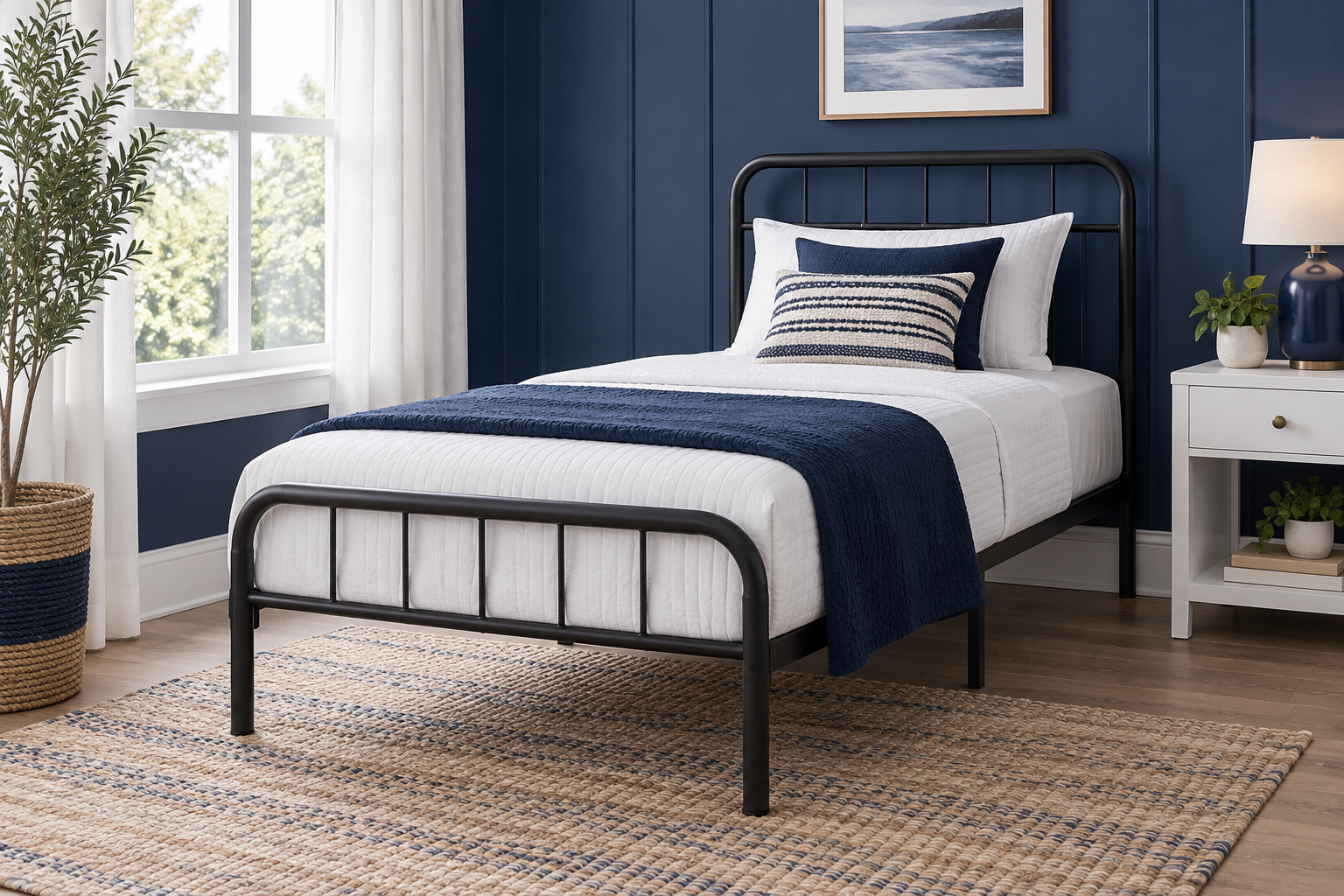
A headboard is partly a proportion problem. As mattress thickness rises, less of the headboard remains visible above pillows, and lower decorative details may disappear. Measure from the support deck to the headboard feature you want to keep visible, then subtract the planned mattress and topper profile. Also inspect the gap between the mattress top and any opening in the headboard. Follow the frame instructions and do not improvise gap fillers that could introduce an entrapment or support concern.
Footboards create another constraint. A very thick mattress can rise above a low footboard and change the intended silhouette; a high footboard can make changing fitted sheets harder when the mattress sits low behind it. Neither result is automatically wrong, but it affects usability. Imagine lifting a mattress corner, pulling the fitted sheet beneath it, and tucking bedding without scraping knuckles on the rail. A few minutes with the frame diagram and vertical measurements can prevent a daily annoyance.
Side rails can either reveal or conceal the mattress edge. Upholstered frames often create a visually continuous border, while minimal metal platforms leave most of the profile exposed. Consider how much sheet and mattress side will show after the bed is made. Deep-pocket sheets on a shallow mattress may bunch below the edge; sheets with insufficient pocket depth can pull off a thick mattress. Bedding compatibility therefore belongs in the same vertical-fit check as the frame, even though it is not a structural component.
Know when a special-purpose frame needs its own thickness guide
This furniture-fit method is intended for ordinary platform, upholstered, metal, and wood frames. Bunks, lofts, trundles, and beds with safety rails introduce separate constraints that should not be reduced to headboard proportions. Their maximum mattress height, moving clearance, or guard exposure comes from the exact product instructions. When a frame belongs to one of those categories, stop the decorative fit exercise and follow the dedicated thickness or safety guide for that use.
The distinction prevents two different questions from being blended. On a standard upholstered bed, the practical concern might be whether a thick mattress hides tufting or makes the side rail awkward while changing sheets. On a guarded upper bed, the same added inches affect the remaining containment above the sleep surface. One is primarily furniture fit; the other is a product-specific safety limit. The stricter manufacturer requirement always takes priority over appearance.
Do not alter rails, supports, or the mattress foundation to recover a preferred visual height. If the approved sleep stack makes a frame look disproportionate, choose a different mattress profile or a different ordinary frame. If the design is guarded or has a moving lower deck, move to the relevant specialist guide and confirm the exact manual before ordering.
Decide whether a foundation belongs in the stack
A foundation is not a general-purpose height adapter. Many platform frames are intended to support a mattress directly, while traditional rail frames may require a box spring or another specified base. Read both sets of instructions. Adding a foundation where one is unnecessary can raise the mattress too high, conceal the headboard, change rail relationships, and place layers on a surface that was not designed for them. Omitting a required base can leave the mattress improperly supported.
If the frame allows more than one setup, calculate each complete stack. Compare direct-on-platform, low-profile approved foundation, and other permitted configurations by finished height and visible frame features. Also confirm that every layer has the correct twin footprint and remains stable within any retaining lip. A foundation should sit evenly without rocking or bridging decorative rails. Never use a smaller base simply because bedding hides the mismatch.
Mattress warranty and care instructions may specify support spacing, center support, or foundation type. Those requirements can be narrower than the frame's general capability. The compatible setup must satisfy both products at once. When the documents do not align, contact the manufacturers before purchase. A combination is not truly compatible merely because the mattress can be placed on top of the frame; it must receive the support its maker requires while remaining within the frame's intended configuration.
Run a vertical-fit review before ordering
Create a short worksheet with exact model names and sources. Record mattress size, stated thickness, frame support-deck height, rail height, headboard landmarks, permitted foundation type, and any maximum thickness. Mark uncertain figures rather than filling gaps with estimates. Product names that sound similar can refer to different sizes or revisions, so save the manual or listing associated with the precise item under consideration. This makes the decision auditable when the bed arrives.
Use removable tape on a wall to show the predicted mattress top and pillow zone. Place a nightstand or box at the proposed height and rehearse reaching a lamp, sitting down, and making the bed. For a child, consider how use will change as the child grows without assuming that an adult-friendly surface is suitable now. For a guest room, favor a conventional, accessible arrangement over an unusually tall stack that looks luxurious but is difficult to enter.
On delivery, verify the labels before removing all packaging, then assemble the frame fully and measure again. Confirm that slats and supports are installed in the specified positions before placing the mattress. After the mattress expands, recheck rail exposure and finished height. If the setup conflicts with a stated limit, stop using it until the correct component is substituted. A disciplined vertical-fit check protects comfort, appearance, and the intended performance of both frame and mattress.
Frequently asked questions
Does a thicker twin mattress fit a standard twin frame?
It may match the length and width while fitting poorly vertically. Check the frame's mattress-thickness limits, rail depth, headboard and footboard relationship, finished height, and any guardrail requirements.
How do I calculate the finished bed height?
Add the floor-to-support-deck height, any manufacturer-approved foundation, the mattress thickness, and a topper if one will remain on the bed. Confirm the actual assembled measurements.
Can I add a box spring to make a thin mattress taller?
Only if both frame and mattress instructions allow that foundation. A platform may not need one, and adding it can create an excessively high or incompatible stack.
What if the frame is a bunk, loft, daybed, or trundle?
Use the dedicated guide and the exact product manual. Those designs have safety or moving-clearance limits that take priority over the headboard, rail, and footboard appearance covered here.
Will thick mattresses hide a headboard?
They can hide lower headboard details and reduce visible height. Measure from the support deck to important design features, then subtract the planned mattress and topper thickness.
Final verdict
Mattress thickness is a vertical furniture-fit decision on an ordinary twin frame. Confirm the footprint, calculate the completed surface height, and compare that line with the side rails, visible headboard, footboard, bedding access, and nearby furniture. Then verify that the selected support arrangement satisfies both manufacturers. If the bed is guarded, convertible, or fitted with a moving deck, use its dedicated guide instead of treating the question as an appearance problem.
Product examples