TwinBed.app practical guide
Two Twin Beds vs. a King Bed: Dimensions and Setup Tradeoffs
The familiar phrase “two twins make a king” leaves out the direction that matters: they make the width, not the length. That five-inch discrepancy changes fitted sheets, frames, and comfort for tall sleepers. Even if the rectangles matched, two independent beds and one king would behave differently. The center seam, rails, firmness choices, room arrangements, and moving logistics make this a use-case comparison rather than a simple arithmetic exercise.
Quick answer
Two standard twin mattresses side by side total approximately 76 × 75 inches. They match a standard king’s 76-inch width but are five inches shorter than its 80-inch length. Separate twins offer flexible guest layouts and easier moving; a one-piece king provides a continuous shared surface, while two Twin XL mattresses create the true split-king equivalent.
Begin with the dimensional math
A standard twin mattress measures 38 by 75 inches. Two placed side by side total 76 by 75. A standard king measures 76 by 80, so the widths match and the king remains five inches longer.
Two Twin XL mattresses, each 38 by 80, total 76 by 80 and match standard king dimensions. This is the basis of a split king. The difference between standard twin and XL cannot be corrected by shifting the mattresses because the missing length belongs to the entire sleeping surface.
Separate finished frames enlarge the calculation. Outer rails, posts, and a gap can make two framed twins wider than one king frame. Compare assembled furniture in both planned configurations, not only bare mattress sums.
Two standard twins provide about 39.6 square feet of mattress surface, while a standard king provides about 42.2 square feet. The missing area is a five-inch strip across the full 76-inch width. That location explains why a center bridge cannot correct the length shortfall.
If a room drawing already contains a king rectangle, do not assume two twin frames can drop into it. Each frame has outer rails, and paired headboards may extend beyond one king headboard. Draw the complete products separately and include any connector or space required to move them apart.
Separate twins adapt to changing guests
Two twins can sit on opposite walls, run parallel with a shared central aisle, or move together when guests prefer proximity. This flexibility works for siblings, friends, adult relatives, and rooms that alternate between one and two visitors.
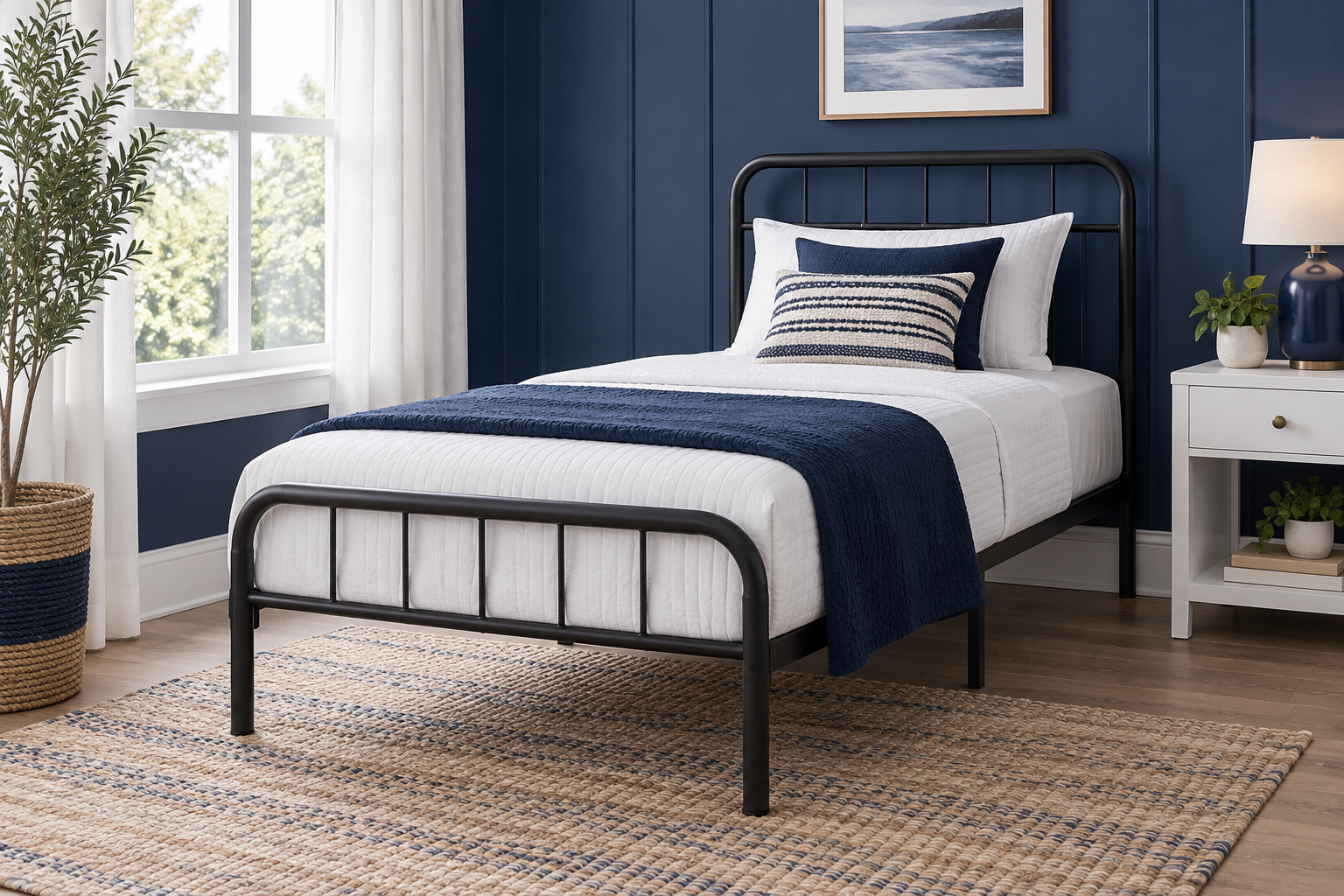
The Yaheetech two-frame set creates a coordinated pair, but even matching frames need exact footprint checks. Headboards, outward-splaying legs, or center rails may prevent the mattresses from meeting closely. If frequent rearrangement is expected, select stable frames that can be moved without damaging floors.
A king cannot divide into two complete beds. It serves a couple or one expansive sleeper well but commits the room to a broad shared surface. Flexibility matters most when guest combinations actually change.
One continuous king changes how couples sleep
A one-piece king has no center separation, so sleepers can use the middle naturally. Children or pets joining briefly also encounter a continuous surface. Mattress construction determines motion isolation and edge feel, but there is no physical joint between halves.
Two standard twins create a seam and also leave tall sleepers with 75-inch length. Pushing them together may suit occasional guests who remain on their own side; it is less convincing for a couple who shares the middle. A bridge can soften a seam but does not add five inches of length.
A split king preserves king dimensions while keeping the mattresses separate. That supports individualized firmness and adjustable bases, yet the center joint remains. Couples should decide whether independent sides or center continuity is more important.
Edge use differs too. A one-piece king's center has no perimeter construction, while paired mattresses place two edges together. Depending on design, those edges may feel firmer, softer, or less stable than the center of one king. People who routinely meet in the middle should test that sensation rather than relying only on a bridge pad.
Partner height can also determine the choice. Two standard twins leave both sleepers on 75 inches; a king or two Twin XL mattresses provides 80. If only one partner is tall, split XL still keeps both halves the same length while allowing different firmness on each side.
The center gap needs deliberate management
Independent frames can drift, particularly on smooth floors. Mattresses may have rounded edges, different heights, or different firmness, creating a visible and tactile channel. A connector system, non-slip layer, or approved bridge can reduce movement in a flat configuration.
Do not improvise straps around powered or articulating components. Any connector should be compatible with the frames and should not create an entrapment point. Level support is the starting requirement; two beds on different floor planes will not align cleanly regardless of a bridge.
If the mattresses differ, compare finished heights after normal use, not only labeled thickness. Foam settling and quilted covers can produce a ridge. Matching models simplify alignment, while intentionally different firmness may require careful height selection.
Bedding exposes the five-inch difference
A standard king fitted sheet is made for an 80-inch-long surface and will be too long around two 75-inch twins. Separate twin fitted sheets give each mattress a secure fit. A king flat sheet or comforter can cover both when they are pushed together, though drape depends on frame separation.
When the beds separate, each needs individual top bedding. That increases the number of items but allows guests to control covers independently. Twin bedding is broadly available and easier to wash than a single king comforter.
Two Twin XL mattresses in a split king normally use two Twin XL fitted sheets. Split-king sets often package these with king top bedding. Independently articulating bases may work better with fully separate covers so one side can move without pulling the other.
Room planning differs in joined and separated modes
A king usually benefits from access on both sides, two bedside surfaces, and a broad clear wall. Separate twins may use more room because an aisle appears between them and each bed needs an accessible side. When joined, two frames can occupy more width than one king frame.
Draw both intended twin arrangements. Include nightstands, door swings, suitcase zones, and the path to the bathroom. A layout that supports separation only after moving several heavy objects is not truly flexible for frequent guests.
The Yaheetech Two-Pack Minimalist Twin Metal Frames may support a visually coordinated setup, but product styling does not determine clearance. Use exact assembled dimensions and mark every leg so the planned central aisle remains clear at floor level.
Moving and maintenance favor smaller components
Twin mattresses are generally easier to carry through doorways, stair turns, and elevators than a king. One person may rotate or change a twin, while a king often needs two people. Modular pieces are valuable in upper-floor rooms and households that relocate often.
Two twins double some maintenance points: two sets of frame hardware, more legs, and more floor edges to clean. A king has one broad mattress that is harder to lift but fewer separate alignment problems. Compare labor over time rather than only delivery day.
Before pushing frames together, ensure all supports remain square and level. Do not remove center rails or legs to reduce the seam. Structural components should remain installed according to each product’s instructions.
Choose according to the room’s recurring job
Choose two standard twins when the room regularly serves separate guests, the 75-inch length suits expected sleepers, and rearrangement adds genuine value. Choose a one-piece king for a couple who wants a continuous 80-inch surface and whose room supports side access.
Choose two Twin XL mattresses when king dimensions, individualized mattresses, or independent adjustable bases matter. Do not choose standard twins for a permanent king simulation merely because their combined width sounds correct; the length, seam, and fitted bedding remain different.
List how often each configuration will be used, then plan for the most common state. Occasional flexibility should not make the room awkward every day. The best system handles its primary occupants well and changes without unsafe improvisation when guests differ.
Consider storage between configurations. When two beds join, the displaced central nightstand and separate bedding need somewhere to go. When they separate, a king bridge, connector, or broad comforter may need storage. A room is not truly convertible if each transition pushes large items into the hallway or blocks the closet.
Record the assembled layout with photographs and measurements after installation. Mark any approved connection hardware and keep tools nearby. Future hosts can recreate the safe arrangement without guessing which rails align or whether a missing support was intentionally removed.
Frequently asked questions
Are two twin beds exactly the same size as a king?
No. They match the 76-inch width but are 75 inches long, five inches shorter than a standard king.
Can king fitted sheets go over two standard twins?
They are generally too long. Use separate twin fitted sheets and, if desired, king-size loose top bedding.
How can I keep two twin beds together?
Level compatible frames, then use an approved connector, non-slip layer, or bridge designed for the setup. Follow all frame instructions.
Are two twins easier to move than a king?
Usually. Each mattress and frame is smaller, though there are more individual components to handle.
Which two mattresses make a true split king?
Two Twin XL mattresses, each 38 by 80 inches, create standard king dimensions.
Final verdict
Two standard twins imitate king width but not king length. Their strongest advantage is not pretending to be one mattress; it is separating and reconfiguring for different guests. A one-piece king favors shared continuity, while two Twin XL mattresses create the dimensionally correct split system. Decide from the room’s regular occupants, center-seam tolerance, and furniture plan, then buy bedding for the configuration that actually exists. Measure frames in both joined and separated positions, and preserve safe support components during every change. Flexibility is valuable only when transitions remain practical, stable, and well documented.
Product examples