TwinBed.app practical guide
Do Two Twin XL Beds Make a King? A Practical Split-King Guide
A split king is mathematically exact and experientially different. The two halves total the same width and length as a king, yet their independence changes firmness choice, motion transfer, articulation, bedding, and the feel of the center. For some couples, that separation is the primary benefit. For others, it creates the one feature they dislike most. The right setup treats the bases, mattresses, linens, and gap as a coordinated system.
Quick answer
Yes. Two Twin XL mattresses, each 38 × 80 inches, form a nominal 76 × 80-inch surface—the same dimensions as a standard king. This split-king arrangement allows independent mattresses or adjustable positions, but it requires compatible support, two Twin XL fitted sheets, aligned heights, and a plan for the center seam.
The dimensions form a standard king
One Twin XL mattress is 38 inches wide and 80 inches long. Placing two side by side doubles width to 76 inches while preserving the 80-inch length. A standard king is nominally 76 by 80, so the rectangles match.
Two standard twins are also 76 inches across but only 75 inches long. They cannot become a standard king by adding a connector or larger sheet. The five-inch difference affects body fit, support, and fitted bedding across the entire setup.
Finished systems may exceed 76 inches because bases, frames, rails, or a central gap add width. The dimension equation refers to mattress surfaces, not a universal outer furniture footprint.
In metric terms, each half is roughly 96.5 by 203.2 centimeters, and combined width is about 193 centimeters. Conversions are approximate because U.S. sizes originate in inches. Imported frames labeled king may follow another national standard, so confirm interior support dimensions before combining products from different markets.
Thickness remains independent. Both halves need not use identical materials, but their top surfaces should align closely if the bed will share a comforter or center bridge. Measure after compressed mattresses have expanded and protectors are installed, because the finished sleep plane is what the couple feels.
Independent firmness can solve a real disagreement
Each partner can select a different firmness or construction while retaining one king-size room footprint. This is useful when body weights, sleep positions, pressure preferences, or temperature needs differ. Replacing one half later can also be simpler than replacing an entire king.
The mattresses should finish at similar heights. A thick hybrid beside a low foam model creates a ridge and complicates shared top bedding. Labeled thickness is a starting point; quilting, expansion, and settling affect the actual top plane.
Different constructions can produce different edge feels at the center. Strong, square edges create a clearer joint but better support near it; rounded soft edges may form a valley. Couples who sleep close to the middle should examine edge behavior, not only firmness.
Different firmness does not require dramatically different heights. Many product lines offer several feels within one construction family, simplifying alignment. When mixing brands, compare layer descriptions, edge reinforcement, trial terms, and measured height. A topper on one side can fine-tune feel but may create another level difference.
Weight distribution matters at the seam. A sleeper on one half uses that mattress normally; someone spanning both sides loads two independent edge systems. The result can feel stable, ridged, or hollow. Testing the likely sleep position is more informative than pressing the seam by hand.
Motion isolation improves because the surfaces separate
Movement does not travel through one continuous mattress core, which can reduce partner disturbance. The bases can still transmit some vibration through the floor or shared frame, but the mattress separation removes a major path.
Separate mattresses also let one partner sit or get up without deforming the other side as much. The benefit depends on construction, body weight, base stability, and whether a tight bridge mechanically links the halves.
A one-piece king with strong motion isolation may already perform well enough for many couples. Split is most valuable when motion reduction arrives alongside another needed feature, such as independent firmness or adjustable positions.
Adjustable bases are a primary split-king use
Two Twin XL adjustable bases allow each person to raise head or feet independently. The ZINUS Nadia Twin XL Adjustable Bed Frame represents the individual-half format. Mattresses must be approved for articulation, and retainers must hold them as the bases move.
Some systems can synchronize both halves for unified movement. Others are intended to remain independent. Use the maker’s controls, cables, power requirements, and weight limits exactly as documented. Do not add straps or a bridge that blocks articulation.
Independent movement affects bedding. One king top sheet can pull when only one side rises, while separate sheets and blankets move freely. Couples should decide whether visual unity or functional independence matters more during actual use.
Support must be designed for the split arrangement
Use two compatible Twin XL bases or a king frame documented to accept split foundations. Center support, leg placement, and floor contact must remain as designed. Two decorative Twin XL frames may place rails between the mattresses and create a wider, more separated installation.
Level the floor and check that both support decks sit at the same height. Lock approved casters and use manufacturer-provided connectors where applicable. A small base mismatch becomes noticeable at the mattress seam.
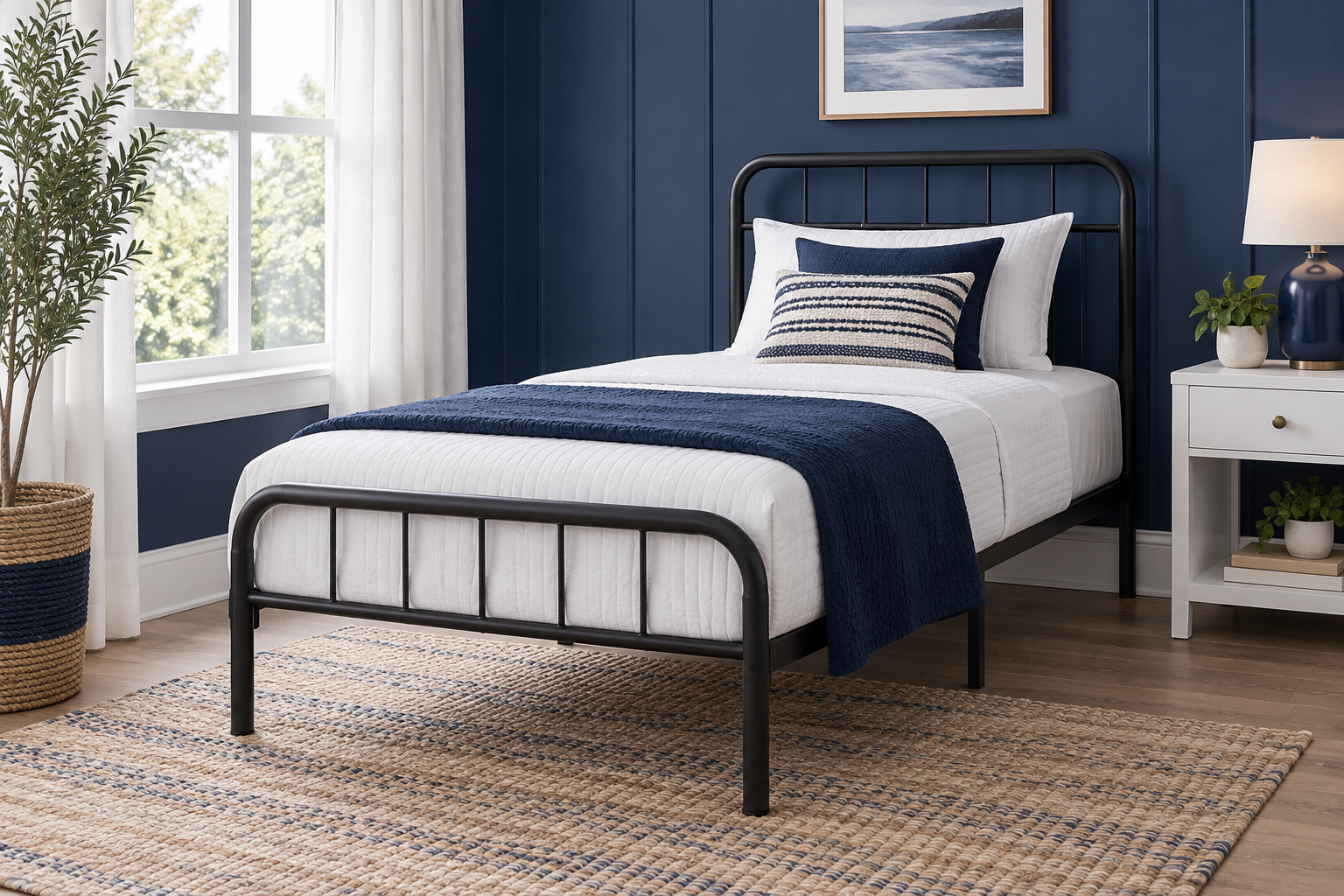
A straightforward product such as the MAF 16-Inch Twin XL Metal Platform Bed may support individual XL use, but dimensions alone do not guarantee that two units create an intended split-king system. Verify whether the frames can join safely and whether their rails allow the desired mattress spacing.
Manage the center seam according to how the bed moves
For a flat split king, a non-slip surface, approved connector, and mattress bridge can reduce separation and soften the seam. The bridge should lie smoothly, remain compatible with protectors, and not create excessive pressure on mattress edges.
On independently articulating bases, a bridge can shift, buckle, or prevent one side from moving freely. In that case the gap is part of the design, and sleepers should use their own side rather than trying to erase it with a rigid connection.
People who sleep in the center or whose children regularly join them may prefer a one-piece king. The seam is least troublesome when each adult stays primarily on one half and values the autonomy that separation provides.
Choose bedding that respects both halves
Use two Twin XL fitted sheets and protectors. A split-king sheet set commonly combines those with a king flat sheet and king pillowcases. Check pocket depth independently if the mattresses differ in thickness.
A king comforter can create one visual bed when the bases remain flat or move together. Separate comforters prevent cover stealing and support different warmth preferences. They are usually more practical when each base articulates independently.
A single king mattress protector placed across both halves can pull at the seam and reduce movement independence. Separate protectors preserve the split. Any bridge or topper should be evaluated for whether it intentionally joins the feel or interferes with adjustability.
Use a split-king decision checklist
Choose split when partners need different firmness, independent elevation, reduced motion transfer, or easier-to-handle components. Choose one-piece king when center sleeping, simple shared bedding, and an uninterrupted surface have higher value.
Discuss what happens when one partner travels. The remaining sleeper may enjoy an independent adjustable side but might prefer the middle of a one-piece king. Families whose children or pets join in the center should count that routine as a primary use, not an exception.
Plan service access as well. Powered bases need reachable connections and troubleshooting clearance. Two mattresses are easier to lift individually, but there are twice as many controllers, legs, and mechanisms. Keep model numbers and instructions for each side so maintenance does not depend on memory.
Measure the room from the complete bases, not just 76 by 80 inches. Include bedside clearance, power-cord routing, wall distance needed for articulation, and access to service components. Confirm that two Twin XL units can reach the room through stairs and doors.
Before ordering, write down mattress height, construction, adjustable compatibility, base model, sheet depth, and connector plan for each side. A split king succeeds through coordination. Correct total dimensions alone do not resolve mismatched heights or incompatible mechanisms.
Confirm electrical capacity and outlet location before placing powered bases. Avoid pinched cords, overloaded extensions, and inaccessible plugs. Follow the base maker's clearance requirements from walls and furniture, because articulation can move both mattress and bedding beyond the flat footprint.
Agree on the bedding strategy before buying sets. Two fitted sheets are unavoidable, but couples can choose shared or separate flat sheets and comforters. Testing that decision in the positions the bases will use prevents a unified-looking bed from defeating the independent movement that justified split king.
Frequently asked questions
What fitted sheets fit a split king?
Use two Twin XL fitted sheets. A king flat sheet and comforter can cover both when the intended movement allows it.
Can two standard twins make a split king?
No. They match king width but remain five inches shorter.
Can the two mattresses have different firmness?
Yes. That is a major benefit, though similar finished heights reduce a ridge between the sides.
How do I reduce the middle gap?
Level compatible bases, limit drift with approved hardware or non-slip materials, and consider a bridge only when it will not interfere with movement.
Is a split king wider than a king?
The mattress surfaces have the same nominal width. Separate decorative frames or a gap can make the full furniture installation wider.
Final verdict
Two Twin XL mattresses create a true king-size rectangle, but the joint remains functionally important. Build the system around aligned support, compatible mattress heights, appropriate fitted bedding, and the intended base movement. Split king excels when partner independence has daily value. A one-piece king remains the cleaner answer when the center is shared and synchronized comfort matters more than separate settings. Verify the complete system rather than assuming dimensional equality guarantees mechanical compatibility.
Product examples