TwinBed.app practical guide
Where Should a Twin Bed Go? A Small-Room Decision Tree
This is a placement decision tree, not a gallery of room arrangements. The best wall is not always the one that accepts a 38-by-75-inch mattress on paper. Frames project beyond the mattress, doors need arcs, and a person needs a route from the entrance to clothing storage. Work through the constraints in order: essential route, longest usable wall, windows and equipment, required open side, then a two-position trial. That sequence produces a defensible location instead of choosing by symmetry alone.
Quick answer
Start with one decision: which wall preserves an uninterrupted route from the entrance to the closet? Eliminate positions that interfere with required window access, doors, vents, or heat sources. Of the remaining walls, choose the one that lets the exact frame operate—drawers, trundle, ladder, and bed-making access included—then test that position at full scale before ordering.
Protect the Essential Route First
Stand at the doorway and identify the route used most often—usually to the closet, dresser, desk, or opposite side of the room. Keep that route continuous. It should not require turning sideways around a footboard or stepping over storage. Users with mobility aids need a plan based on their actual turning and transfer needs, not a generic aisle suggestion.
Open the entry and closet doors simultaneously. A bed that fits when both are closed may prevent one from opening fully. Sliding closet doors reduce swing conflicts but still need clear access across their width. Mark the path of drawers and a desk chair, too. Movement zones overlap only if they are never needed together; morning routines often prove otherwise.
Emergency access matters. Do not position the bed where it blocks the only exit or required window egress. Local rules and the room’s architecture take priority over a stylish arrangement. Keep floor lighting and cords outside the route.
Evaluate the Longest Uninterrupted Wall
The longest plain wall is a strong first candidate because a twin bed placed lengthwise leaves the remaining floor in one useful block. Measure between trim, radiators, and door casings rather than from corner to corner. Add the complete headboard and footboard length. Upholstery, curved ends, and storage fronts can add inches beyond the mattress.
A wall-side placement works especially well for a solo sleeper who does not need access on both sides. It can also support a daybed arrangement. Leave the mattress and frame clearance recommended by their makers, and check the wall for moisture or cold-surface condensation. Do not pack pillows into a damp gap.
If the wall holds outlets, decide whether plugs remain accessible without being crushed behind the frame. Use safe cord routing and avoid extension cords across walking paths. A wall-mounted reading light should be installed for the wall type and positioned so it does not become a head hazard when the bed is used for sitting.
Treat Windows as Functional Architecture
A low bed beneath a window can free solid walls for a desk or storage, but check more than sill height. The bed must not obstruct required egress, locking hardware, blinds, curtains, radiator output, or safe cleaning. Long curtain cords and fabric near the sleeper require particular care. Follow window-covering safety guidance.
Light and temperature affect comfort. Morning sun may be welcome; direct afternoon heat or a draft may not be. A headboard against a window can block airflow or light and may be awkward to clean. If the position is permitted, a frame without an unnecessarily tall headboard can preserve function.
Never use furniture as an unsafe climbing step to an upper-story window. For children’s rooms, consider fall prevention, blind cords, and furniture-placement recommendations from relevant safety authorities. A few extra feet of floor space do not outweigh window safety.
Choose Corner or Center Based on Access
A corner placement combines the bed’s head and long side with two walls, usually leaving the largest open floor. It suits play space, exercise, or a compact workstation. The tradeoff is harder sheet changing and loss of access to wall-facing drawers. A corner-oriented model such as the LUSIMO Corner Twin Bed Frame with Storage Drawer should be checked for drawer direction so the storage faces the room.
A centered headboard creates two side aisles. This is helpful when drawers open on both sides or a caregiver needs access, but only if both aisles are wide enough to serve their jobs. Two very narrow gaps are often less useful than one generous aisle. Place tape for the frame and walk each side before choosing symmetry.
An off-center compromise can preserve one full aisle plus a small cleaning gap on the other side. Visual balance can come from centered art or lighting rather than equal floor clearance. Function should determine inches; decor can restore composition afterward.
Let the Bed Type Choose Its Necessary Open Side
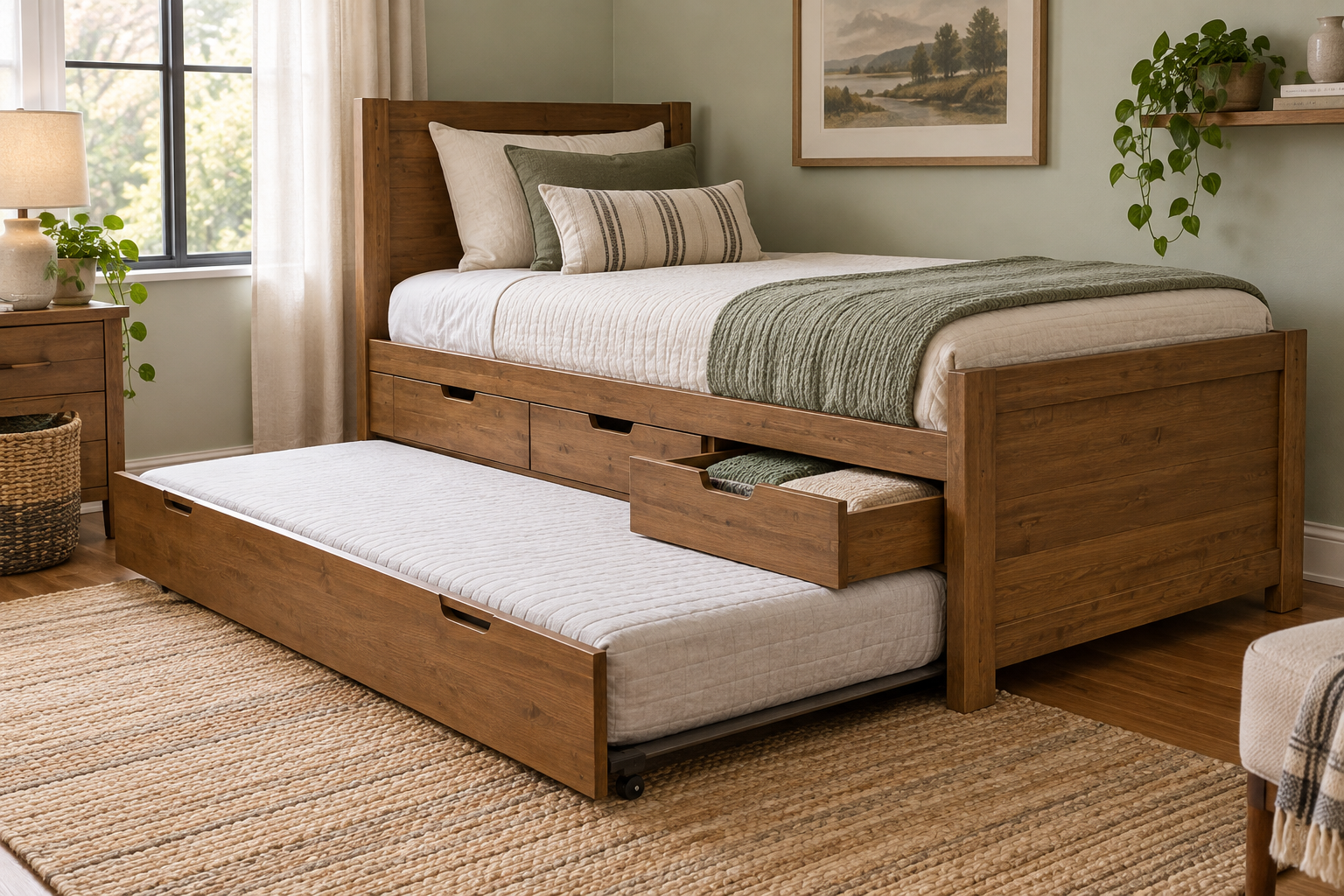
Storage drawers require their complete extension plus operating room. Place them toward the open floor and count only drawers that remain reachable. A high-clearance platform with loose bins may allow access from the foot even if one side is near a wall. Verify center-leg locations before planning long containers.
A trundle demands an open zone approximately the lower deck’s full exterior size. A model such as the ZINUS Suzanne Bamboo and Metal Daybed with Trundle needs to be mapped in both closed and open positions from current dimensions. The room door and nighttime path must still work with a guest on the lower mattress.
A loft bed requires ladder access and ceiling clearance rather than a pull-out rectangle. The DHP Studio Loft Twin Bed over Desk and Bookcase combines work and sleep vertically, but its assembled height, upper-mattress limits, age guidance, guardrails, and desk clearance must suit the user and room. The best placement for one bed category can be completely wrong for another.
Run a Two-Position Trial
Select the two plausible walls and mark each frame outline on different days. Place boxes where the headboard and footboard project. Use the room normally: open the closet, carry laundry, sit at the desk, make a pretend bed, and walk to the door in low light. A position that looked less impressive on paper may feel calmer because it protects one direct route.
Check cleaning access. Can a vacuum head reach the exposed sides? Can the mattress be rotated or cared for as directed? Can an adult reach the far corner to fit a sheet without standing on unstable furniture? The placement should support maintenance, not only sleep.
Photograph both trials from the doorway. Look for a clear first view rather than a wall of furniture, but do not let appearance override exits and function. Once the bed location is chosen, add the smallest supporting pieces. A narrow shelf, wall hook, or underbed bin may solve a need without consuming the aisle reclaimed by careful placement.
Repeat the trial at the time the room is most crowded. For a child, that may be homework time with a backpack open and toys in use; for an adult, it may be morning with closet doors and a laundry basket in the aisle. A bed position that works only in a perfectly cleared room is vulnerable to ordinary life. The better location contains clutter rather than allowing it to block the exit.
Listen as well as look. A headboard against a shared wall may transfer movement or tapping, and a metal frame close to trim can knock when the sleeper turns. Keep the manufacturer’s placement guidance and use appropriate floor protection. If ordinary frame movement would strike a wall, allow a little more space rather than wedging soft objects into a gap where they collect dust or moisture.
Document the winning placement with wall-to-frame reference measurements before delivery. Installers or helpers can then reproduce the tested position instead of centering the bed by instinct. After the mattress and normal bedding are added, walk the route again because overhang and a shifted frame can narrow it. Small corrections made before adding shelves or art preserve the flexibility to fine-tune the room.
Keep the original sketch with the furniture instructions. If the bed is moved for cleaning or painting, the household can restore the verified route rather than guessing. The same record helps determine whether a future nightstand or larger desk will fit without undoing the placement work.
- First protect the path from entry to closet.
- Then test the longest wall at exact assembled dimensions.
- Keep required window, vent, heat, and outlet functions accessible.
- Aim drawers, trundles, and ladders toward their needed open zones.
- Live with two taped positions before ordering the frame.
Frequently asked questions
Is it okay to put a twin bed in a corner?
Yes when it preserves circulation and suits the user, provided ventilation, wall conditions, bed-making, and storage access remain acceptable.
Should the bed face the bedroom door?
There is no universal requirement. Prioritize a safe route, usable doors and windows, and the bed’s moving features before visual orientation.
Can the head of a twin bed go under a window?
Sometimes, but only when required egress, locks, coverings, temperature, and child safety remain protected. Check local and product-specific guidance.
How far should a bed be from a radiator or vent?
Follow the heating or cooling equipment maker’s clearance guidance and local requirements. Do not use a generic bed-spacing number.
What if no wall supports both the bed and storage drawers?
Choose foot-access storage, underbed bins, a storage headboard, or a simpler frame with separate vertical storage. Do not pay for permanently blocked drawers. Compare usable capacity after the placement constraint is applied.
Final verdict
Put the twin bed where it preserves the room’s essential route and allows the exact frame to work. The longest wall and a corner are strong starting points, but windows, heat, storage mechanisms, and the user’s bed-making needs can change the answer. Test two positions at full scale. The right one will feel less like fitting a rectangle and more like making every daily movement easier.
Product examples