TwinBed.app practical guide
Captain’s Bed vs. Standard Storage Bed
Retail naming makes this comparison less tidy than it sounds. Captain’s bed is a style label, not one universal construction standard, and standard storage bed can describe everything from two shallow drawers to a platform with four rolling boxes. Product names establish an idea; dimension drawings establish the furniture. Compare interior storage, operating clearance, mattress height, moving parts, and what the bed replaces in the room.
Quick answer
A captain’s bed usually emphasizes built-in drawers or compartments in a taller, substantial base and may combine storage with a trundle or shelving. A standard storage bed is a broader category that can use a few drawers, a storage headboard, open clearance, or lift-up space. Choose the captain’s bed for integrated capacity and the simpler storage bed for lower height, lighter construction, or more flexible access—after verifying the exact model.
Understand What the Labels Usually Signal
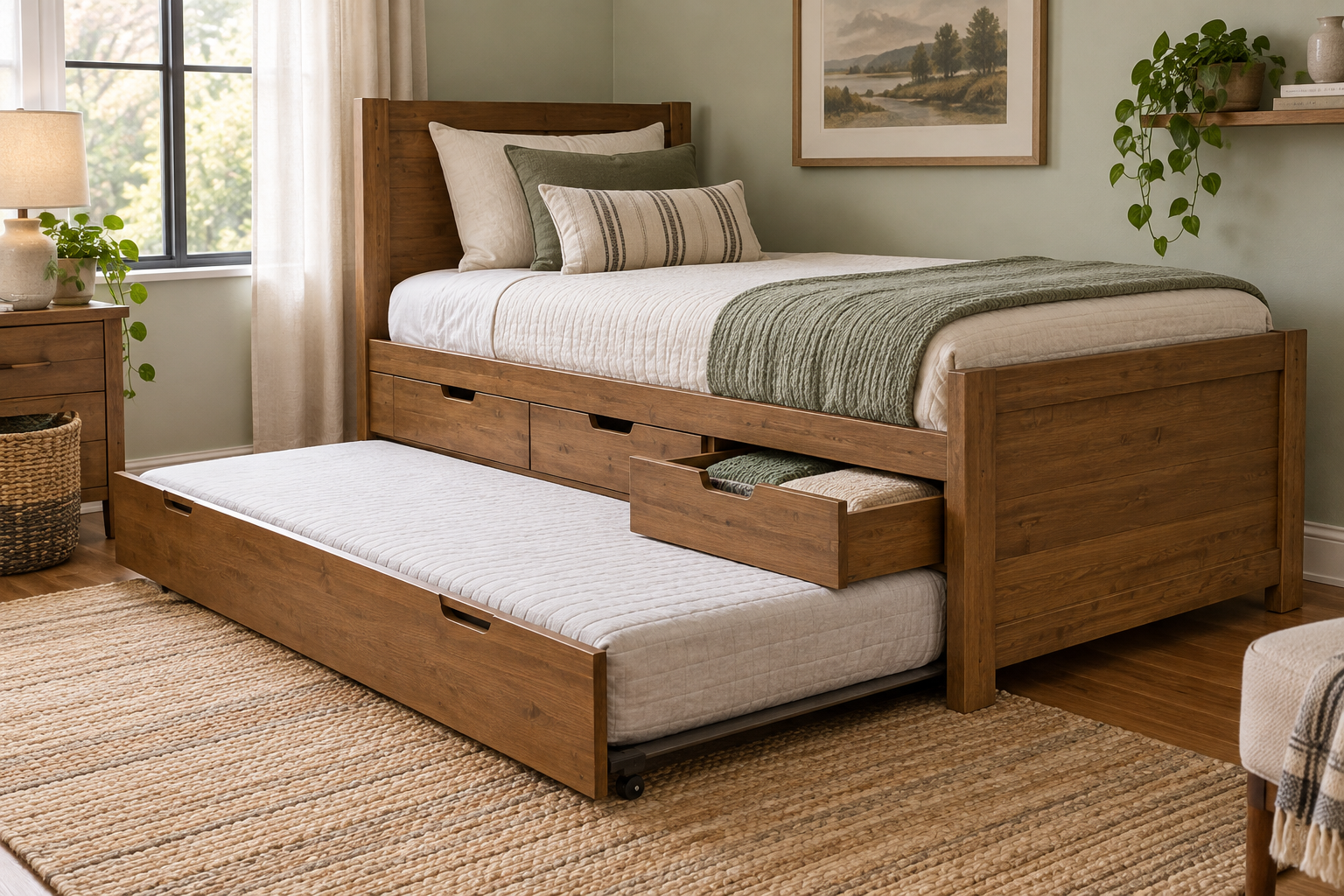
The traditional captain’s-bed idea is a raised box-like base with built-in storage below the mattress, echoing compact shipboard furniture. Modern versions may include drawers on one or both sides, shelves, cabinets, or a trundle. The taller base creates volume but also raises the sleep surface and increases visual weight.
A standard storage bed is any bed whose design includes dedicated storage. That can mean two large drawers, four smaller drawers, a bookcase headboard, loose underbed bins, or an upholstered platform with drawer boxes. Because the category is broad, it may be lower, lighter, and simpler than a captain’s bed—or equally complex.
Do not classify only by title. Inspect the exact current construction. The Harper & Bright Designs Twin Captain’s Bed with Trundle explicitly combines a captain’s style with guest capacity, while a frame named storage platform may focus only on drawers.
Compare Usable Storage, Not Visual Mass
A tall base looks capacious, but drawer boxes, trundle cavities, center rails, and hardware divide the interior. Obtain the inside width, depth, and height of every compartment. Count only drawers that can open in the planned room. If one side meets a wall, an apparently generous two-sided captain’s bed may lose half its practical storage.
A simpler model such as the Giantex Twin Bed with Storage Drawers may offer fewer compartments but easier categories and a lower visual profile, depending on current dimensions. The FORABAMB Twin Bed Frame with Four Storage Drawers offers more separation by title, yet drawer count alone does not reveal interior volume or floor travel. Verify each listing.
Match shape to belongings. Shallow wide drawers suit folded clothing; deep boxes suit blankets but encourage stacking. A trundle cavity is not storage while it holds a guest mattress. A shelf at the head may replace a nightstand but cannot substitute for clothing drawers.
Height Changes Entry, Safety, and Appearance
Captain’s beds often place the mattress higher because storage sits below it. Finished height equals the platform plus the approved mattress. A taller surface may make standing easier for some adults and more difficult for smaller children. The sleeper should be able to enter and exit without an unstable step. Follow age and safety guidance for the exact product.
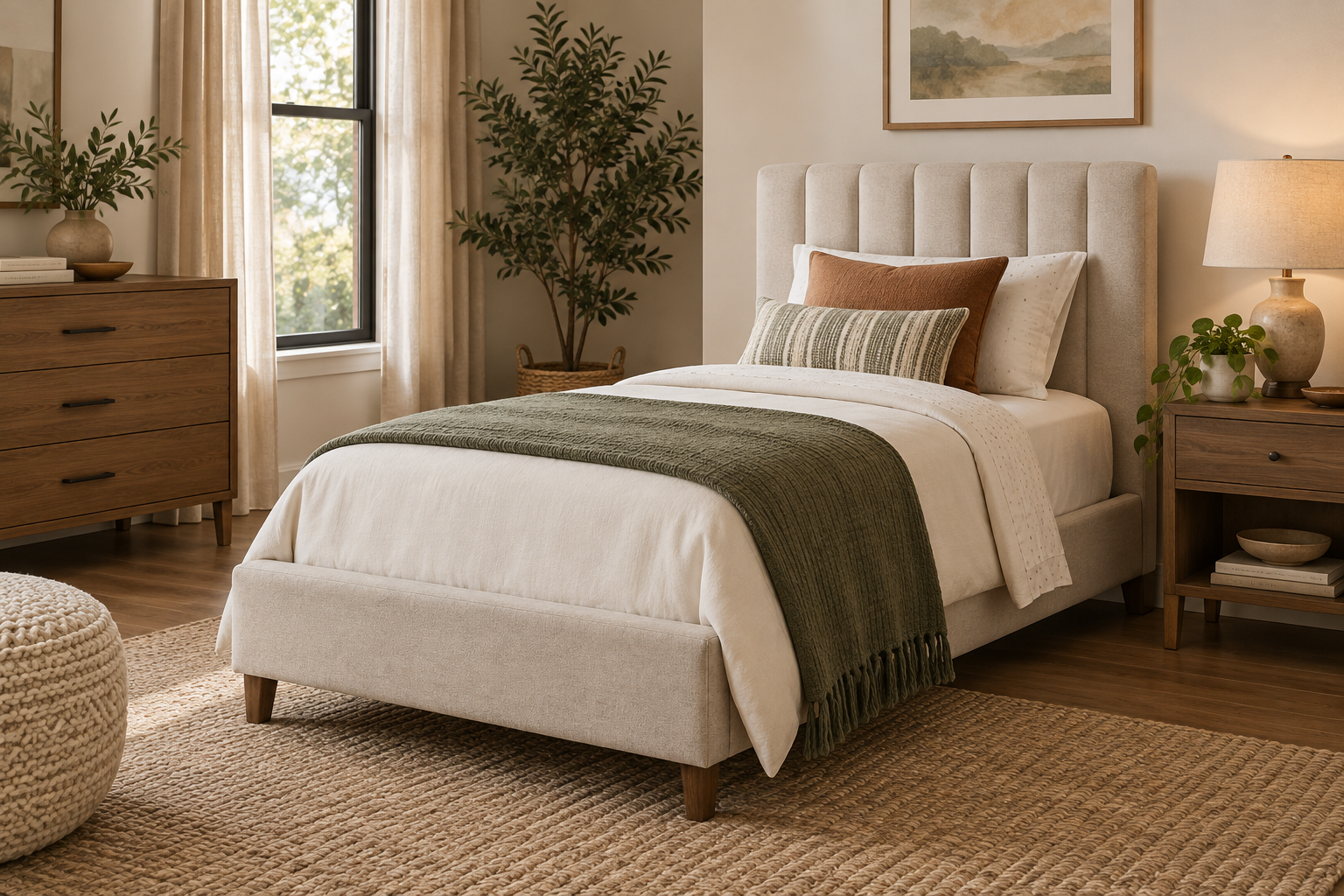
A lower standard storage platform can make a small room feel less crowded and may suit a child transitioning from a low bed. It may provide less drawer height or move storage to the headboard. Low is not automatically safer or more accessible; someone with knee or hip limitations may prefer a higher seat edge.
Measure window sills, wall shelves, and sloped ceilings relative to the finished sleep surface. Do not use an excessively thin or thick mattress to manipulate height outside the frame’s limits. Mattress support and any guard or rail dimensions must remain compliant.
Clearance Can Favor Either Type
Drawer beds need full drawer extension plus a place for the user to stand. A captain’s bed with several side drawers may demand one long open aisle. A model with a trundle needs nearly another mattress footprint when expanded. A standard bed with foot drawers may work better in a narrow room, while lift-up storage can preserve side clearance but requires overhead operating space.
Tape each moving component, not just the frame. Open the bedroom and closet doors over the tape. Position the nightstand and desk chair at their in-use dimensions. If storage access blocks the only route, it is not practical for daily clothing even if it opens technically.
Consider sequencing on a multifunction captain’s bed. Can drawers be opened while the trundle is out? Where does bedding go? Does a bag block a cabinet? Integrated features save pieces of furniture only when their operations coexist.
Assembly and Moving Deserve Real Weight
A box-like captain’s bed can have more panels, runners, fasteners, and alignment steps than a simple platform. Component dimensions matter on stairs and through doors. Assemble on a level floor in the prescribed order, square the frame before final tightening, and use all required supports. Do not drag a loaded bed across the room.
Removable rolling drawers may make a standard storage bed easier to relocate, though mounted slides can provide more controlled movement. Label drawers and hardware during authorized disassembly. A trundle adds another large piece that needs a transport route and storage while the main bed is serviced.
Long-term maintenance includes checking fasteners, runners, casters, and drawer bottoms. Heavy blankets, books, or toys can exceed storage-component limits even when the bed supports a sleeper safely. Bed capacity and drawer capacity are separate specifications.
Organization Style Matters as Much as Capacity
Captain’s beds reward assigned compartments. A drawer for shirts, another for sleepwear, and a shelf for books can keep a small room orderly without extra furniture. They are less successful when one deep drawer becomes a mixed container for toys, bedding, and clothing. The integrated format makes it harder to replace one weak storage zone with a different organizer, so category planning should happen before purchase.
A simpler storage bed can be more forgiving. Removable bins, open clearance, or fewer broad drawers allow the system to change as the occupant grows. A child’s toy bin can become a teenager’s clothing drawer. That flexibility may outweigh the polished built-in appearance, especially in a rental or a bedroom expected to change functions.
Visibility influences whether storage stays organized. Shallow drawers expose more of their contents in one glance; deep drawers require dividers or vertical folding to prevent buried layers. Shelves near the mattress are easy to reach but collect visual clutter. Decide whether the user benefits from open cues or needs closed surfaces to keep the room calm.
Plan an overflow rule. When a drawer no longer closes without pressing, remove or relocate items rather than exceeding the box or runner limit. Leave a small buffer for laundry returning from the wash. A bed can replace furniture only if its compartments remain easy to open, identify, and reset; maximum packed volume is rarely the most usable volume.
Think about ownership when two children share the room. A single broad drawer may have more cubic capacity but create disputes or mixed categories, while smaller compartments establish clearer boundaries. Labels can help without making the furniture look institutional. For an adult, a shallow organizer inside a large drawer can create the same separation and move to another piece later.
Use storage weight where the frame is designed to carry it. Do not concentrate dense books, tools, or equipment in one drawer merely because they fit geometrically. Follow each component’s stated limit and distribute ordinary clothing or linens sensibly. If a category is too heavy to lift comfortably in its drawer, assign it to fixed shelving or another suitable storage location.
Decide by the Furniture the Bed Can Truly Replace
List the proposed functions: daily clothing, spare linens, books, a guest mattress, toys, or bedside objects. Then assign each to an actual verified compartment. A captain’s bed earns its larger presence if it removes a dresser, nightstand, or guest cot without making access worse. If several features remain empty or blocked, a simpler storage bed may be the more efficient purchase.
Run a two-week container trial using boxes close to the advertised drawer interiors. Live from them at floor level. This reveals whether bending, category size, and laundry habits fit the design. Keep existing furniture until the assembled bed proves its capacity.
Choose the captain’s style for integrated, room-specific organization and an acceptable higher profile. Choose a standard storage platform when a lower silhouette, fewer moving parts, or flexible modular bins better fit the household. The best type is the one whose storage gets opened rather than merely admired.
- Verify drawer interiors and access direction.
- Calculate finished mattress height.
- Map trundle, drawer, and door movements together.
- Separate bed capacity from drawer or trundle capacity.
- Credit only the furniture functions the bed genuinely replaces.
Frequently asked questions
Is every captain’s bed a storage bed?
Captain’s beds are generally associated with built-in storage, but configurations vary. Confirm the exact drawers, shelves, or trundle shown for the selected product.
Are captain’s beds higher than regular beds?
They often are because storage occupies the base. Calculate final height from the current frame and approved mattress rather than relying on the style name.
Can a captain’s bed replace a dresser?
It may replace a small dresser when accessible drawer interiors fit the actual wardrobe. Test capacity and low-level access before removing existing furniture.
Can a captain’s bed go in a corner?
Yes if all needed drawers, shelves, and any trundle face open space. Wall-facing compartments should not be counted.
Which type is easier to move?
Simpler platforms with removable drawers are often less complex, but component weight and assembly vary. Review the manuals and never move either bed while loaded.
Final verdict
Captain’s bed describes an integrated storage idea; standard storage bed describes a much wider field. The meaningful comparison is compartment by compartment and motion by motion. Verify interior volume, final height, open clearance, and the furniture each model eliminates. Choose the more substantial captain’s format only when its integrated features match the room. Otherwise, a straightforward drawer platform may deliver more usable storage with less complexity.
Product examples