TwinBed.app practical guide
Twin Bed With Drawers vs. Lift-Up Storage: Which Is Easier to Use?
Storage beds solve a real problem, but the two common mechanisms behave very differently in a lived-in room. A drawer bed borrows space beside or at the foot of the frame. A lift-up bed borrows space above the mattress and turns almost the entire cavity below it into one compartment. That distinction affects where the bed can sit, how often the storage gets used, and whether a child or an adult can reach it comfortably. Compare the complete routine—opening, finding, closing, cleaning, and making the bed—rather than choosing from a capacity photo alone.
Quick answer
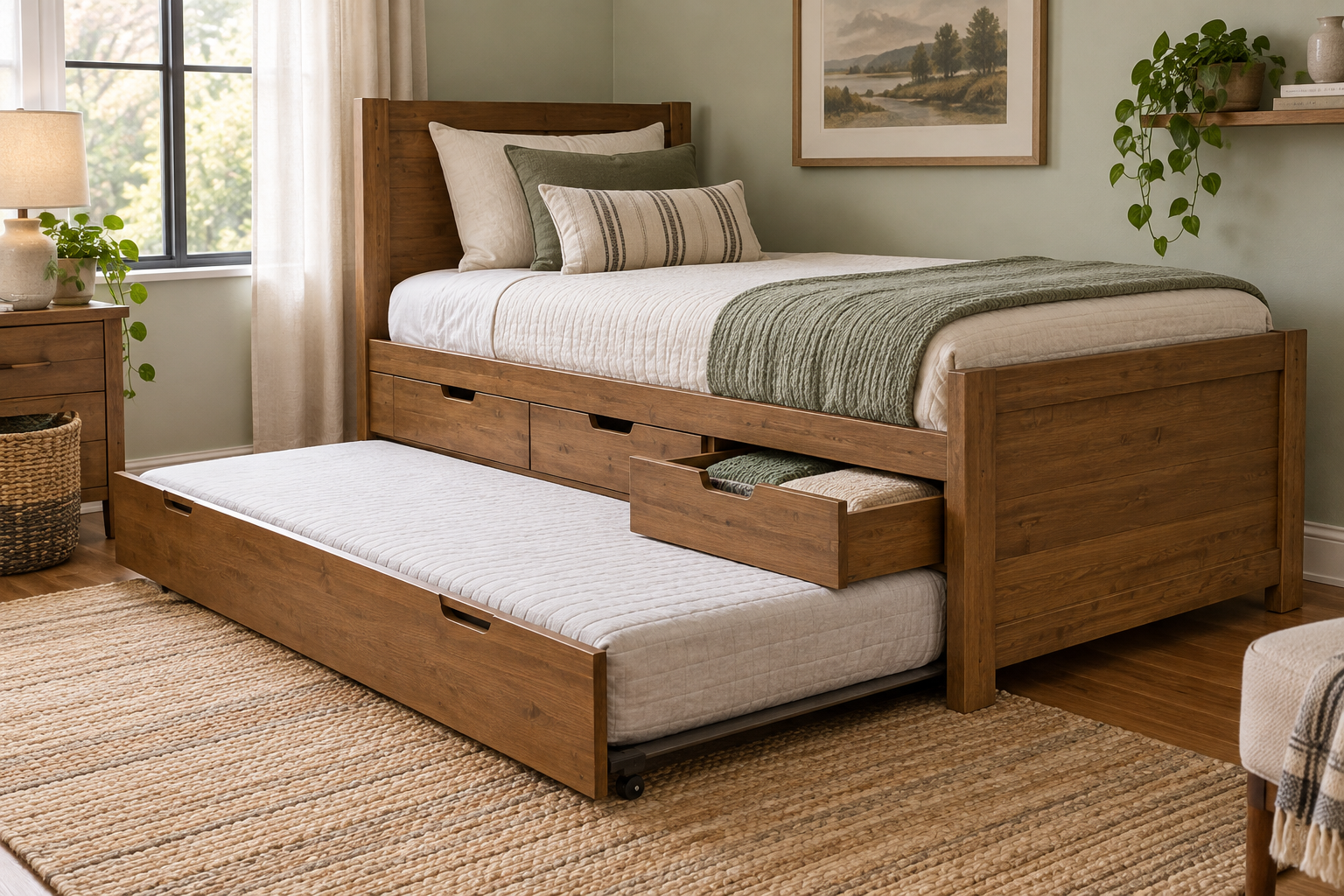
Drawers are usually easier for items you reach every day because they open one section at a time without disturbing the mattress. Lift-up storage usually holds bulkier or seasonal belongings, but opening it requires clear space above the bed and a usable lifting mechanism. The better choice depends less on raw capacity than on access frequency, aisle width, and who will operate the bed.
Start With the Motion Each Bed Requires
A drawer travels horizontally. Before it can open, the floor beside it must be free of a nightstand, hamper, rug edge, toys, and the person pulling it. A nominally deep drawer can demand an aisle almost as deep as the drawer itself. Side drawers therefore work best when at least one long side of the bed faces an open walkway. Foot-end drawers can rescue a bed placed against a wall, but they need room between the footboard and the opposite wall or furniture.
A lift-up deck rotates upward, commonly from the side or foot. It does not need a drawer-sized side aisle, yet it needs vertical and working clearance. Pillows may have to move; a heavy comforter can make the deck awkward; and low shelves or a sloped ceiling can interrupt its arc. The user also needs a safe place to stand while lifting. Sketching that movement on the room plan reveals more than the phrase ‘space saving.’
Daily Convenience Favors Compartments
Drawers naturally divide belongings. One can hold pajamas, another spare sheets, and another shoes. Opening a single compartment keeps everything else contained, which makes drawer storage practical for daily routines. Full-extension runners, recessed pulls, stops, and a drawer bottom that is supported rather than merely stapled all affect ease of use. Casters can roll well on hard flooring but may wander or catch on thick carpet; mounted runners keep alignment but add hardware that can loosen.
Lift-up cavities are closer to a small closet laid flat. They swallow suitcases, off-season blankets, and labeled bins, but an undivided cavity can become a dark pile. Shallow handled containers make the space more manageable. If the bed must be opened every morning to retrieve clothing, the theoretical capacity may not compensate for the repeated lifting and rearranging of bedding. Reserve the deepest zone for low-frequency items and keep routine items close to the opening edge.
Capacity Is More Than Cubic Inches
Lift-up designs usually expose more of the footprint because they do not sacrifice gaps between drawer boxes. That makes them attractive for bulky, soft goods. Nevertheless, usable capacity may be reduced by center supports, hinge hardware, gas struts, or a recessed base. Confirm the interior length, width, and depth instead of assuming the full mattress footprint is empty. Also check whether the platform has ventilation openings and whether the compartment is enclosed from floor dust.
Drawer beds lose some volume to runners, framing, and the need for multiple boxes, but they can be easier to fill efficiently. A wide, shallow drawer may be better for folded clothing than one deep cavity. Count the dimensions of the drawer interior, not its decorative front. Four drawers are not automatically more useful than two: on a twin bed in a corner, drawers facing the wall may be unreachable. Access determines effective capacity.
Who Will Use the Mechanism?
For a child’s room, a light drawer with a safe pull is usually more intuitive than raising a mattress platform. Drawers still require care: fingers can be pinched, overfilled clothing can jam, and an extended drawer becomes a trip hazard. Anchor any separate tall furniture that remains in the room, and teach children to close one drawer before opening another. Follow the bed maker’s age and operating guidance.
A lift-up platform should have a mechanism matched to the deck and mattress. Assistance from gas struts can reduce effort, but it does not make every design suitable for every user. Ask whether the platform stays securely open, where hands belong, and what mattress weight range is supported. Someone with limited grip, reach, balance, or back mobility may prefer drawers even in a tighter room. Ease must be judged by the actual operator, not by a demonstration with an empty platform.
Cleaning, Noise, and Long-Term Upkeep
Drawer tracks collect dust and may need occasional tightening or alignment. Floor-running drawers can be removed for cleaning, though loaded boxes are heavy. On uneven floors, they may roll poorly. Lift-up beds have fewer storage boxes but more consequential moving hardware. Hinges and struts should move symmetrically, fasteners should remain tight, and the deck should never be forced when obstructed.
Noise depends on construction rather than storage type alone. Loose drawer fronts can rattle, while a lift deck can squeak at pivots. Check assembly instructions, slat seating, center supports, and hardware after the first few weeks. Felt pads on removable bins and sensible load distribution can quiet both formats. Do not exceed stated storage or bed weight limits, and avoid packing objects against moving hardware.
Think Through Moving Day and Room Changes
Storage mechanisms also affect how easily the bed adapts later. Drawer boxes are usually removed before the frame is moved, which makes individual pieces lighter but creates several bulky components to carry and protect. Mounted slides can be bent if movers grip the frame in the wrong place. Label each drawer and its original bay during disassembly because small alignment differences can matter when the bed returns together. Never lift a fully loaded storage frame, and use the maker’s assembly sequence rather than improvising around the hardware.
Lift-up platforms often contain a broad deck, hinges, and assisted struts that require careful release or transport. Some mechanisms should not be detached after installation except as directed. The large cavity is useful in one room but cannot compensate for a stair turn or doorway the assembled pieces cannot pass. Review component dimensions as well as final dimensions if the bed will enter an apartment, attic room, or narrow hall.
Future layout matters, too. A drawer arrangement chosen for a left-side aisle may fail after the room becomes a home office or a sibling moves in. Reversible drawers, foot access, or storage that is independent of the frame can offer more flexibility. A lift-up bed is less dependent on side aisles but more dependent on overhead freedom and operator strength. If the room is likely to change soon, give adaptability almost as much weight as capacity.
A Room-by-Room Decision Test
Choose drawers when an open side or foot aisle exists, storage will be accessed several times a week, and organization into separate zones matters. Models such as the Giantex Twin Bed with Storage Drawers or Harper & Bright Designs Twin Platform Bed with Two Drawers illustrate this familiar arrangement, though exact dimensions and drawer direction must be verified on the current listing. A four-drawer design can add separation when both sides remain accessible.
Choose lift-up storage when side clearance is scarce, the user can operate the deck safely, and the main need is seasonal or bulky storage. Before ordering, tape the assembled bed outline on the floor, mark the opening side, and rehearse where the user will stand. Then compare interior dimensions and hardware details. This short physical test often overturns a choice based solely on appearance.
- Measure open-drawer depth or lift-deck arc, not only closed-bed dimensions.
- List five items that will live in the bed and how often each is needed.
- Check carpet thickness, baseboards, radiators, and bedside furniture.
- Confirm mattress-weight guidance and safe operating instructions.
Frequently asked questions
Do storage-bed drawers need extra room?
Yes. They need enough clear floor area to travel fully plus space for the user to stand and pull. Use the manufacturer’s drawer depth and assembled dimensions; do not estimate from the mattress width.
Is lift-up storage suitable for daily clothing?
It can be, but frequent access means lifting bedding and the platform repeatedly. Daily clothing is often easier in drawers or shallow bins positioned near the lift opening.
Which type keeps out dust better?
An enclosed lift-up base may block more floor dust, but construction varies. Drawers with enclosed boxes also protect contents reasonably well. Lidded bins are useful in either design.
Can a storage bed sit against a wall?
Yes if its accessible drawers or lift direction remain usable. A side-drawer bed against that same side wall may sacrifice part of its storage.
Are four drawers always better than two?
No. Four drawers improve sorting only when all open freely. Two larger drawers can be more useful in a room with one open side or for bulky belongings.
Final verdict
Drawers win on quick, divided access; lift-up storage wins on uninterrupted volume. Neither is universally easier. Map the mechanism in the actual room, consider the operator’s reach and strength, and match the compartment style to the belongings. A bed that stores slightly less but opens without moving furniture will usually serve better than a high-capacity design that becomes inconvenient after installation.
Product examples