TwinBed.app practical guide
How Much Clearance Do Twin Storage Drawers Need?
Closed dimensions tell only half the story of a storage bed. A frame may fit neatly between two walls and still leave its drawers unusable. Clearance is a moving measurement: the distance consumed by the open drawer, the person pulling it, and anything that must continue to pass behind that person. A careful plan uses the exact drawer direction and extension. When those specifications are unavailable, conservative mockups are safer than assuming every drawer stops halfway beneath the mattress.
Quick answer
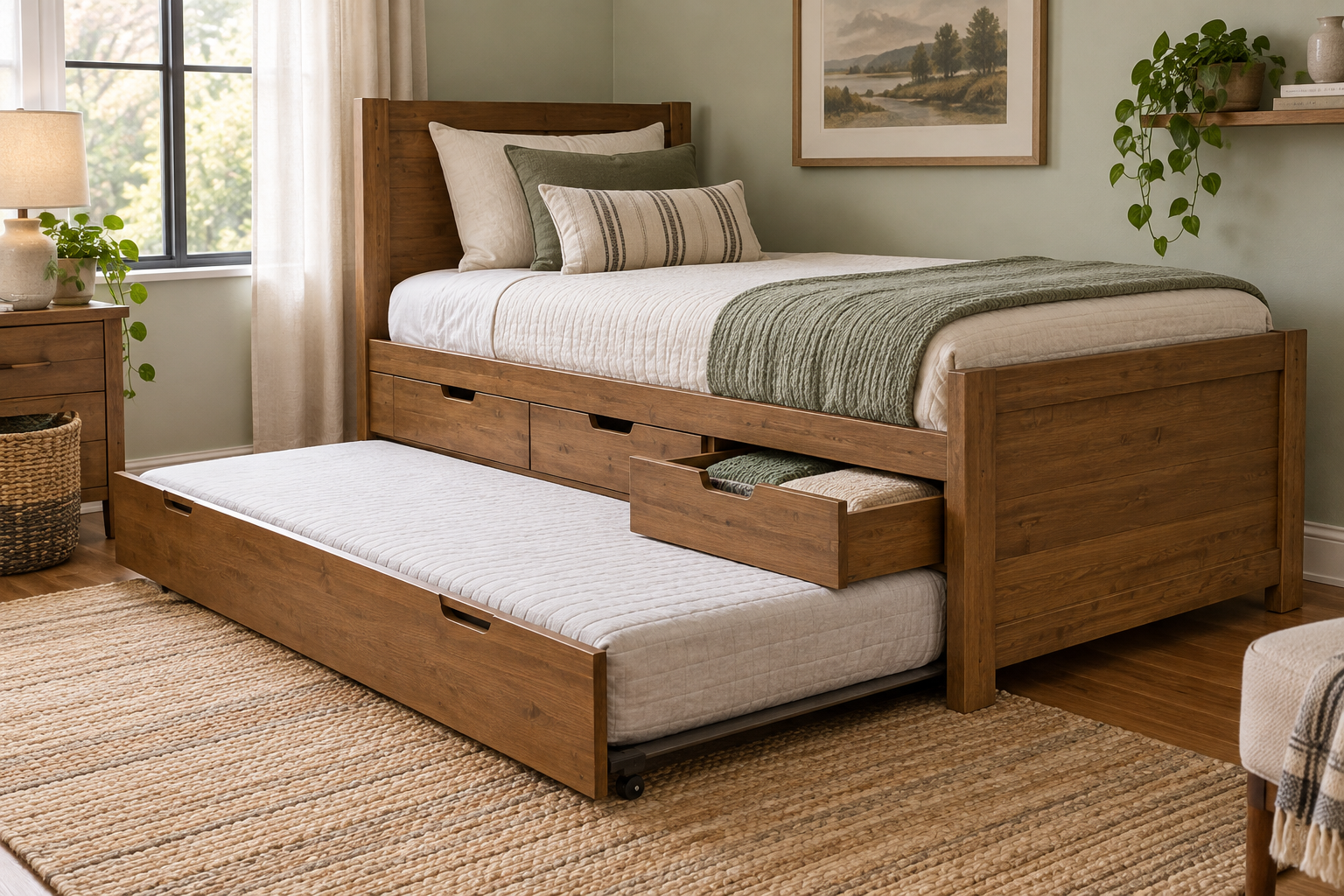
A twin storage drawer needs its full open depth plus enough space for a person to stand and operate it. Because drawer dimensions vary, there is no universal number. As a planning method, add the manufacturer’s stated drawer extension to roughly 18–24 inches of working room, then check doors, furniture, rugs, and traffic paths in that same zone.
Three Clearances, Not One
First is mechanical clearance—the distance from the closed drawer front to its farthest open position. Second is operating clearance—the space for hands, knees, and torso while pulling and looking inside. Third is circulation clearance—the route another person needs through the room. These zones can overlap only when the drawer is opened infrequently and the room is otherwise quiet. Daily clothing drawers deserve a more generous working aisle than seasonal linen drawers.
A useful formula is drawer extension plus operator space. If a drawer extends 22 inches, adding 18 to 24 inches creates a planning zone of about 40 to 46 inches from the closed front. This is a design allowance, not a product specification or building code. A small child may physically occupy less room, while an adult kneeling to reach the back may need more. Test with the intended user.
Find the Extension the Listing Does Not Highlight
Look for an assembly diagram, dimension drawing, or manual showing drawer-box depth and runner travel. Overall drawer-front width is not extension. A drawer on fixed slides may stop before the back is fully visible; a loose drawer on casters can roll completely out. When documentation gives only bed dimensions, contact the seller rather than converting a marketing image into inches.
Until exact information is available, place painter’s tape from the bed side to a conservative open position. Put a laundry basket or cardboard box within that outline and practice opening it beside a nightstand. This catches conflicts that a top-down floor plan misses, including a low drawer front hitting a rug ridge or the operator backing into a desk chair.
Side Drawers and Foot Drawers Behave Differently
Side drawers use the long aisle, which is often where a nightstand and bedroom door already compete. A pair of shorter side drawers may each extend less than one large box, but both require access along the bed. If drawers appear on both sides, a corner placement may render half of them useless. Count only the compartments that can open in the final arrangement.
Foot-end drawers concentrate the clearance beyond the mattress. They can work when both bed sides are tight, but a dresser, desk, or inward-swinging door opposite the foot can block them. They may also open into the main entry path. Map the drawer while the room door and closet door are open; bedrooms are used with more than one moving object at a time.
Floor Conditions Change Real Clearance
Floor-running drawers need a smooth route. Thick carpet increases resistance and may lift the box enough to rub the frame. A rug edge can stop a small caster. Hard floors roll more easily but may allow an untethered drawer to drift or mark the surface. Check whether the design uses mounted slides, guided wheels, or independent boxes, then follow its installation instructions.
Baseboards create a subtle problem when the bed sits close to a wall: the frame may stand farther out at the bottom than expected, and a drawer face or handle can meet trim during movement. Radiators, floor vents, and power cords also need protection. Never route a cord through the drawer path. Measure at floor level, not only at mattress height.
Measure the Human Task
The user rarely opens a drawer empty-handed. Imagine holding folded laundry, kneeling, placing items, and closing the compartment. Can the drawer stay open without blocking the only exit? Can someone reach its back without stepping into another piece of furniture? For a child, can the drawer be operated without pulling from one corner and twisting it? A comfortable routine requires more than a technically unobstructed front.
Accessibility needs deserve a full-scale test. Someone using a mobility aid may need a turning area that the standard estimate does not provide. If bending is difficult, storage headboard shelves or a conventional dresser may be more practical. The bed should support the user’s habits rather than forcing a difficult motion because the product is labeled space-saving.
Account for Tolerances and Installation Reality
Rooms and furniture are rarely as square as a diagram. An old wall can bow, a floor can slope, and baseboards can push the frame farther into the aisle. Drawer boxes also need a little lateral freedom so their faces do not scrape. Do not plan a zero-clearance fit from rounded catalog measurements. Leave a margin, and measure at several points along the wall and floor rather than taking one reading near the mattress center.
Assembly position can affect alignment. Tighten the frame on a level surface in the order shown, square it before final tightening, and install anti-tip or anchoring components whenever supplied or required. If a mounted drawer binds, diagnose alignment instead of shaving parts or forcing it. For floor-running drawers, check that all wheels carry the load evenly. A drawer that opens during an empty test may behave differently after it holds blankets, so repeat the clearance check at a realistic load within the stated limit.
Wall protection deserves attention in an extremely close layout. A handle or drawer corner that stops one inch from drywall under ideal alignment may touch it when the frame shifts. Bed movement also can narrow the opposite aisle. Non-slip feet or manufacturer-approved placement may help, but never attach the bed to a wall unless directed. Recheck the taped plan after accounting for trim, hardware projections, and the actual frame’s tendency to move.
Finally, distinguish minimum movement from comfortable use. A drawer that clears by a quarter inch may technically open, yet require perfect positioning every time. That fragile arrangement will be frustrating after bedding hangs over the side or a rug creeps. A few inches of resilience can be more useful than selecting the largest possible drawer. If the room cannot provide that resilience, bins reached from the foot or storage elsewhere may be the more dependable choice.
Photograph the taped layout and record the final measurements before shopping. That small record makes it easier to reject a similar-looking frame whose drawers open in the wrong direction. It also helps household members compare the same constraints instead of relying on memory. Recheck the numbers if flooring, baseboards, or a large piece of furniture changes before delivery.
Tape the Final Choice Before Ordering
Mark the assembled frame, not the 38-by-75-inch mattress alone. Add the headboard and footboard projection from current specifications. Mark every drawer’s open rectangle in a different tape color, then place existing furniture at its true dimensions. Walk the route at night, open the closet, and pull out a substitute box. A five-minute mockup can prevent living with permanently blocked storage.
Storage models differ: the Harper & Bright Designs Twin Platform Bed with Two Drawers, Giantex Twin Bed with Storage Drawers, and FORABAMB Twin Bed Frame with Four Storage Drawers should each be evaluated from their own current dimensional diagrams. Never transfer one model’s extension to another simply because both fit a twin mattress.
- Use assembled-frame width and length.
- Add exact drawer extension when available.
- Allow space for the operator and laundry in hand.
- Test door swings, rugs, vents, and nightstands.
- Do not count wall-facing drawers as storage.
Frequently asked questions
Is 24 inches enough in front of a storage drawer?
It may allow some drawers to open, but it may not leave room for a person once open. Add exact extension and operating space rather than relying on 24 inches as a universal aisle.
How do I measure clearance when drawer depth is missing?
Request the assembly manual or interior dimensions. Meanwhile, mock up a conservative full-depth box; do not assume the photograph is scaled accurately.
Can storage drawers roll over carpet?
Some can, but thick pile and rug edges may increase resistance or cause rubbing. Confirm the wheel or slide design and test the floor route.
Can I block one side of a four-drawer bed?
The bed may physically fit, but blocked drawers cease to be useful. Ensure doing so does not conflict with assembly, ventilation, or manufacturer guidance.
Should clearance be measured from the mattress?
No. Measure from the outermost closed drawer front or frame edge because the assembled bed is wider and longer than the mattress.
Final verdict
The reliable answer is a method, not a single number: exact drawer extension plus room for the user and the remaining traffic path. Measure at floor level, map every moving door and drawer, and test with a box before buying. Storage is valuable only when it can be reached without rearranging the bedroom.
Product examples