TwinBed.app practical guide
Platform Bed vs. Traditional Bed Frame for a Twin Mattress
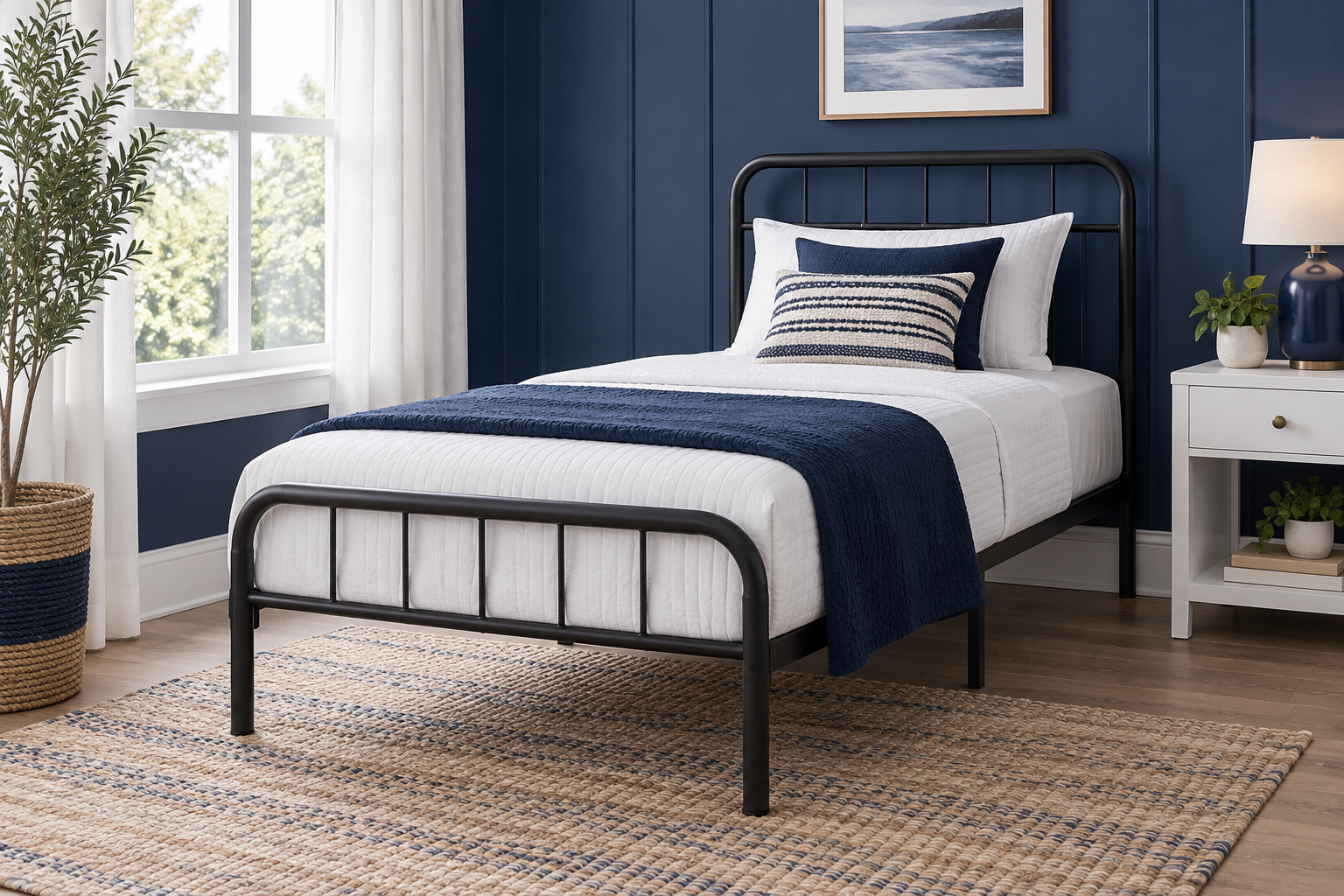
The phrase bed frame is broad enough to hide the most important difference in this comparison. A platform includes the surface that supports the mattress. A traditional rail frame generally outlines the bed and carries a separate foundation, which then supports the mattress. Both can work well, but they distribute cost, height, storage, moving effort, and future replacement decisions differently.
Quick answer
Choose a twin platform when you want built-in mattress support, fewer layers, and often useful underbed space. Choose a traditional rail frame when you already have a compatible foundation, want its additional height, or need a flexible headboard arrangement. Compare complete systems rather than frame labels.
Follow the support path
A platform uses slats, a metal grid, or a solid deck to transfer load into rails and legs. Direct placement is appropriate only when that deck meets the mattress maker’s spacing and surface rules. The phrase no box spring needed is useful, but it does not replace measurement.
A traditional rail frame uses a box spring or rigid foundation as a structural layer. Sparse crossbars position that foundation; they are not necessarily a mattress deck. Removing the foundation can create large unsupported areas even when the rails remain stable.
Some foundations marketed as box springs are rigid rather than springy. Identify the actual construction because a modern mattress may permit one type and reject another.
Compare the entire purchase
A platform price may include rails, legs, slats, headboard, and footboard. A traditional frame may still need a foundation, brackets, and decorative pieces. List every required component before comparing convenience or value.
If you already own a compatible foundation in good condition, a rail frame can reuse it. If stairs or doors make that foundation hard to move, a platform with smaller disassembled parts may be easier despite having more hardware.
Account for replacement cycles. A platform ties support and furniture together; a damaged deck may require model-specific parts. A traditional system lets a foundation be replaced separately, provided the frame remains sound.
Calculate finished height
Add floor-to-support height, mattress thickness, and any foundation, then subtract mattress recess. A rail frame plus foundation often sits taller, but tall open platforms also exist. Category names do not establish seat height.
A higher surface can help some adults stand, yet it may cover a headboard, challenge a child, or dominate a small room. A low platform can make the room feel open but leave little cleaning or storage clearance.
Headboard proportions depend on the stack. Compare the top of the mattress and pillows with visible headboard features, not with the empty frame photograph.
Storage and cleaning
Open platforms may provide room for bins, but braces and center legs interrupt usable volume. Storage platforms replace open space with drawers or shelves. Traditional frames can also provide clearance, though a box spring does not create storage by itself.
Measure the lowest entrance and the clear path around legs. Robot vacuums need enough height and navigation room. A bed skirt can conceal bins but may block sensors or collect dust.
Drawer systems need extension space beyond the bed. A nominally efficient storage frame can fail beside a wall or nightstand if the drawers cannot open.
Mattress and user fit
Foam and hybrid mattresses commonly pair well with approved platforms, while some traditional mattresses may be designed around foundations. The documentation for the exact mattress controls. Do not infer compatibility from material alone.
For a child, a moderate direct-support height and fewer loose layers may simplify use. For an adult guest, edge stability and sit-to-stand height may matter more. Frequent movers may prioritize compact components and connectors that tolerate repeated assembly.
Bunks, lofts, trundles, and adjustable bases are special systems rather than ordinary versions of either category. Their mattress thickness, clearance, and motion rules take priority.
Compare representative constructions
The ZINUS Abel Metal Platform Bed Frame – Twin Option illustrates an open metal platform, while the Harper & Bright Designs Solid Wood Twin Platform Bed uses a furniture-style direct-support structure. The ZINUS Compack Adjustable Metal Bed Frame represents a separate-foundation approach.
Use those examples to compare architecture, not to assume specifications. Check the exact size, deck, capacity, dimensions, and included components on the current listing. A photo of another size can show different center support.
The better choice is the system whose required parts are known, whose completed height works for the sleeper, and whose support surface satisfies the mattress.
A decision worksheet
Write down the mattress model and approved support types. Inventory components you already own. Measure room access, desired top height, underbed clearance, and headboard position. Then price or compare the complete systems.
Eliminate any option with unclear support, a poor access height, or unusable storage. Among the remaining choices, consider appearance, moving frequency, and repairability.
This order prevents style from overriding compatibility. It also makes future mattress replacement easier because the support surface and its dimensions are documented.
How the systems behave over time
A platform concentrates routine inspection in the frame itself. Slats can shift, caps can loosen, center feet can lose contact, and bolts can settle after initial use. These are visible once the mattress is removed, and many are straightforward to diagnose if the manual and parts remain available. The drawback is that a proprietary deck can be difficult to replace years later if the model has disappeared.
A traditional system divides inspection between frame and foundation. The rail frame can remain square while the foundation develops a sag, broken internal member, or noise. Conversely, a healthy foundation cannot correct spreading rails or a missing crossbar. Test the layers separately when comfort changes. Replacing the mattress without inspecting the foundation can carry the old support problem into the new purchase.
Think about the next mattress before committing. A platform that works for the current innerspring may have gaps too large for a future foam model. A flexible old box spring may not suit a new hybrid even though its dimensions match. No frame must accommodate every possible future mattress, but documented deck measurements reveal how much flexibility the system offers.
Room changes matter too. Moving from hard floor to deep carpet can alter center-foot contact. Adding a thick rug can make storage bins unusable. A new headboard can change bracket needs, and a thicker mattress can erase its visible panel. Compare the adaptability of the complete bed rather than treating support as a decision made once.
Finally, distinguish fewer parts from less maintenance. A platform may remove the separate foundation but add many slats and retainers. A rail frame may have few metal pieces yet depend on a bulky foundation whose interior cannot be repaired easily. The better ownership experience is the one whose important components can be inspected, understood, and replaced without improvising.
Bed-making changes with the system. A mattress recessed inside a platform rail can stay visually tidy, yet the fitted sheet may be harder to pull around the lower corners. A foundation lifts the mattress edge above many rails, making linen changes easier but exposing more of the sleep stack. Someone with limited grip or reach should rehearse the sheet-changing motion at the proposed finished height rather than judge access from an empty frame.
Noise diagnosis follows different paths. On a platform, a squeak can begin where slats meet ledges, where center feet contact the floor, or where frame joints move. On a traditional setup, the foundation adds internal members, a fabric cover, and contact points with the rails. Isolate layers before tightening everything. Never continue using a visibly damaged component merely to complete a comparison.
Ventilation is a support consideration rather than a slogan. Widely open slats permit airflow but must remain close enough for the mattress. A solid deck can create even support yet may require specific ventilation provisions. A foundation has an internal structure and cover whose airflow varies by design. Follow mattress guidance for moisture management and keep the room ventilated; no base compensates for persistent dampness.
Moving frequency can reverse the apparent convenience. A platform may break into rails, slats, and compact legs that fit a car, but repeated assembly can wear threaded inserts or invite missing retainers. A traditional rail frame may fold or separate quickly while its rigid foundation becomes the largest object on the staircase. Record the longest and bulkiest components before calling either system easier to move.
The systems create different repair boundaries. If one platform slat cracks, the frame may accept an approved replacement. If a proprietary welded grid bends, options may be limited. A traditional rail frame can outlast several foundations only while brackets and crossbars remain compatible. Ask how support parts are obtained, not solely how long the furniture finish is covered.
Room use should settle a close decision. A platform with clear underbed height can serve a compact bedroom where every bin matters. A traditional frame plus foundation may suit a guest room where familiar height and easy linen changes matter more. Neither deserves a universal recommendation; choose the complete support stack whose measurements, service points, and daily motions fit the sleeper.
Before ordering, sketch each complete stack from floor to mattress top and list every included and separate component. That final drawing catches missing foundations, unexpected brackets, and height assumptions while return decisions remain manageable.
Frequently asked questions
Is a platform better for a foam mattress?
It can be when its deck meets the foam mattress’s requirements. Platform is a category, not proof that the slat gap or ventilation is correct.
Can I put a foundation on a platform?
Sometimes, but it may be redundant and create excessive height. Verify frame approval, load conditions, and headboard proportions.
Which type is easier to move?
A simple rail frame may fold compactly, but it requires moving a foundation. A platform has more parts but removes that bulky layer.
Do platforms always provide more storage?
No. Tall open platforms can, while low platforms offer little. Measure braces, legs, and actual entrance clearance.
Final verdict
A platform is an integrated support system; a traditional frame is one layer of a support system. Choose by mattress compatibility, complete component list, finished height, usable storage, and moving realities. Those facts matter more than assuming one category is more modern or inherently stronger.
Product examples