TwinBed.app practical guide
Twin Bed Underbed Clearance: How Much Storage Space Will You Get?
A raised twin frame can appear to offer a generous storage zone while providing surprisingly little usable space. The difference comes from the way clearance works in practice. A container has to pass the outer rail, avoid bolt heads and diagonal braces, travel across the floor, and remain accessible after bedding hangs over the side. The highest open pocket beneath the mattress is irrelevant if the side opening is lower. A careful measurement turns that irregular volume into a realistic storage plan. This guide explains where to measure, which obstructions matter, how to compare bins with drawers, and when a taller frame creates more inconvenience than capacity.
Quick answer
Usable underbed clearance is the smallest vertical opening between the floor and any rail, bracket, center support, or hardware that a container must pass beneath. Do not estimate it from the frame's advertised height. Measure at the exact entry side, then subtract room for the bin lid, handles, floor covering, and comfortable movement. Also map legs and braces before choosing container width or length.
Define usable clearance before measuring
Start by separating three measurements that are often confused. Overall frame height runs from the floor to the top of the support deck or another stated point. Underbed clearance describes open vertical space beneath part of the frame. Entry clearance is the opening a bin must actually pass through. For storage planning, entry clearance is usually the controlling number. A bed may have a high deck but a deep side rail, decorative apron, or low crossbar. Those features reduce the opening even though the central cavity looks tall when viewed from the foot of the bed.
The safe working figure is the smallest height along the intended path. Measure from the finished floor surface to the lowest fixed obstruction above it. That obstruction might be the bottom edge of a rail, a center beam, the end of a fastener, or a support bracket. If the bed stands on carpet, measure from the compressed carpet under a firm ruler or a flat scrap of board rather than pushing the tape tip loosely into the pile. Repeat the check at several points because floors, rugs, and frames are not always perfectly level.
Treat storage dimensions as external dimensions. A bin described by its internal capacity may have a taller lid, flared rim, wheels, or handles. Likewise, soft bags can bulge after loading. Leave a practical movement margin instead of matching the container height exactly to the opening. That margin lets the container cross a rug edge, clear a slightly uneven floor, and come out without scraping the rail. The goal is not to fill every fraction of an inch; it is to create storage that remains easy enough to use regularly.
- Measure the side or foot opening you will truly use.
- Record the lowest rail, bolt, brace, and center-support point.
- Compare those measurements with the container's maximum outside dimensions.
- Reserve extra height for a lid, wheels, handles, and lifting angle.
Map the entire storage path, not just one opening
Underbed space is rarely one uninterrupted rectangle. Legs divide the perimeter, a center support may split the interior, and diagonal braces can narrow the route as a box moves inward. Draw a simple overhead sketch of the frame. Mark every leg and support that reaches the floor, then measure the clear bays between them. A long container may fit through the opening yet collide with a middle leg before it is fully concealed. Two shorter containers can sometimes use the same volume more effectively because each stays within one structural bay.
Next, test the pull-out path beyond the bed. A bin as deep as the bed is useful only when there is enough open floor beside the frame to withdraw it. A wall, dresser, desk chair, or inward-swinging door can stop the container halfway. Measure from the bed rail to the nearest obstacle with the room in its normal arrangement. If the aisle is narrow, choose shallow boxes that can be removed individually or plan access from the foot. Do not assume that rotating a loaded bin in a tight aisle will be comfortable.
Bedding changes access as well. A comforter that drops near the floor hides storage attractively, but it must be lifted every time a container is used. A fitted cover or shorter quilt leaves handles visible. Decide whether concealment or quick access matters more. Frequently used clothing benefits from small, light containers near the easiest opening. Seasonal items can occupy the harder-to-reach center. This zoning approach makes the same measured capacity more useful without changing the frame or adding permanent components.
- Sketch support legs as fixed islands inside the footprint.
- Measure bay width and depth separately.
- Check withdrawal space beside the bed.
- Assign daily items to the most accessible bays.
Calculate practical container dimensions
Once the limiting opening is known, convert it into a shopping limit. Start with the measured vertical entry and subtract a modest handling allowance. Then use the narrowest bay width, again allowing room for fingers and imperfect alignment. For depth, use the shorter of the interior bay and the clear floor available for pulling the container out. These are not universal deductions because lids, floors, and usage differ. The important discipline is to write a maximum outside height, width, and depth before looking at products rather than trying to justify a favorite bin afterward.
Container shape affects whether the numbers translate into easy movement. Straight-sided boxes use a rectangular bay predictably, while tapered boxes sacrifice interior volume but may nest when empty. Wheels help on hard flooring, although they add height and can roll into a low cross member. Flexible zip bags tolerate a slightly irregular cavity, but overfilling can make them taller than expected and harder to slide. Handles should face the access side and remain reachable beneath the rail. If handles fold upward, include their lifted height in the entry test.
A cardboard mock-up is an inexpensive final check. Cut or fold a box to the proposed outside profile, add a little temporary weight, and move it along the complete route. The test reveals snagging hardware, rug friction, or a turn that a tape measure did not capture. It also shows whether the user can grip the container without kneeling awkwardly. When measuring for a child or someone with limited mobility, ease of reach may justify smaller bins even if larger ones technically fit.
Compare open space, drawers, and trundles
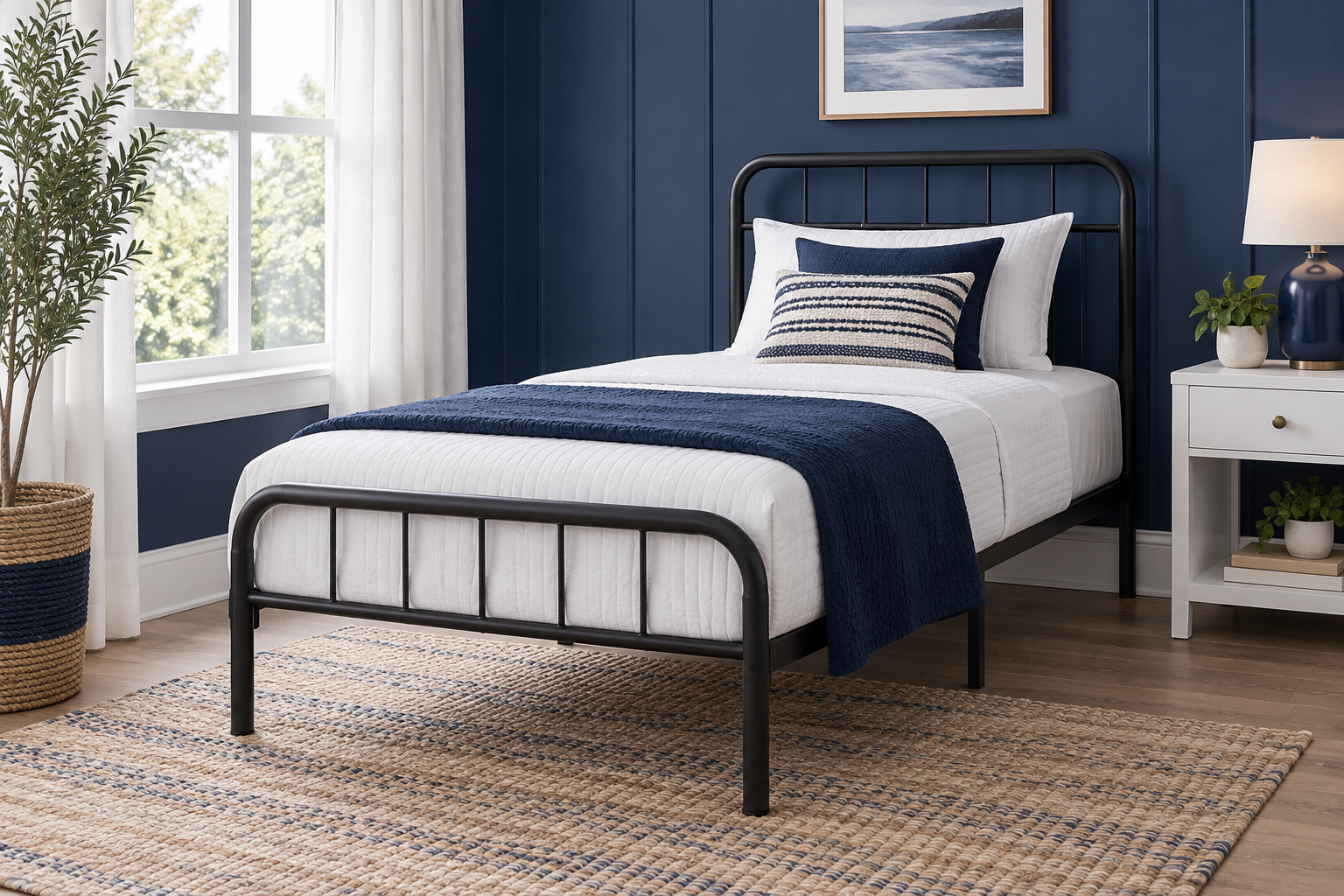
An open platform frame offers flexible underbed storage because containers are not tied to built-in hardware. You can change sizes, remove everything for cleaning, or leave the area empty. The tradeoff is that bins, dust protection, and labeling become separate decisions. Models such as the VECELO 14-Inch Twin Metal Platform Bed and the Yaheetech 13-Inch Twin Metal Bed Frame signal underbed-clearance intent in the catalog, but the product page and assembly instructions remain the authority for exact dimensions and obstructions.
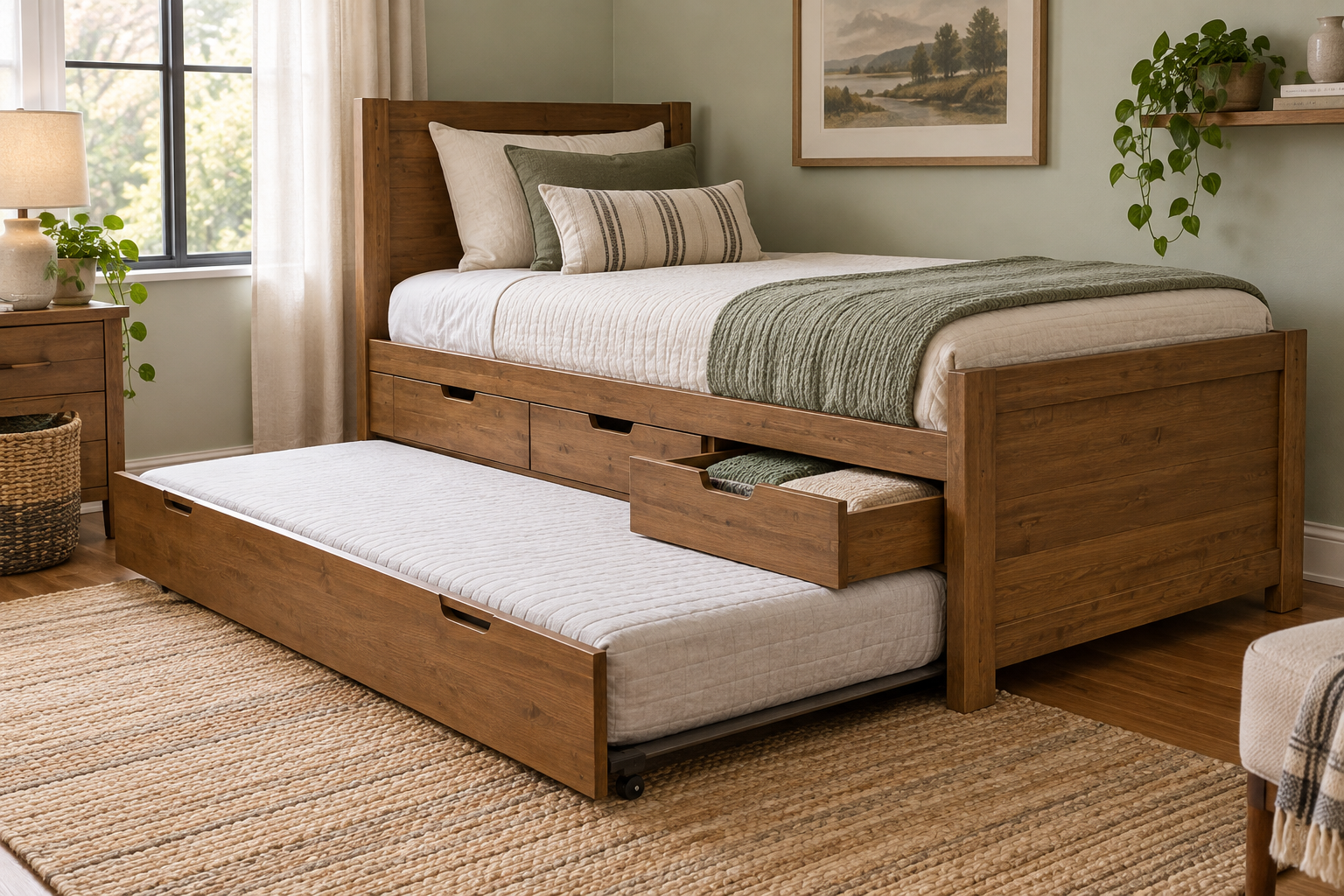
Built-in drawers organize the footprint differently. They establish their own box, runners, or casters and usually create a more finished appearance. Their useful capacity depends on internal drawer dimensions, not the open space below the support deck. They also need a clear extension zone beside the bed. The Wood Twin Platform Bed with Storage Drawers represents this storage-first category. When comparing it with an open frame, measure the room path as carefully as the drawer itself, including knobs, bedding overhang, and nearby furniture.
A trundle occupies the same general zone but should not be counted as ordinary storage unless its instructions permit that use. It is a moving sleep platform with mattress-clearance, rolling, and access requirements of its own. Mixing loose objects around a trundle can interfere with operation. Decide early whether the area must hold containers or a second sleep surface. Trying to preserve both functions in one crowded cavity usually makes each less reliable and increases the chance that objects will catch in moving parts.
Plan for floors, dust, and routine access
Floor type changes the practical result. On a hard surface, grit trapped beneath a bin can scratch as it slides. Felt pads may reduce abrasion but can gather debris, while small wheels concentrate load in narrow tracks. On carpet, broad containers can drag and their bottom panels may bow when loaded. Test the actual combination instead of assuming that a container labeled for underbed use will move well everywhere. A thin, washable mat can define the storage zone, but its thickness must be included in the clearance measurement.
Dust control should be designed into the system. Lidded containers or zippered bags protect textiles better than open baskets, yet every closure adds edges that can catch beneath a rail. Vacuum around supports before loading the area, and keep a small gap from walls so air and cleaning tools can reach the perimeter. Avoid packing damp textiles or blocking any ventilation details specified by the manufacturer. Storage should remain dry, stable, and inspectable rather than becoming a sealed space that is ignored for months.
Finally, set an access rhythm. If the bed must be moved each time something is needed, the storage plan is too ambitious. Label the outward-facing end, keep related items together, and avoid making one heavy container the gatekeeper for everything behind it. Periodically check that fasteners remain tight and that bins have not begun rubbing against structural parts. Underbed storage is successful when it supports the room's routine, not merely when the maximum possible volume has been occupied.
Use a final clearance checklist before buying
Review the frame documentation before treating any catalog phrase as a measurement. Confirm the assembled size, the location of center supports, and whether the diagram provides an explicit floor-to-rail dimension. Photos can help identify likely obstructions, but perspective makes them unreliable for scale. If a critical measurement is absent, ask the seller or wait until the frame is assembled before ordering containers. Buying bins first can lock the room into a storage plan the structure cannot accommodate.
Record your results in a small table with separate entries for side opening height, foot opening height, clear bay width, usable interior depth, and pull-out floor space. Add notes for carpet, baseboards, outlets, heating vents, and bedding. This record makes later replacements easier and prevents a household member from buying by a single height figure. It also clarifies whether both sides of the bed need to remain open or one side can sit against a wall.
The best configuration often leaves some space unused. A little vertical and lateral tolerance protects the frame finish, keeps lids from popping open, and allows seasonal swelling in soft goods. It also makes cleaning and inspection possible. Choose containers based on the smallest verified route, distribute weight so each box remains manageable, and preserve access to any fasteners the instructions say to inspect. Those choices turn measured clearance into dependable storage rather than a one-time packing puzzle.
Frequently asked questions
Where exactly should I measure twin bed underbed clearance?
Measure from the finished floor to the lowest fixed obstruction along the container's entry and travel path. Check the rail, brackets, bolts, braces, and center support at several points, then use the smallest result.
Can I use the advertised frame height to choose bins?
No. Overall height may include the support deck or other structure and does not show the lowest opening. Use an explicit underbed-clearance dimension or measure the assembled frame.
How much extra room should a storage bin have?
Leave enough tolerance for the lid, handle, floor variation, rug edges, and a comfortable pull. There is no single deduction for every setup, so test the route with the container's maximum outside dimensions.
Are wheeled bins better under a twin bed?
They can be easier on some floors, but wheels add height and may concentrate pressure or catch on braces. Include them in the outside measurement and test how they behave on the actual flooring.
Should I choose built-in drawers instead of loose bins?
Choose drawers for an integrated look and defined compartments; choose open clearance for flexibility. Both need unobstructed pull-out space, and drawers should be compared by internal capacity and extension path.
Final verdict
Useful twin bed underbed clearance is determined by the tightest opening and the full movement path, not by the tallest empty point beneath the mattress. Measure the assembled structure, map every support, account for the floor and bedding, and shop from maximum external container dimensions. A system with comfortable margins and sensible access will usually outperform one that fills every possible inch.
Product examples