TwinBed.app practical guide
Single Bed vs. Twin Bed: Are They the Same Size?
People often search for a hidden size difference between single and twin. In the United States, there usually is none: the distinction is linguistic rather than physical. The complication is that both words travel. They appear in hotel room names, international product catalogs, and casual descriptions of who can sleep in a room. A sound comparison explains the American equivalence while preserving enough caution for settings where the terms no longer guarantee 38 by 75 inches.
Quick answer
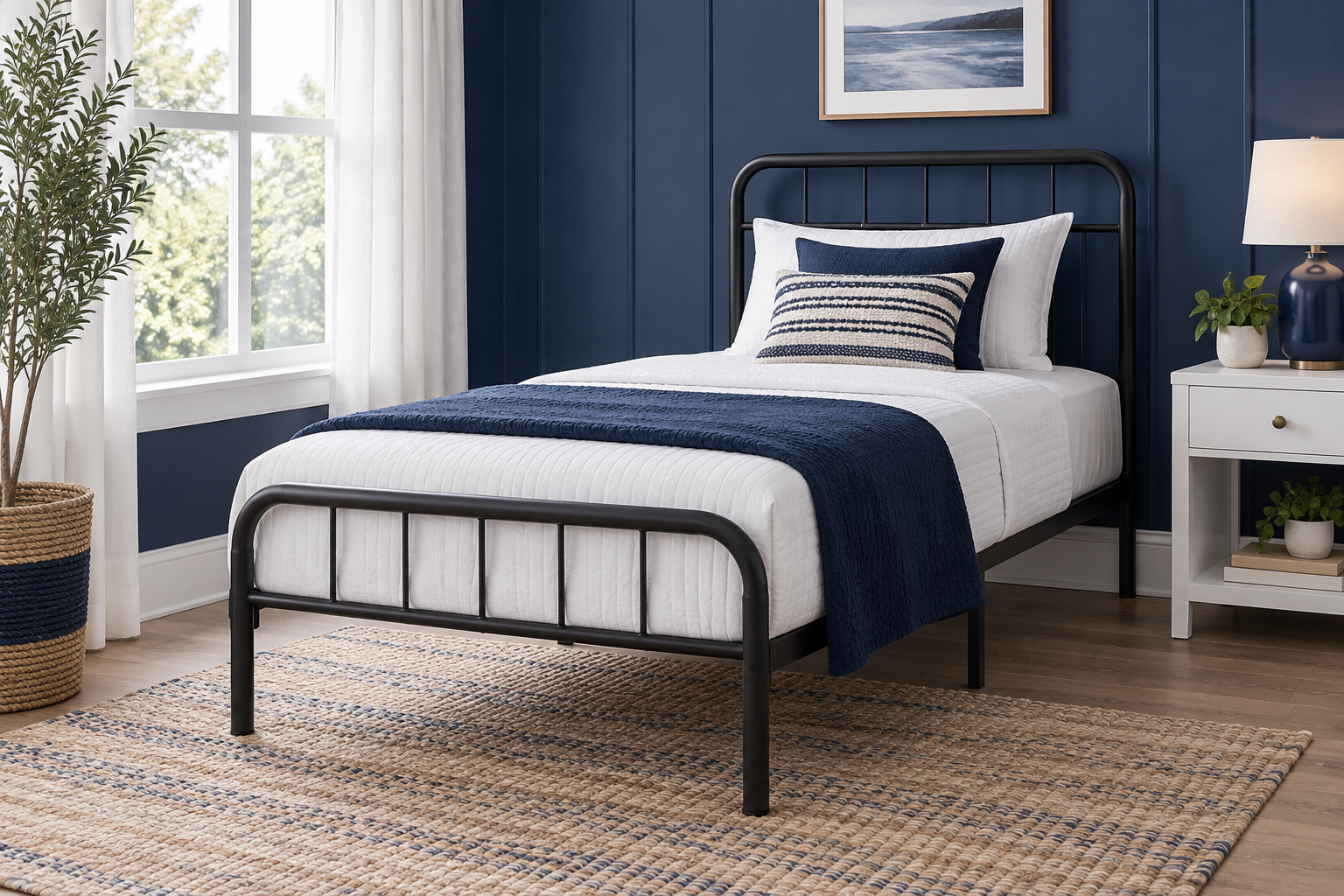
In U.S. mattress retail, single and twin generally refer to the same 38 × 75-inch mattress size. Twin is the dominant current product label, while single often describes occupancy or appears in hotel and international contexts. Verify dimensions because a single in another market may not match a U.S. twin.
The standard U.S. equivalence
A U.S. twin mattress is nominally 38 inches wide and 75 inches long. Single is a conventional alternate name for that same sleep surface. American frames, sheets, protectors, and mattresses are more likely to use Twin in the size selector.
The surface is designed for one sleeper, which explains single. Twin is associated with using two matching single beds as a pair in a shared room. Neither name means half of a full, queen, or king in a mathematical sense.
Small manufacturing tolerances remain possible. When fitting an old rigid frame or custom enclosure, measure the actual opening and mattress rather than relying on the equivalence alone.
A mattress measurement should be taken across the broadest points without compressing the soft sides. Let a boxed mattress expand for the stated period before evaluating it. Measure the frame's interior support opening separately from its exterior footprint. Those two records answer different questions: compatibility with the mattress and fit within the room.
The word single is sometimes applied casually to narrow rollaways, cots, or folding guest beds that do not follow the residential twin standard. Portable products should be compared by inflated or deployed dimensions and weight limits, not by the occupancy word. A one-person product is not necessarily a standard single mattress.
Antique frames are another exception. Their openings may predate current conventions, and modifications by previous owners can change support dimensions. A custom mattress or qualified restoration advice may be appropriate; forcing a modern twin into a nonstandard enclosure can create gaps or damage.
Why the two names continue to exist
Furniture language reflects history and room arrangements. Twin became the common retail label, while single remained intuitive when describing sleeping capacity. Consumers therefore encounter both even though stores may stock only a Twin button.
The label describes mattress width and length, not outer furniture dimensions. Two twin frames can have different footprints because headboards, rails, posts, upholstery, and storage extend beyond the shared mattress standard. Single and twin being equivalent does not make every bed frame identical.
Context also shifts the meaning from object to room. A single room can mean one occupant. A twin room can mean two separate beds. Those hospitality uses are about accommodation, not necessarily a specific American mattress category.
International single sizes can differ
Countries maintain distinct size standards, many expressed in metric measurements. A common single abroad may be narrower, wider, shorter, or longer than the U.S. twin. An English translation can preserve the word single while hiding the physical difference.
Imported frames and mattresses require a dimension-by-dimension comparison. Check interior support width and length, not merely outer furniture size. For bedding, check mattress width, length, and thickness or pocket depth.
Rounded conversions may differ slightly across charts. Ninety-six versus ninety-seven centimeters can both be approximations of roughly 38 inches. Larger differences indicate another standard or variant and should be clarified before ordering.
Do not confuse Twin XL with standard single
Twin XL measures 38 by 80 inches, adding five inches of length. It is a separate U.S. size and requires a longer frame and fitted bedding. Some sources may call a similar category long single or extra-long single, but the phrase does not guarantee exact U.S. Twin XL dimensions internationally.
A frame such as the MAF 16-Inch Twin XL Metal Platform Bed is labeled XL because that extra length matters. A standard twin mattress placed on it can leave a five-inch gap; an XL mattress will not fit safely within a standard twin enclosure.
When a dorm or rental requests extra-long bedding, obtain the actual dimensions. Twin XL is common in U.S. colleges, but institutional mattresses can have unique thicknesses that affect fitted-sheet pocket depth.
Frames, mattresses, and sheets use size differently
The mattress uses the nominal 38-by-75-inch size. The frame supports that surface but has a larger exterior footprint. The fitted sheet matches mattress length, width, and depth. A flat sheet or comforter is intentionally larger so it can drape.
The VECELO 14-Inch Twin Metal Platform Bed is a standard-twin frame format. Its fourteen-inch description relates to frame profile, not a new mattress size. Product titles can include several numbers, so locate the dimensional diagram and identify what each measures.
Mattress thickness varies independently. A six-inch and fourteen-inch twin share length and width but need different pocket depths and create different sitting heights. Guarded beds may also impose a maximum thickness for safety.
Hotel language needs a direct question
A hotel single may refer to a room sold for one occupant and could contain a bed larger than a U.S. twin. A twin room commonly indicates two separate beds. Neither phrase guarantees the exact mattress measurement or whether two beds can be combined.
When configuration matters, ask how many independent mattresses are in the room, their approximate size, and whether they are permanently joined. This is more reliable than asking whether the room is single or twin because staff can answer from the physical arrangement.
Travelers who need separate beds for health, sleep, or relationship reasons should obtain confirmation in writing when possible. Photos may show a representative layout and can make dimensions hard to judge.
A safe process for online shopping
Set the target as 38 by 75 inches for a U.S. standard twin. Check the selected country storefront, variant, assembled frame size, support system, and return policy. Make sure the displayed dimension belongs to the chosen Twin option rather than another size in the listing.
For sheets, verify fitted dimensions and pocket depth. A product labeled Single/Twin may cover the U.S. standard, but its numeric specification is decisive. For a mattress, compare construction and support requirements after confirming size.
Save the dimension graphic and order confirmation. If the delivered item appears wrong, measure it consistently and allow compressed mattresses their instructed expansion period before documenting the discrepancy.
Communicate the requirement without ambiguity
When buying for someone else, say “a U.S. twin mattress, nominally 38 by 75 inches” rather than only single. When reserving lodging, say “two separate sleep surfaces” rather than only twin. The added words turn a convention into a checkable requirement.
When measuring inherited furniture, record the interior support opening and outer footprint. A seller may have used single casually for a nonstandard antique or imported frame. Physical dimensions are the common language across age and geography.
Keep units attached to every figure. A note that says 190 may be obvious as centimeters to one person and confusing to another. Precision is not needless formality when the purpose is compatibility.
When a retailer uses both Single and Twin filters, do not assume the categories are duplicates. Open the dimension charts for representative items. The store may be separating regional imports, youth products, or another internal catalog convention. Filter labels are navigation aids, not standards authorities.
The same care applies to marketplace titles assembled by sellers. A title can contain Single, Twin, and an approximate metric measurement to attract searches. Give greater weight to a consistent specification table, manufacturer documentation, and selected variant, while resolving contradictions before purchase.
For a replacement mattress, measure after removing bedding and examine the frame's support. If the old mattress was custom or has compressed with age, its current dimensions may not reveal the intended standard. Model labels, receipts, or a frame maker's instructions can clarify whether a modern U.S. twin is appropriate.
Once compatibility is confirmed, label stored linens clearly as Twin or Twin XL. Their similar width makes them easy to confuse, and an extra-long fitted sheet may look plausible until it is installed. A small storage label avoids repeating the terminology problem on laundry day.
Frequently asked questions
Is a single mattress smaller than a twin?
Usually not in U.S. retail; both commonly mean 38 by 75 inches. International single sizes can differ.
Can single sheets fit a twin bed?
Yes when the sheets follow U.S. twin dimensions and have the correct pocket depth. Check the numeric specification.
Why call it twin if one person sleeps there?
The name is associated with using two matching single beds as a pair.
Is long single the same as Twin XL?
It may describe a similar extra-long size, but regional dimensions vary. Confirm that it is 38 by 80 inches for U.S. Twin XL compatibility.
Does single describe a hotel room or its bed?
It can describe occupancy, room category, or bed size. Read the detailed configuration and ask the property when unclear.
Final verdict
Single and twin are normally two names for one U.S. mattress size. The equivalence is dependable for domestic retail but should not be exported blindly into travel and international shopping. State the dimensions, country standard, and number of sleep surfaces, and the naming question becomes a clear compatibility check. Exact physical measurements remain the final authority.
Product examples