TwinBed.app practical guide
Twin Bed vs. Queen Bed: Which Size Fits Your Room?
Twin and queen do different jobs. One preserves the room around the sleeper; the other creates a mainstream shared sleeping surface. The choice affects much more than bedtime: doors, dressers, laundry, moving, room symmetry, and the possibility of keeping a desk all change. Comparing the complete systems reveals whether queen’s added comfort earns the permanent floor area it occupies.
Quick answer
A twin mattress measures 38 × 75 inches, while a queen measures 60 × 80 inches. Queen adds 22 inches of width and five inches of length, making it the much stronger regular choice for couples and a spacious choice for one adult. Twin saves substantial floor area and suits one sleeper, compact rooms, and multipurpose layouts.
Dimensions and area difference
Twin is nominally 38 by 75 inches, providing about 19.8 square feet of mattress surface. Queen is 60 by 80 inches, about 33.3 square feet. Queen therefore adds roughly 13.5 square feet, or about 68 percent more mattress area.
The added space appears in both directions: 22 inches wider and five inches longer. Finished queen frames also use broader headboards and support structures. Compare exact assembled dimensions rather than adding mattress differences to a generic twin footprint.
Queen’s 80-inch length matches Twin XL and king. A tall solo sleeper who needs length but wants to protect room width can choose Twin XL instead of moving directly to queen.
The perimeter difference affects where bedding falls. Queen comforters and blankets extend across a much broader surface and may overlap nearby furniture in a tight room. Twin bedding is easier to keep clear of floor vents and narrow passages. Drape is not part of the furniture footprint, but it changes cleaning, visual bulk, and how easily covers can be pulled into place.
Room diagrams should show both mattress and frame rectangles in different colors. The inner shape explains sleeper area; the outer shape explains furniture fit. Add a third outline for open drawers or door swings. This layered drawing prevents the queen's larger sleep benefit from being compared against only the twin mattress while ignoring both frames.
For a solo sleeper, calculate what the added 22 inches replace. It may remove only unused floor, or it may eliminate a desk and turn the bedroom into a single-purpose space. Naming that displaced function gives the extra area an opportunity cost rather than treating bigger as automatically better.
Capacity for one sleeper or two
Twin is designed for one person. A solo sleeper receives 38 inches and may find that fully adequate when sleeping relatively still. Queen provides a solo sleeper generous turning space, room for a pet, and flexibility for occasional shared use.
Two adults on queen receive about 30 inches of width each. That is less personal width than one sleeper gets on twin, but it is a practical mainstream compromise for couples. Two adults on twin would share only 19 inches each and cannot treat it as a realistic regular arrangement.
Couples should also consider motion, temperature, firmness preference, and edge support. Queen solves basic capacity, not every compatibility issue. Those requiring more individual area may prefer king or another suitable configuration.
The five-inch length advantage
Standard twin’s 75-inch length can feel short for sleepers near six feet because pillows move the body downward and feet need margin. Queen’s 80 inches provides the same length as Twin XL and king. Sleep posture and footboard style still affect perceived room.
A tall back or stomach sleeper often benefits more from extra length than a curled side sleeper, but standing height alone does not decide. Test the surface with the normal pillow. If queen fits the body but not the room, Twin XL preserves the length in a narrower package.
Do not confuse mattress and frame length. An open, minimal queen platform may add little, while a storage headboard or footboard adds several inches. A bulky standard-twin frame can sometimes approach a lean Twin XL in total length.
How queen changes room circulation
The 22-inch width increase can eliminate a desk, narrow a dresser aisle, or move the mattress center away from a window. Queen works best when both partners can reach their side and the foot path remains clear. Twin can sit in a corner and preserve a larger open zone.
Tape complete frames into the room and open all doors. Include the nightstands a couple is likely to want on both sides of queen. If one partner must climb across the other because the frame is against a wall, the room technically accommodates queen but does not provide its most useful setup.
In a dedicated primary bedroom, giving floor space to queen can be sensible. In a guest office, craft room, or child’s room, twin may let the room perform its daily function rather than being dominated by occasional sleep.
Account for bedding in the aisles. A thick queen comforter may extend beyond the rail and brush a nightstand or floor, while a twin cover can have a generous drop without reaching as far into the room. This soft overhang should not be treated as a structural obstacle, but it affects cleaning, door clearance, and how narrow a passage feels.
If the room has only one viable bed wall, locate each mattress center. Queen shifts the sleeper positions outward and may align one person with a window, vent, or overhead fixture. Twin keeps one sleeper closer to center. Comfort depends on these relationships as well as the remaining inches at the frame edge.
Bedding and household maintenance
Queen requires size-specific fitted sheets, protectors, and toppers. Its flat sheets and comforters contain more fabric, require more storage, and are heavier when wet. Twin bedding is easier for one person to handle and may fit smaller washing machines more comfortably.
Making a queen with two accessible sides can be easier than making a twin pushed tightly into a corner. Maintenance depends on room access as much as mattress width. Plan where the person changing linens will stand and how the mattress can be lifted at each corner.
Mattress rotation and moving also differ. Queen components are broad around stair turns and may require two people. Twin frames and mattresses generally pass doorways more readily, making them practical for frequent relocations and upper-floor rooms.
Design options do not belong to one size
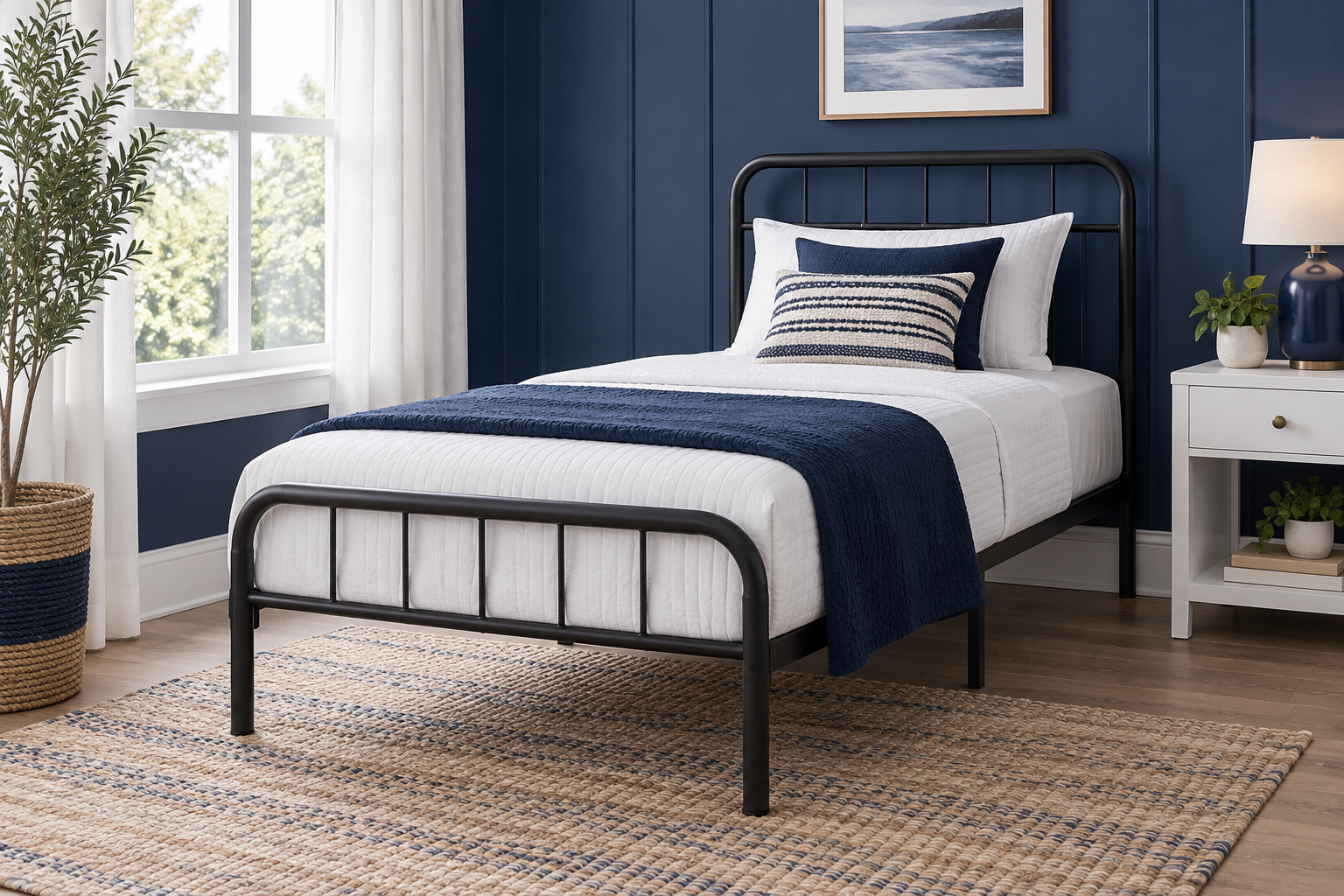
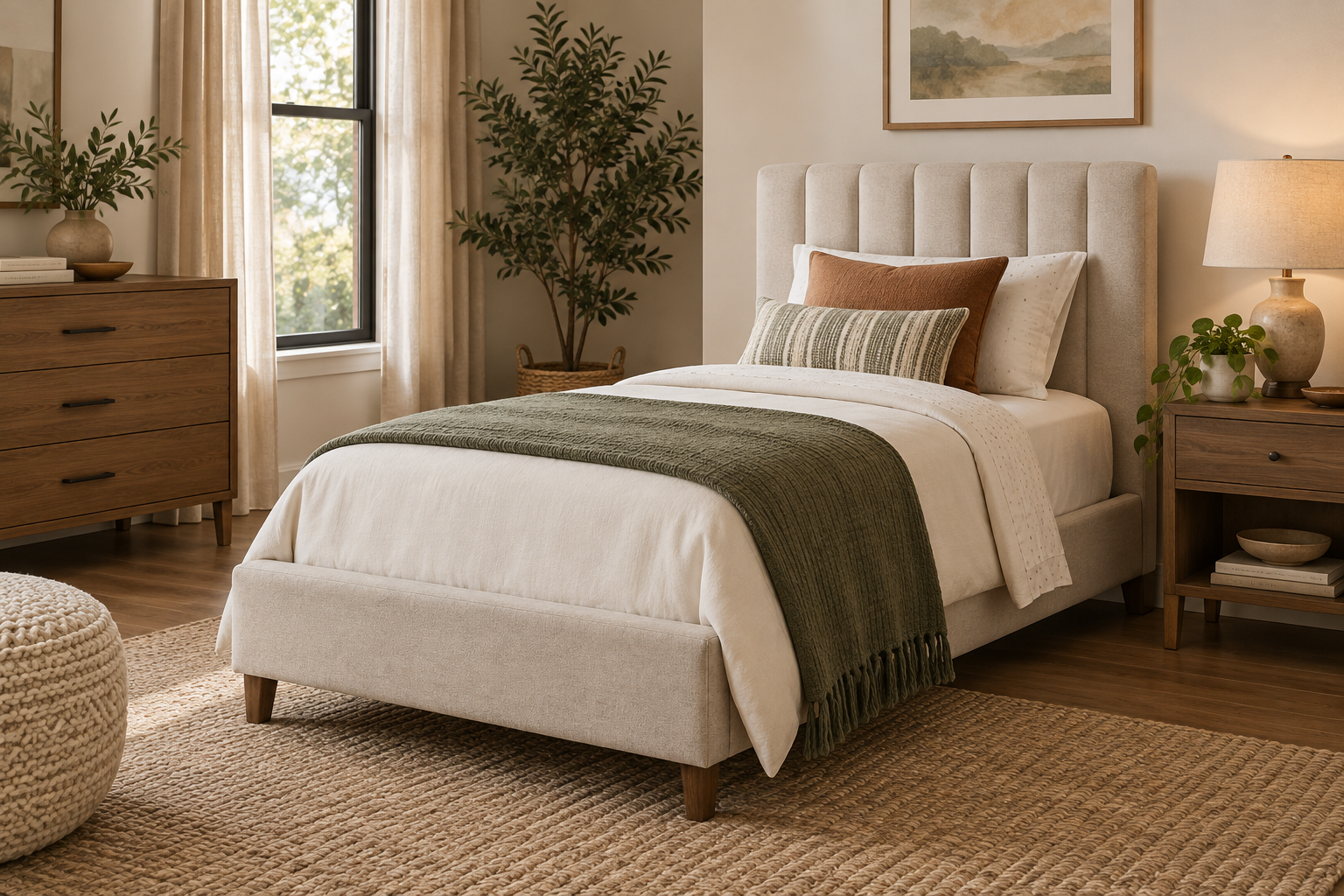
A twin can look permanent and adult rather than temporary. The Allewie Velvet Upholstered Twin Platform Bed uses a furnished upholstered profile, while the DUMOS Wood Twin Platform Bed Frame presents a simpler wood approach. Styling can give a compact mattress visual weight without consuming queen-level width.
Queen has vast frame and mattress availability because it is a common adult size. Twin has advantages in specialized furniture such as bunks, trundles, daybeds, and lofts. Select the format required by the room before assuming the larger adult category is automatically more appropriate.
For either size, verify support, slat spacing, weight capacity, and foundation need. Mattress area and structural capacity are different specifications.
Cost and long-term use without quoting prices
Queen generally uses more material in the mattress, frame, foundation, and bedding, but construction quality and brand can outweigh size. Compare equivalent support and durability rather than assuming every twin is less costly than every queen.
A queen can remain useful for a solo adult, couple, or broad guest population. A twin can move between a child’s room, dorm-like room, home office, and paired guest arrangement. Long-term value depends on which sequence is plausible in the household.
Storage costs count too. Spare queen linens take more shelf space, and a queen mattress is harder to store temporarily. Twin’s smaller components are easier to repurpose, but buying an undersized bed and replacing it early is not economical.
Choose with an occupant-first checklist
Start with sleepers: one or two, height, movement, pets, and likely duration of use. If two adults share regularly, queen is the clear starting point between these options. If one person uses the bed, determine whether added width and length improve comfort enough to justify the room impact.
Next protect nonnegotiable room functions. Mark the main route, closet and dresser operation, desk chair, and emergency exit. Compare assembled frames with these items open. Reject a layout that works only when every drawer is closed.
Finally evaluate handling, bedding, style, and future roles. A size is successful when its advantages are used regularly and its compromises do not burden every day.
Frequently asked questions
Can two adults sleep on a twin bed?
A 38-inch-wide twin is not a practical regular bed for two adults.
How much larger is queen than twin?
Queen is 22 inches wider and five inches longer, with about 68 percent more mattress surface area.
Is Twin XL as long as queen?
Yes. Both are nominally 80 inches long, while Twin XL remains only 38 inches wide.
Can twin sheets fit a queen?
No. Twin fitted bedding is much too narrow and shorter. Use bedding made for queen dimensions and the mattress depth.
Which size is easier to move?
Twin components are generally easier through doors, halls, and stairs, though actual weight and frame construction vary.
Final verdict
Queen is the regular shared-sleep choice; twin is the high-efficiency solo choice. For one sleeper, decide how much the extra mattress room improves sleep compared with what the 22 saved inches could do elsewhere. For two sleepers, ensure queen fits with meaningful side access rather than forcing a couple’s bed into a one-person layout. Measure the selected frame rather than only the mattress, and protect the room functions that will be used every day. A bed size succeeds when both the sleeper and the surrounding space remain comfortable.
Product examples