TwinBed.app practical guide
Twin Bed vs. Full Bed: Size, Space, and Sleeper Fit
Twin versus full is not a simple child-versus-adult decision. Adults can sleep on twin mattresses, teenagers can enjoy full mattresses, and both sizes share the same 75-inch nominal length. The decision is about allocating sixteen inches: should they belong to the sleeper or return to the room as circulation, storage, or work space? The answer changes with sleep position, body size, furniture, and the number of people using the bed.
Quick answer
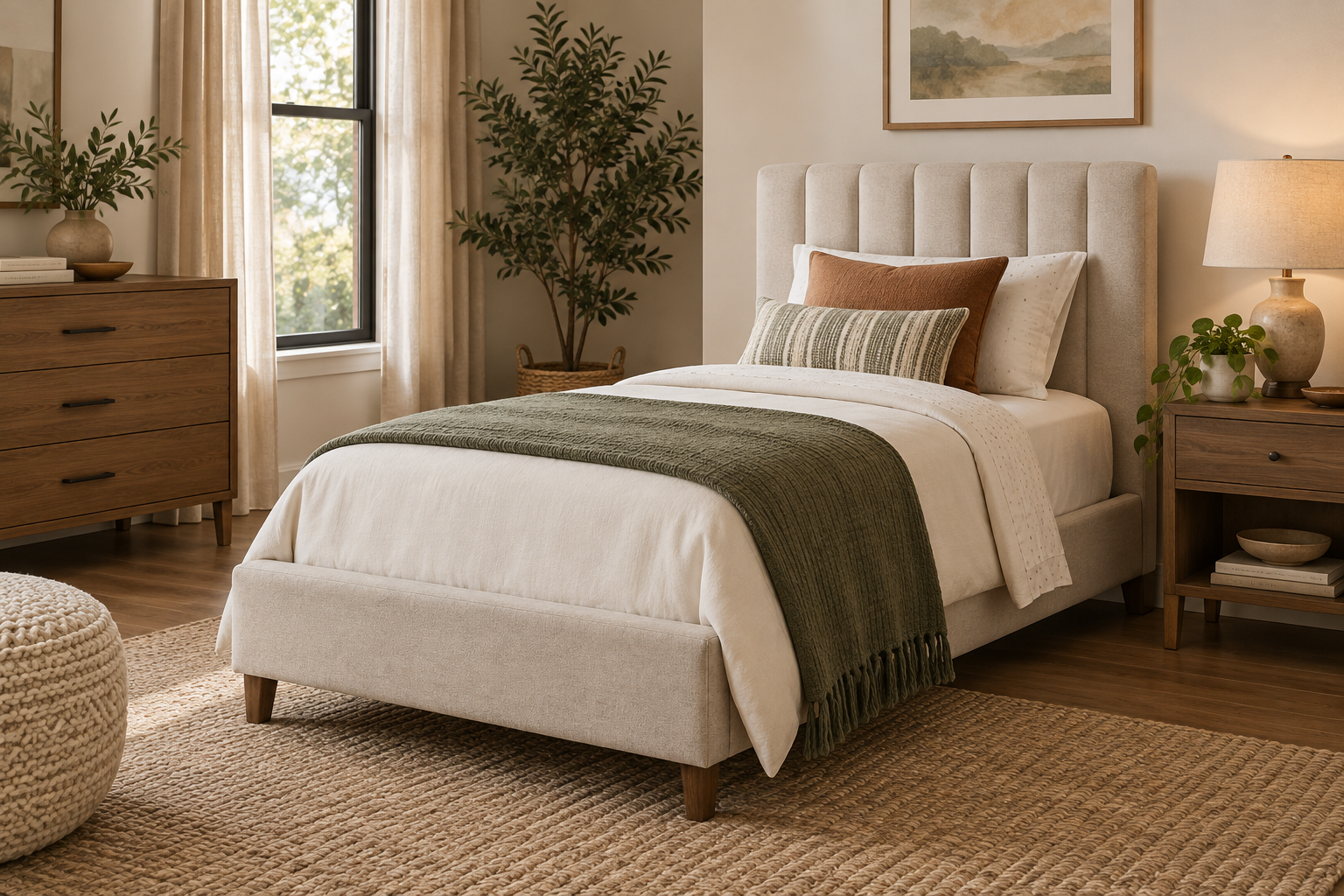
A twin mattress measures 38 × 75 inches; a full measures 54 × 75 inches. Full adds 16 inches of width but no length, giving one sleeper more room while requiring roughly 8.3 additional square feet of mattress area. Twin is usually the stronger space-saving choice; full is typically more comfortable for a solo adult but remains narrow for most couples.
Dimensions and sleeping area
A standard twin is 38 inches wide and 75 inches long, producing about 19.8 square feet of surface. A standard full, often called double, is 54 by 75 inches, or about 28.1 square feet. Full therefore offers approximately 42 percent more mattress area, entirely through extra width.
Both sizes remain shorter than Twin XL, queen, or king, which commonly use 80-inch length. A tall sleeper does not gain foot room by moving from twin to full. Someone who needs length but not width should compare Twin XL rather than assuming the larger name solves both dimensions.
Finished frames exceed mattress sizes. Compare assembled twin and full versions of the same design where possible. Upholstery, broad posts, and footboards can alter the room difference beyond the sixteen-inch mattress calculation.
Width also changes the relationship between the sleeper and bedside objects. A nightstand placed for a twin is closer to the mattress center than the same nightstand beside a full. Wall lights, outlets, and artwork may need repositioning when the mattress grows. Include those secondary adjustments instead of treating a size upgrade as a simple frame swap.
The surface-area calculation describes the top rectangle, not the amount of bedroom claimed. A full may require broader side access and larger bedding drape, while a twin may be pushed toward one wall. Compare the complete occupied zone—the frame plus functional clearance—before deciding how much space each option really costs.
Personal space for one sleeper
Twin gives one person 38 inches of width. A compact sleeper who remains near the center may find that adequate, particularly when the surrounding room performs important functions. An active sleeper who changes position, spreads arms, or shares the surface with a pet may value full’s added room every night.
Full also provides more margin at the sides when sitting, reading, or briefly comforting a child. That flexibility can make it feel more adult-oriented, but size does not determine support quality. A well-chosen twin mattress can offer sophisticated foam or hybrid construction; the CJJSleep 10-Inch Twin Hybrid Memory Foam and Pocket Coil Mattress is an example of a twin using a hybrid format.
Test width physically when uncertain. Lie on each size in a normal sleep posture, turn over, and notice whether elbows or knees reach the edge. Showroom minutes cannot predict every night, but they reveal whether 38 inches immediately feels restrictive.
Why full is not an ideal couple’s size
Although the older term double implies two sleepers, dividing 54 inches leaves only 27 inches per person. Each partner receives eleven fewer inches than a single person gets on a twin. Two adults can physically occupy a full, but many will find it restrictive for routine sleep.
An occasional guest couple may accept that trade in a compact room. A nightly couple should compare queen, king, or another appropriate arrangement, considering not only body fit but motion, temperature, edge use, and the ability to enter from both sides.
Twin is clearly intended for one sleeper. Two twins can offer separate guest flexibility, but two standard twin mattresses combined are five inches shorter than a king. Bed-count and size decisions should follow actual occupants instead of the historical meaning of a label.
How sixteen inches changes a bedroom
Sixteen inches can create the difference between a blocked dresser and a working aisle. A twin may leave room for a desk, exercise mat, larger play area, wheelchair route, or second separate bed. In a generous room with little other furniture, returning that space to the mattress may be the more valuable choice.
Tape complete frame footprints on the floor. Open closet and dresser doors, pull back the desk chair, and walk the main route with a laundry basket. A full that technically fits may still force every daily task through one narrow gap. A twin that looks modest on a plan can make the room feel substantially more capable.
The saved width has value only if it appears in a useful place. Sixteen inches trapped between a bed and an inaccessible wall does less than sixteen inches added to the room’s main passage. Layout orientation belongs in the comparison.
Consider the room when a second person is present even if the bed is for one. A parent helping a child, a caregiver assisting an adult, or a guest setting down luggage may need temporary standing room. Full can provide more space on top of the mattress, but twin can preserve the adjacent floor where help occurs. The relevant comfort may therefore be beside the bed rather than on it.
Visual scale matters without replacing measured fit. Full can anchor a large wall, while twin may look isolated unless paired with a balanced nightstand, art, or storage. Those design solutions use far less floor than enlarging the mattress. Do not choose full solely to fill visual emptiness if the sleeper does not need its width.
Bedding, lifting, and maintenance
Twin fitted sheets and protectors will not fit a full, and full fitted bedding will be loose on twin. Top bedding also changes in width and drape. Full comforters occupy more closet and washing-machine space and become heavier when wet, though material and construction can matter as much as label size.
Twin mattresses and frames are generally easier for one person to rotate, carry, and maneuver through stair turns. Full components are still manageable in many homes but require more clearance. Consider who will change bedding, move the bed for cleaning, and transport it during a relocation.
A twin against a wall saves room but makes the far fitted-sheet corner harder to reach. A centered full might actually be easier to maintain if the larger room provides two good aisles. Evaluate access rather than assuming smaller always means easier.
Frames and specialized formats
Twin is common in bunks, lofts, trundles, daybeds, and paired guest-room arrangements. These formats exploit its narrow footprint. Full appears in some bunks and daybeds but enlarges the structure and can change safety limits, ceiling relationships, and room capacity.
The VECELO Upholstered Twin Bed Frame shows that a twin can have a finished, adult-facing appearance. A minimalist platform can emphasize open floor; an upholstered profile can emphasize comfort and style. Select the frame after choosing the mattress size so furniture bulk does not quietly reverse the space savings.
Check weight capacity, slat spacing, foundation requirements, and mattress-thickness guidance. These support specifications matter independently of width. A full is not automatically stronger, and a twin is not automatically designed only for children.
Plan for changing needs
A twin can move from a child’s room into a guest room, dorm-style setting, or paired arrangement. Its portability and broad bedding availability support reuse. Full can transition from teenager to solo adult and provide a more generous guest experience for one person.
Think about the furniture’s likely lifespan. If a growing teenager already uses most of a twin’s width but has adequate length, full may postpone another change. If a small room will soon need a study zone, twin may preserve the flexibility the next life stage requires.
Avoid buying for an imagined future that the current room cannot support. A too-large bed imposes its compromises every day. Choose for the most probable occupants and room functions over the next several years, then preserve exact measurements for future moves.
A practical decision sequence
First decide whether the 75-inch length is adequate. If not, compare Twin XL or queen rather than debating twin and full. If length works, test the sleeper’s width preference. Then tape both complete frame options into the room and see what each does to circulation and essential furniture.
List the sacrificed function beside the gained comfort. For example: full adds turning room but removes desk-chair clearance; twin preserves the desk but limits pet space. Concrete tradeoffs are easier to evaluate than size names.
Finally compare the whole system: mattress construction, frame support, bedding already owned, moving constraints, and the person maintaining the room. The winning size is the one whose benefits appear nightly without creating daily friction elsewhere.
Frequently asked questions
Is a full bed longer than a twin?
No. Standard U.S. twin and full mattresses are both nominally 75 inches long.
How much wider is a full than a twin?
A full is 16 inches wider: 54 inches compared with 38 inches.
Is a twin bed large enough for an adult?
It can be for one adult when the width and 75-inch length suit the person. Taller sleepers may prefer Twin XL.
Can full sheets fit a twin mattress?
A full fitted sheet is too wide for a secure fit. Fitted sheets and protectors should match the mattress label and depth.
Which size is better for a guest room?
Twin preserves multipurpose floor space and can be paired for separate guests. Full gives one guest more width and can accommodate two people occasionally, though tightly.
Final verdict
Full gives the sleeper sixteen more inches; twin gives the room those inches back. Because neither adds length, start with body length, then decide whether solo movement or surrounding floor function has greater value. The right answer is visible only after the exact frames and the room’s daily activities are compared together.
Product examples